
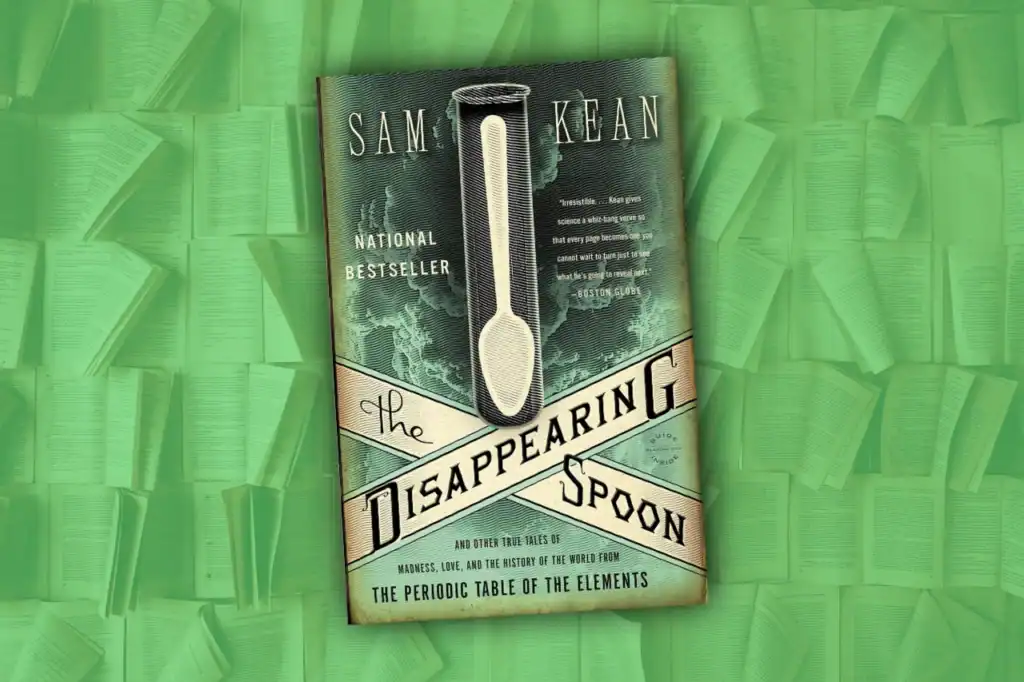

What if the periodic table wasn’t just a cold, colour-coded grid pinned to every classroom wall, but a living, riotous soap opera of brilliance, betrayal and bizarre experiments..? That’s exactly the lens Sam Kean brings in The Disappearing Spoon, turning chemistry into something shockingly alive, occasionally scandalous and always irresistibly entertaining...
At the heart of this wild ride is gallium – a silvery metal that can melt from the heat of a human hand, making spoons vanish spectacularly into teacups. But that famous party trick is only the prologue. Kean goes on to reveal a backstage pass to the elements: how they’ve started wars, bankrupted empires, saved lives, wrecked reputations and sparked obsessions that burned brighter than any Bunsen flame.
In these pages, the periodic table transforms from abstract symbols into a menagerie of human stories: Marie Curie wrestling with deadly radium, the Manhattan Project’s frantic hunt for uranium and plutonium and how something as seemingly harmless as tellurium sparked gold fever. Kean’s narrative is equal parts science history and human drama -stories of scientists driven by love, rivalry and the irresistible lure of discovery!
What keeps it electric is Kean’s fearless storytelling. He doesn’t tiptoe around the weirdness: there are radioactive mishaps, poison plots, pranks involving molten metals and tragic tales of ambition gone too far. The tone dances between curiosity and cheeky irreverence, making even dense subjects like electron shells and nuclear isotopes feel like juicy secrets rather than textbook slog(!)
And it isn’t just about famous scientists. Kean also digs into the darker corners: forgeries fuelled by alchemical greed, Nobel snubs that ruined careers and entire industries undone by a single misplaced element. The result feels less like a chemistry lesson and more like wandering through a cabinet of scientific curiosities with each story stranger and more fascinating than the last. We approve!
Yes, the book occasionally dives deep into atomic minutiae, but Kean’s wry humour and eye for the human stakes keep things buoyant. Even when the science gets heavy, it’s cushioned by anecdotes so colourful you can’t help but grin (or grimace). It’s a clever sleight of hand: you learn plenty, almost by accident, swept along by the stories.
The Disappearing Spoon ultimately proves something thrilling: that every element on that dusty old chart hides a story of genius, obsession, and sometimes utter madness. It turns chemistry from something memorised under fluorescent lights into something lived, fought over and occasionally died for.
For anyone who’s ever thought science lacked drama, Kean’s book is a revelation. It’s funny, smart and crackling with the chaotic energy of discovery. A reminder that the real alchemy isn’t just in elements themselves, but in the wildly human stories they leave behind…
Why did Gandhi hate iodine (I, 53)? Why did the Japanese kill Godzilla with missiles made of cadmium (Cd, 48)? How did radium (Ra, 88) nearly ruin Marie Curie's reputation? And why did tellurium (Te, 52) lead to the most bizarre gold rush in history?
The periodic table is one of our crowning scientific achievements, but it's also a treasure trove of passion, adventure, betrayal and obsession. The fascinating tales in The Disappearing Spoon follow carbon, neon, silicon, gold and every single element on the table as they play out their parts in human history, finance, mythology, conflict, the arts, medicine and the lives of the (frequently) mad scientists who discovered them.