
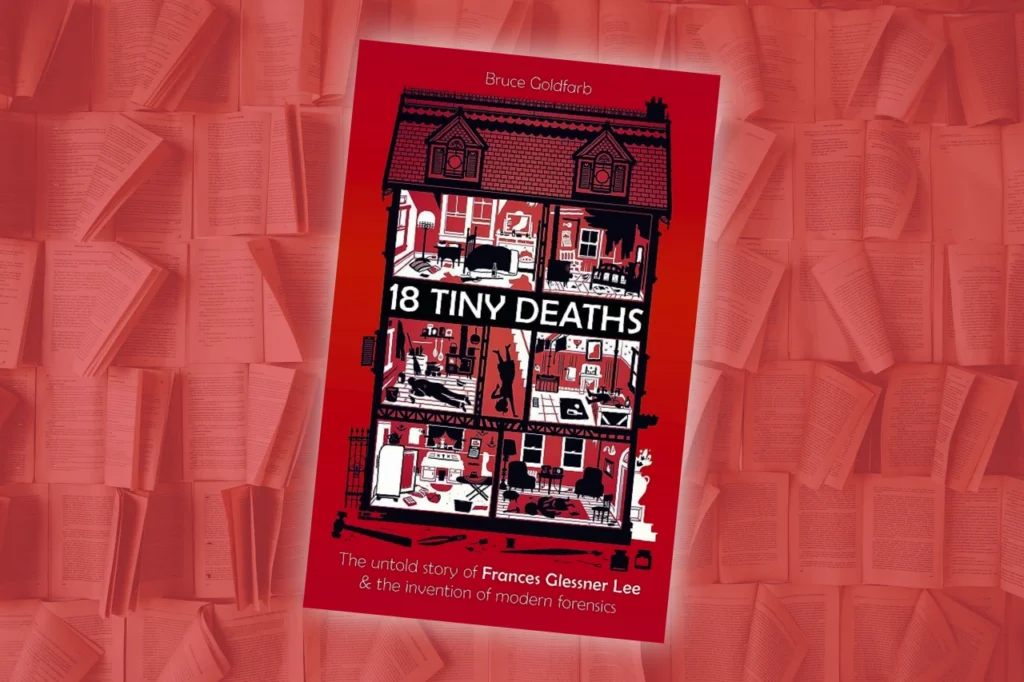
In 18 Tiny Deaths, Bruce Goldfarb delivers the unsettling yet strangely riveting story of Frances Glessner Lee, a wealthy Chicago heiress who turned polite society’s tea parties and embroidery circles on their head by building miniature scenes of death. And not for art’s sake: Lee’s meticulously crafted “Nutshell Studies of Unexplained Death” would become some of the most unexpectedly influential tools in modern forensic science…
At first glance, the idea sounds almost grotesque. Dollhouse‑scale crime scenes complete with tiny blood spatters, carefully sewn curtains and minute domestic clutter, each scene frozen in the aftermath of violence. But Lee wasn’t chasing shock value. She believed that solving real deaths required a different skill: the discipline to see what others overlook. Through these models, she trained generations of investigators to read the quiet language of a crime scene – the tipped‑over chair, the scorch marks, the undone shoelaces and to separate truth from assumption.
Goldfarb paints Lee not as an eccentric tinkerer, but as a sharp, quietly radical figure who recognised that the American coroner system was so broken it bordered on criminal itself. In an era when coroners were often political appointees with no medical training, she used her fortune (and an iron will) to create change from the inside. Her efforts culminated in founding the country’s first Department of Legal Medicine at Harvard, forcing the field to take the science seriously.
What makes the book so compelling isn’t just Lee’s defiance of the polite path expected of women of her class, but the unsettling brilliance of her method. By shrinking scenes of death down to a scale you could hold in your hands, she forced investigators to slow down, study and really look. Goldfarb captures this strange blend of grim realism and dollhouse craftsmanship without romanticising it, showing how obsession and stubborn vision can upend even the most complacent systems.
18 Tiny Deaths is both biography and quiet rebellion: the story of a woman who refused to look away from death and, in doing so, taught a generation to see it properly. It’s a testament to the power of detail, the danger of assumption and the unlikely ways real change sometimes takes shape. All from someone who chose to build tiny murder scenes instead of hosting dinner parties..!
A captivating blend of history, women in science, and true crime, 18 Tiny Deaths tells the story of how one woman changed the face of forensics forever.