
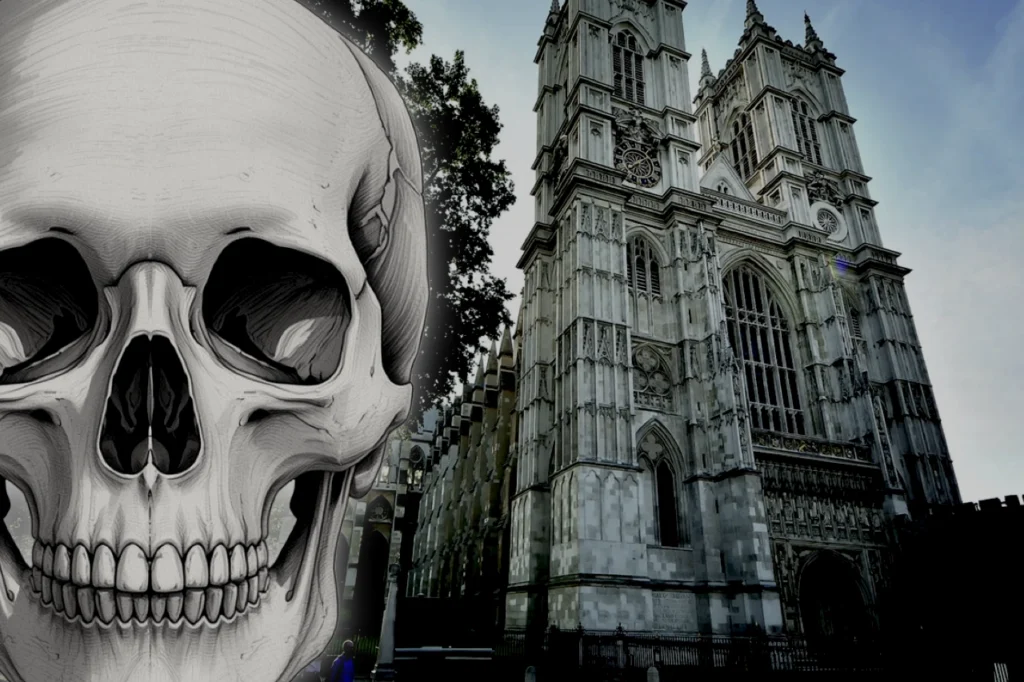

Westminster Abbey sits on every tourist map as Britain’s most revered building. Coronations happen here. Royal weddings. State funerals. But the Abbey’s darker, more bizarre, history sometimes doesn’t make it into the official tour script…
This isn’t about ghost stories or urban legends. The factual record is strange enough without embellishment – and we’ve saved the goriest story for last….
The Abbey Ran Its Own Prison for 400 Years
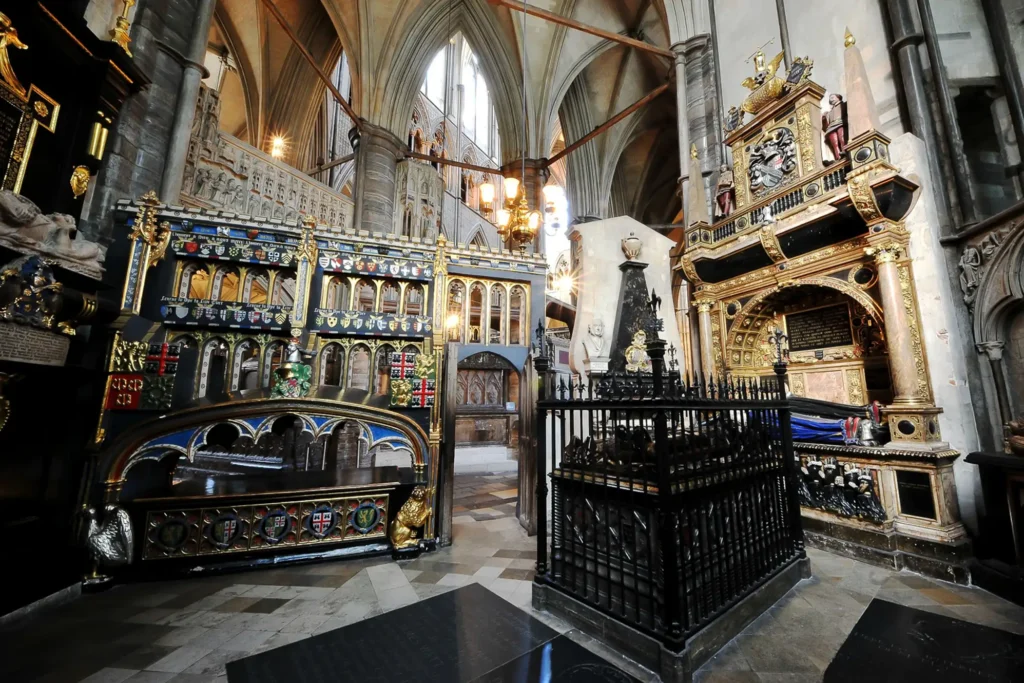
Gatehouse Prison opened in 1370, built directly into Westminster Abbey’s structure. The Abbot, a churchman with considerable power, controlled two separate gaols. One for clerics. One for everyone else.
Sir Walter Raleigh spent his final night here in October 1618. The explorer and courtier wrote poetry in his cell, hours before his execution. Poet Richard Lovelace followed in 1642, penning his famous line “stone walls do not a prison make, nor iron bars a cage” whilst locked inside the Abbey’s walls.
The prison operated until 1776. Four centuries of incarceration attached to Britain’s holiest site.
Cromwell’s Corpse Got Dug Up And Hanged
Oliver Cromwell—the Puritan military leader who overthrew the monarchy and ruled as ‘Lord Protector’ during the English Civil War, received a state funeral at Westminster Abbey in 1658. Full honours. A ceremony normally reserved for monarchs.
Two years later, everything changed…
Charles II, son of the executed King Charles I, returned to power in 1660 and ordered Cromwell’s body exhumed. The corpse was hanged at Tyburn gallows, then thrown into an unmarked grave. Posthumous execution.
But the King didn’t stop there. Bodies of everyone responsible for his father’s death were disinterred. John Bradshaw, the judge who presided over Charles I’s trial and signed his death warrant, had his decomposing corpse hung from the gallows fourteen months after his death. His rotting head ended up on a spike at Westminster Hall. The Abbey became a site of revenge against the dead.
One Poet Was Buried Standing Up
Ben Jonson died broke in 1637. The playwright and Shakespeare contemporary couldn’t afford a proper burial plot in Westminster Abbey, six feet by two feet cost more than he had.
Jonson apparently said “two feet by two feet will do for all I want.” So They buried him vertically.
Standing upright in his grave to save space and money. The only person in Westminster Abbey’s 3,300+ burials to be interred this way. A cash-saving measure that became permanent historical oddity.
Students Stole the Coronation Stone On Christmas Eve
The Stone of Scone sat under King Edward’s Chair for 654 years. Every British coronation since 1296 used this 336-pound block of sandstone.
On Christmas Eve 1950, three Scottish students broke into Westminster Abbey through a works yard. They reached the Chapel, lifted the Stone, and it crashed to the floor. It broke into two pieces.
At 5am, as they attempted escape, a policeman appeared. Kay Matheson and Ian Hamilton immediately fell into a lovers’ clinch. They had a casual conversation with the officer whilst standing metres from Britain’s most sacred stolen object.
The Stone was successfully smuggled back to Scotland. Stonemason Bertie Gray repaired it in secret, creating around 34 fragments which he distributed to Scottish nationalists.
The heist worked. The Stone stayed in Scotland for months before being returned…
A Suffragette Bomb Broke It First (Nobody Noticed for 36 Years)
On 11 June 1914, suffragettes planted a bomb next to the Coronation Chair and Stone of Scone. The device was loaded with metal bolts and nuts to act as shrapnel.
The explosion blew off a corner of the Chair and cracked the Stone in half.
The Abbey had 80-100 visitors at the time. No serious injuries were reported. But here’s the genuinely bizarre part: nobody discovered the Stone was broken until 1950, when the Scottish students stole it!
For 36 years, one of Britain’s most sacred objects sat cracked in half beneath the Coronation Chair. Thousands of visitors walked past. Official custodians maintained the Abbey. Multiple coronations used the Chair and nobody looked closely enough to notice…
The Stone Spent WWII Hidden With Medieval Corpses
When war broke out, officials worried the Stone of Scone might fall into German hands. They moved it to a secure location: behind ancient lead coffins in a burial vault under Abbot Islip’s Chapel.
Only the Dean and the Surveyor knew where it was hidden.
Worried the secret could be lost if they were killed during bombing raids, three maps were drawn showing the Stone’s location. Two were sealed and sent to Canada. One went to the Canadian Prime Minister, who deposited it in the Bank of Canada’s vault.
Britain’s coronation stone spent the entire war stacked amongst medieval corpses. The backup plan involved transatlantic map storage.
Death Literally Emerges From The Ground Inside
The memorial to Lady Elizabeth Nightingale stands as one of Westminster Abbey’s most macabre sculptures. Created by Louis François Roubiliac, it shows Death as a skeleton emerging from the ground.
Death points a lance at the dying Elizabeth whilst her husband tries unsuccessfully to shield her.
The sculpture has lost its lower jaw over the centuries, making it even more unsettling. It remains one of the Abbey’s darkest artistic elements, a permanent reminder that even in Britain’s most sacred space, death gets the final word…
A Diarist Kissed A Dead Queen On His Birthday
Possibly saving the best until last…
On 23 February 1669, Samuel Pepys, the famous diarist and naval administrator, celebrated his 36th birthday in an unusual way. He took his wife and young relatives to Westminster Abbey to look at the tombs.
But Pepys had a special request.
For over two centuries, the coffin of Queen Catherine of Valois, widow of Henry V, had lain open in the Abbey, her embalmed body visible to visitors who paid for the privilege. Her tomb’s alabaster memorial had been deliberately destroyed during Henry VII’s reign, possibly to distance himself from his illegitimate ancestry and her coffin lid was accidentally raised, turning her corpse into a tourist attraction.
Pepys recorded in his diary that he “had the upper part of her body in my hands, and I did kiss her mouth, reflecting upon it that I did kiss a Queen.”
He noted with satisfaction that this was his birthday and “that I did first kiss a Queen.”
According to historical accounts, her body had been “firmly united and thinly clothed with flesh, like scrapings of tanned leather” after being interred in 1437 and later disturbed during building works. Between the 16th and 18th centuries, she was regularly put on display for Abbey visitors, only being properly re-interred during Queen Victoria’s reign…