
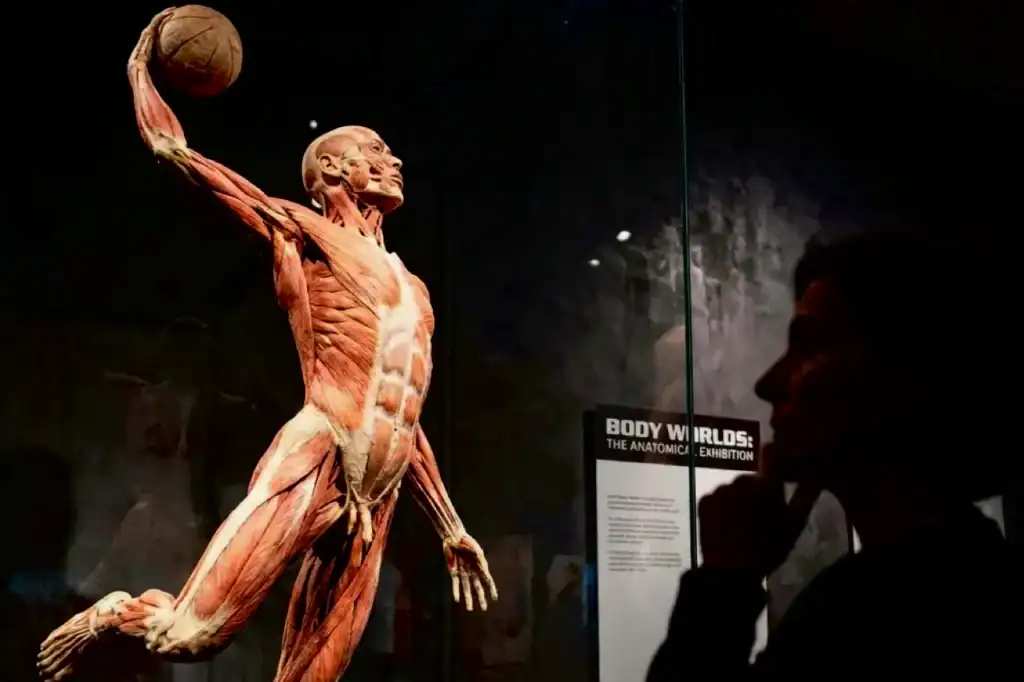

The bodies stand frozen mid-motion. A basketball player suspended in an eternal jump. A chess player locked in contemplation. A pregnant woman with her womb exposed…
Body Worlds exhibitions have pulled in over 50 million visitors worldwide since opening. The concept is simple but arresting: real human bodies, stripped of skin, preserved through plastination and displayed as anatomical art.
The creation process itself borders on the unbelievable. Plastination replaces bodily fluids and fat with liquid polymers through vacuum impregnation.
The central phase alone takes 2-5 weeks. Dissection can require 500-1,000 hours depending on complexity. A plastinated giraffe took three years to complete and needed a whopping ten people to move it!
The final specimen retains its original weight. The body becomes plastic but stays recognisable to its original form. But this, is where fascination collides with controversy…

The Executed Prisoner Admission
In 2004, creator Gunther von Hagens admitted something that changed the conversation permanently.
He returned seven corpses to China because they showed evidence of being executed prisoners. Two cadavers in his Chinese laboratory even had bullet holes in their skulls.
Curiously, surrounding prison camps had executed 2,468 detainees in 2001. Mostly by gunfire. His laboratory in China continues to operate.
Following a 2008 settlement, competing exhibitions now display disclaimers stating the bodies may be Chinese citizens “originally received by the Chinese Bureau of Police” and that organisers “cannot independently verify that the human remains you are viewing are not those of persons who were incarcerated in Chinese prisons.”
The transparency came through legal force, not voluntary disclosure…
The Anonymisation Paradox
Here’s where the ethical machinery breaks down completely.
Paperwork is separated from bodies after donation forms and death certificates are checked. Each plastinated corpse is made anonymous to “protect its privacy.”
So now, no one can actually verify which consent form belongs to which displayed body.
An ethics professor hired by the California Science Centre matched over 200 donation forms to death certificates. But crucially, he did not match the paperwork to specific bodies von Hagens has on display.
But for those who are curious to see the intricacies of our bodies, three Body Worlds exhibitions still exist – and you can book your tickets right here, if you’re brave enough…!
Body Worlds Las Vegas: Spectacle At Full Volume
The Las Vegas location does what Vegas does best. It amplifies.
Located inside the Luxor Hotel, the exhibition leans into entertainment value. The bodies are displayed with theatrical lighting and dramatic poses. A poker player. An acrobat. Bodies arranged to match the city’s energy.
BOOK NOW:
Body Worlds Berlin: Where It All Started
This is von Hagens’ home territory. The tone shifts towards education and scientific inquiry. The displays focus on anatomical systems: cardiovascular, nervous, muscular.
Body Worlds here feels closer to a medical museum than a touring attraction. Berlin also houses von Hagens’ primary European facility in nearby Guben, where around 100 employees produce specimens. The proximity to production adds a layer of authenticity the other locations can’t match.
BOOK NOW:
Body Worlds Amsterdam: Liberal Dialogue Meets Ethical Debate
Amsterdam’s Body Worlds takes a different approach entirely…
The city’s cultural openness creates space for more direct conversation about the ethical dimensions. The exhibition doesn’t avoid controversy. It acknowledges the questions around consent, sourcing and the commodification of human remains.
Visitors here get to engage with the debate as much as the anatomy.
The location also benefits from Amsterdam’s position as a hub for bioethics discussion. Universities nearby supposedly use the exhibition as a teaching tool for medical ethics courses.
BOOK NOW:
The Legal Loophole That Makes It All Possible
Plastinated bodies are imported under Customs Classification Code “art collections.” This categorisation requires no CDC stamps or death certificates. Both are mandatory for medical cadavers. The preserved remains are treated as plastic objects rather than human tissue.
In 2009, a French judge ruled that exhibiting dead bodies for profit was a “violation of the respect owed to them.” The judge ordered the exhibition to close within 24 hours or face a €20,000 fine for each day it remained open.
The ruling stated: “Under the law, the proper place for corpses is in the cemetery.” Authorities were ordered to seize the 17 bodies on display for proper burial.
Different countries draw different lines. The exhibitions continue in locations where the legal framework permits them. So, take the opportunities above… whilst they’re still legal and open…