
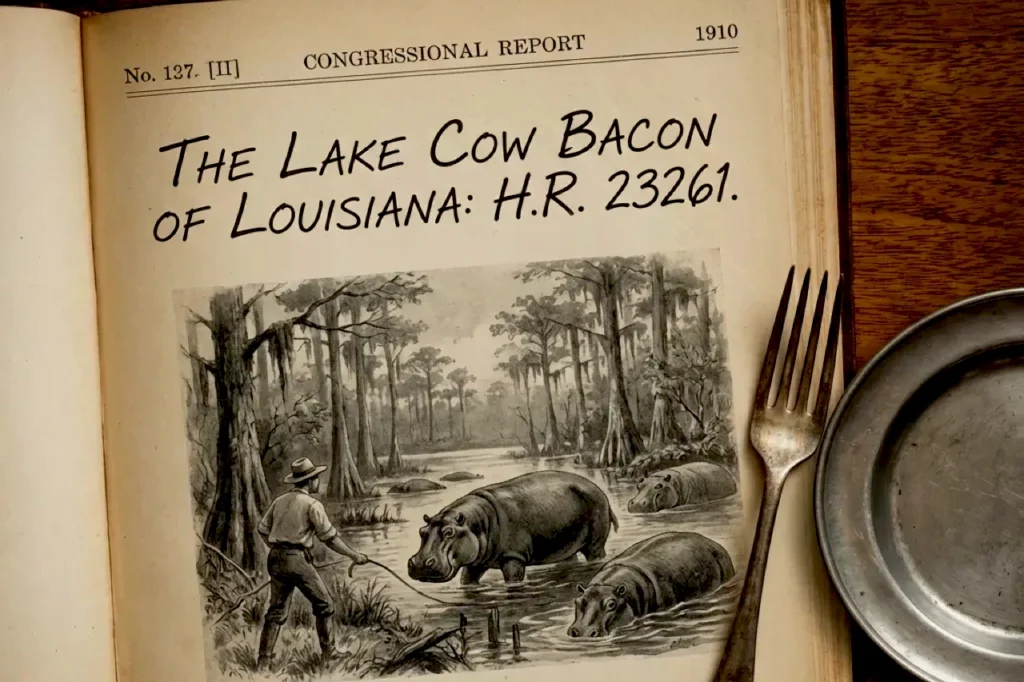

Bizarre But True! In 1910, the United States Congress sat in session and seriously debated whether to fill Louisiana’s bayous with hippopotamuses. Not as a zoo project. Not as an ecological experiment. As livestock for human food…
The plan was bonkers enough to get a bill number – H.R. 23261, and a budget request of $250,000 (roughly $8 million today). The scheme brought together two men who’d spent the Boer War trying to kill each other: British scout Frederick Russell Burnham and South African spy Fritz Duquesne.
Both stood before Congress and testified that hippo meat was not only edible but delicious. The American Hippo Bill nearly passed.
The Meat Shortage That Spawned Madness
America had a protein problem. Beef prices were climbing. Cattle ranching was destroying grasslands. The population was exploding and the country needed massive amounts of meat it couldn’t produce efficiently.
Enter the hippo evangelists.
They argued that hippos were perfect: they thrived in swamps where cattle drowned, they reproduced quickly and they produced enormous quantities of meat per animal. An average hippo yields approximately 1,200 pounds of edible flesh.
The New York Times coined the term “lake cow bacon” to describe what Americans would be eating.
Newspapers ran illustrations of “hippoboys” herding the beasts through Southern wetlands. The vision was absurd but the problem was real.
What Hippo Meat Actually Tastes Like
Congressional testimony provides the only verified flavour descriptions from people who’d actually eaten it.
Doctor W.N. Irwin from the Department of Agriculture told the panel it was “a kind of combination of pork and beef in taste.” Fritz Duquesne claimed he’d spent most of his early life “eating hippopotamus” and pointed to “the vigorous race of Dutchmen” who’d lived on it during the Boer War as proof of its nutritional value.
Later accounts from hunters described it as mild, somewhere between lamb and beef, slightly more marbled than venison.
The meat is lean too – only 4-5% fat compared to beef, and protein-dense at 22-25%. It contains high levels of iron, zinc, potassium and B vitamins. On paper, it’s an excellent protein source. On a plate, it apparently tastes fine…
Why You Can’t Buy It At The Supermarket
The American Hippo Bill failed by a narrow margin. Americans were spared a reality where where meals featured hippo loin and burger shop served battered hippo quarter pounders.
But the reasons you can’t eat hippo today have nothing to do with that 1910 vote.
The World Health Organisation advises against consuming hippo meat due to unmanageable parasite risks. Wild hippo flesh routinely carries anthrax, tuberculosis and a catalogue of zoonotic diseases that have no equivalent in regulated livestock.
There’s zero processing infrastructure. No hippo abattoirs. No safety standards. No supply chain.
Ostrich and crocodile made the jump from wild game to farmed protein with health certifications and industrial processing systems. Hippo never did. The animal also happens to be one of the most dangerous in Africa – responsible for an estimated 500 human deaths annually. Farming them would require solving problems that cattle, pigs and chickens simply don’t present.
The Conservation Paradox
Common hippos are now classified as vulnerable. Populations dropped from approximately 157,000 in 2004 to between 115,000-130,000 currently.
The Democratic Republic of Congo saw a 95% population collapse in the early 21st century. Pygmy hippos face extinction in the wild within a century if current trends continue.
Yet the illegal trade persists. Hippo teeth get trafficked as ivory. Poaching continues because meat demand exists in regions where the animal still lives. Hundreds are shot annually in human-wildlife conflicts over crops and water access.
The cultural complexity is massive. In Uganda, hippos hold spiritual significance – revered as sacred animals with power over rivers and lakes. But West African folklore casts them as trickster figures in Yoruba and Akan tales. Simultaneously, hippo meat remains a traditional delicacy at weddings and festivals in some communities.
What Actually Happened
The siege survival myth needs correcting…
During the 118-day Siege of Ladysmith in the Boer War, British troops didn’t eat hippo meat. They ate their own cavalry horses. The garrison survived on “Chevril” – a gelatinous broth made from boiled bones, named mockingly after Bovril, whilst facing typhoid, dysentery and daily artillery bombardment.
The hippo-as-siege-meat story appears to be largely made-up. Boer War participants referenced hippo consumption in later testimony, but documented Ladysmith diets consisted of draught oxen, horses and muddy river water.
Stone tools found at Kenya’s Homa Peninsula prove early humans were butchering hippos between 2.6 to 3 million years ago though. Cut marks on bones at Spain’s Bolomor Cave show Neanderthals did the same 230,000-120,000 years ago. Ancient Egyptians hunted them. Noble tomb art depicts hunting parties targeting the animals as both sport and necessity.
Humans have been eating hippo for millions of years. We just stopped recently.
The Alternate Timeline
If H.R. 23261 had passed, Louisiana might currently have a thriving hippo ranching industry. Americans might consider hippo burgers as normal as beef.
Or the entire scheme might have collapsed within five years when the first hippo trampled a rancher to death and insurance companies refused to underwrite the operation…
The bill failed. The hippos stayed in Africa. Americans kept eating beef. But for a brief window in 1910, American hippo ranching was one congressional vote away from reality…