
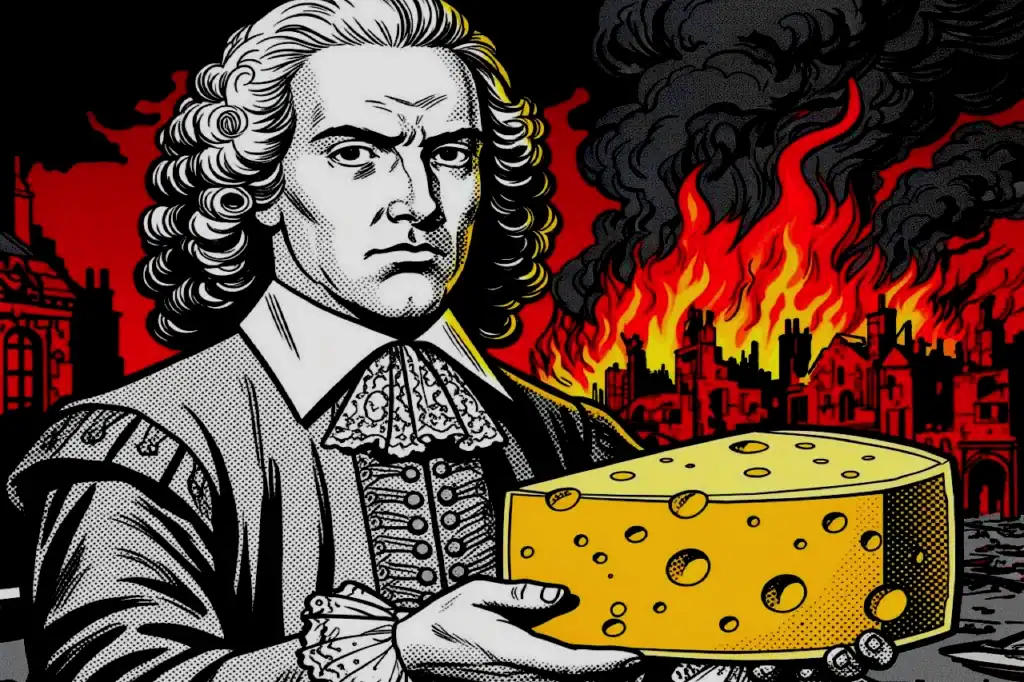

London was burning. The Great Fire of 1666 had been raging for two days, consuming everything in its path. Samuel Pepys – diarist, naval administrator and apparent cheese fanatic, had a decision to make about what to save from his Seething Lane home…

Bizarre But True! He chose Parmesan…
Not just any Parmesan. A massive wheel of the stuff, valuable enough that he grabbed a spade and buried it in his garden alongside his wine and important documents to spare it from the flames. Whilst neighbours fled with family heirlooms and whatever they could carry, Pepys was in his garden, digging a hole for dairy.
When Cheese Was Worth More Than Gold
But this wasn’t madness. It was simple economics.
In 17th-century England, Parmesan was a luxury item. Pope Julius II had given Henry VIII 100 rounds of the stuff back in 1511, each wheel weighing around 200 lbs, as payment for military alliance against the French. Dairy was a currency for war. That’s how valuable this cheese was.
A single wheel cost what a skilled craftsman might earn in months. Importing it from Italy involved risk, expense and the kind of international trade networks that made it genuinely precious. When Pepys looked at that wheel of Parmesan, he wasn’t seeing cheese. He was seeing investment capital!
The Fire That Rewrote Priorities
The Great Fire destroyed four-fifths of London. Over 13,200 houses gone. Eighty-seven parish churches reduced to ash. St Paul’s Cathedral collapsed.
Pepys recorded the chaos in his diary: scorched pigeons falling from the sky, people flinging belongings into the Thames, flakes of fire floating across the city like deadly snow. The price of bread doubled in refugee camps. Cart owners from surrounding regions rushed to London to cash in on surge pricing…
Early on 4 September, a servant woke Pepys to warn him about the fire. He told them to go away and went back to sleep.
Hours later, when the reality became undeniable, Pepys finally acted. He gathered his most valuable possessions: documents, wine and that magnificent wheel of Parmesan. He dug a pit in his garden and buried the lot.
The Cheese That Vanished
But here’s where it gets properly bizarre…
Pepys never recovered the cheese. MOLA archaeologists excavated Seething Lane and found nothing…
Somewhere beneath modern London, a 358-year-old wheel of Parmesan might still exist, perfectly preserved in the soil.
This isn’t fantasy either. In Ireland, archaeologists regularly find butter specimens stored in peat bogs dating back 3,500 years. These chunks remain edible for centuries before finally degrading. Ancient preservation methods genuinely worked.
The economics that made Pepys bury his cheese haven’t disappeared either. Italian banks currently hold 300,000 wheels of Parmesan in their vaults as loan collateral – worth an estimated $200 million. The Credito Emiliano bank stores the stuff like gold bars.
Pepys understood something fundamental: value isn’t about what something is. It’s about what people agree it’s worth.
Get Cheesy With This Unusual London Experience…
You too can now visit the spot where Pepys buried his Parmesan!
Seething Lane still exists, though the garden doesn’t. The street runs through the heart of the City of London, surrounded by the financial district that rose from the ashes of 1666. Somewhere beneath the pavement, that cheese might still be waiting…
If you want to explore London’s genuinely strange relationship with cheese even further – from Pepys’ buried treasure to the modern cheese merchants who’ve turned dairy into an art form, there’s a proper way to do it.
Book a London Cheese Walking Tour (with Tastings!) and discover the stories behind the city’s best cheesemongers. You’ll sample exceptional varieties, learn about London’s culinary history and understand why someone might actually bury cheese during a crisis.
That’s the kind of history worth tasting. Search below now for availability and to book your tour!