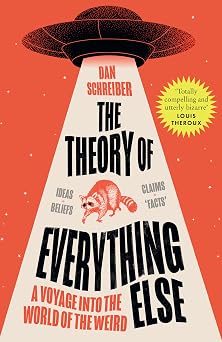

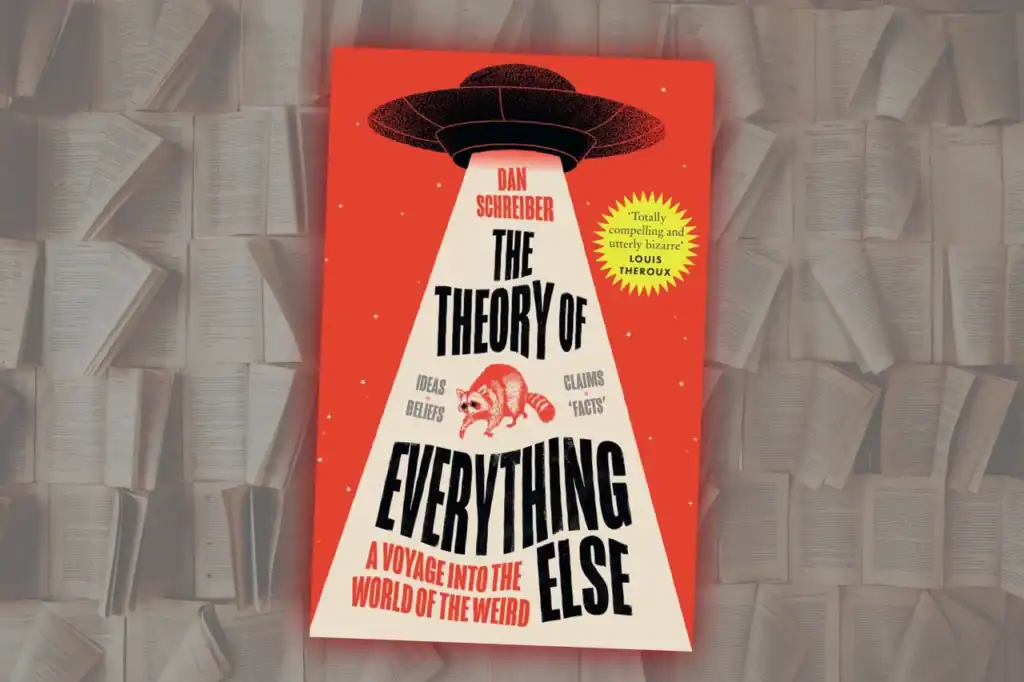
Every so often, a book comes along that feels like it fell straight off the back shelf of a curiosity shop. ‘The Theory of Everything Else‘ by Dan Schreiber is exactly that: an entertaining, eccentric and oddly thought-provoking ramble through the weirdest beliefs, rumours and “what ifs” humanity has managed to dream up… and, more importantly, still clings to…!
At first glance, you might assume it’s another sceptic’s takedown of conspiracy theories and paranormal claims. But Schreiber (best known for co-creating ‘No Such Thing As A Fish‘) takes a different tack. Rather than mocking the improbable, he gathers it up like a magpie, fascinated by what these stories say about us. The result is a book that feels less like a cold examination of truth and more like a late-night conversation you don’t quite want to end.
Across its pages, we meet people who are absolutely convinced of things most of us wouldn’t dare to imagine: time travellers slipping between decades, UFO enthusiasts decoding cosmic messages and the unforgettable story of WT Stead, a Victorian journalist who once ran a bureau for missing people staffed by a secretary who, inconveniently, had been dead for thirteen years. There’s even an exploration of the humble mystery of why your shower curtain insists on billowing towards you. Big or small, cosmic or domestic, Schreiber approaches each with the same amused curiosity.
The real joy here is that Schreiber never quite tells you what to believe. Instead, he treats each story as a clue, a cultural fossil of the strange ways human beings try to make sense of the inexplicable. His writing style feels conspiratorial in the best way: witty, relaxed and with just enough raised eyebrow to keep things grounded. You’re not reading to become a believer, you’re reading to marvel at the endless creativity of the human mind!
Yet The Theory of Everything Else isn’t only a collection of pub anecdotes. Underneath the humour and odd facts, there’s a serious curiosity about why these beliefs persist. Why do some of the most rational people end up fascinated by the impossible? Why does the idea that we might all be living in a simulation sound more plausible in Silicon Valley than in a philosophy seminar? And what does it say about us that, centuries after the Enlightenment, we still haven’t stopped telling ghost stories?!
Don’t expect all the dots to connect perfectly. Part of the charm is that this book embraces its status as what one might call “a ragbag of oddities.” It meanders, it surprises and it sometimes leaves questions hanging in the air. But if you’re the kind of reader who enjoys falling down Wikipedia rabbit holes, that unpredictability is half the fun.
It’s the perfect companion for a train ride, a lazy Sunday, or that 2 a.m. moment when your brain is wide awake and wondering what else might be out there. Not quite science, not quite satire – but somewhere deliciously in between…
This is not a book of facts; it’s a book of ‘facts’. Should you finish it believing we became the planet’s dominant species because predators found us too smelly to eat; or that the living bloodline of Christ is a family of Japanese garlic farmers – well, that’s on you.
Why are we here? Do ghosts exist? Did life on Earth begin after a badly tidied-up picnic? Was it just an iceberg that sank the Titanic? Are authors stealing their plotlines from the future? Will we ever talk to animals? And why, when you’re in the shower, does the shower curtain always billow in towards you?
We don’t know the answers to any of these questions. But don’t worry, no matter what questions you have, you can bet on the fact that there is someone (or something) out there, investigating it on your behalf. From the sports stars who use cosmic energy to office plants investigating murders, The Theory of Everything Else will act as a handbook for those who want to think differently.