

Bizarre But True! England ran much of its entire financial system on notched wooden sticks for seven centuries. No paper. No signatures. No chip and pin. Just split pieces of wood with carved lines representing debt…
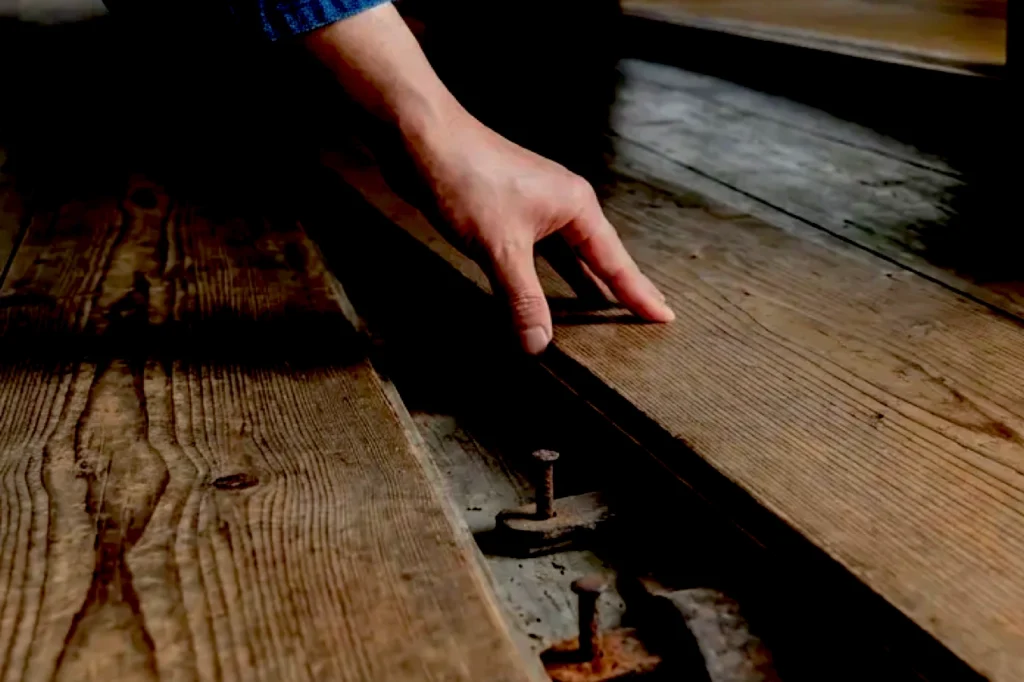
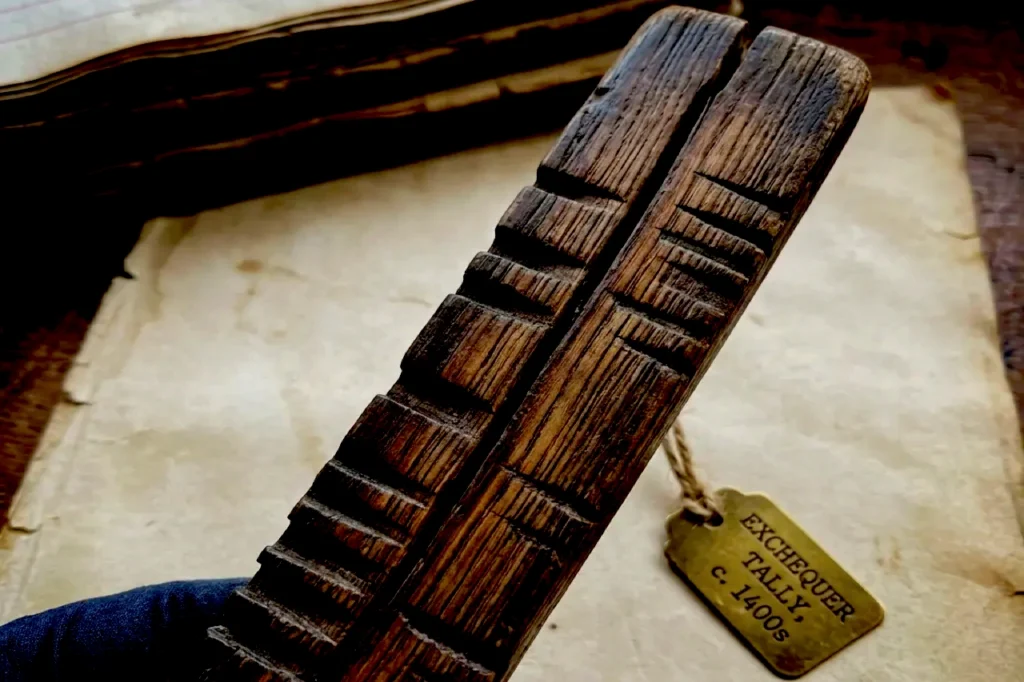
The system worked because wood grain is impossible to fake. When you split a stick lengthwise, the natural pattern creates a unique fingerprint. The two halves have to match perfectly, both the carved notches and the biological structure of the timber itself.
Medieval wood grain functioned as biological cryptography and nature provided the security protocol!

The Measurement System Was Your Actual Body
The thickness of cuts determined the amount owed. Ie, a cut the width of your palm might represent £1,000. Thumb width £100. Little finger £20 etc. A single pound required a cut the width of a swollen barleycorn. A shilling was narrower. A penny was marked by a single slice without removing wood.
So your thumb was literally worth a hundred quid in the national accounting system!
The Exchequer, England’s treasury, used this method to record tax payments from the 1100s until the late 1700s too. Tally sticks predated modern banking by centuries and outlasted countless paper-based alternatives.
They Circulated As Actual Money
The sticks weren’t just receipts. They became currency too.
The crown issued tally sticks in advance to finance wars and royal spending. These wooden IOUs circulated through the economy. Merchants accepted them as payment, at a discount, because you could present them to the treasury as proof of taxes paid.
England operated on weaponised government debt for generations. The entire concept of financial stocks traces its etymology back to the “stock” half of the split tally stick held by creditors. One surviving eight-foot stick records a £1.2 million loan to William III. According to historical records, that debt was technically never repaid. England still owes money to a piece of wood.
The System Was Designed for Illiterate Populations
Most of London couldn’t read in the early medieval period. Even sheriffs, the people collecting taxes, had only basic maths skills.
The tally stick solved this problem through physical design. You didn’t need literacy to understand notches. You didn’t need arithmetic to verify wood grain patterns matched.
The system succeeded precisely because it assumed widespread incompetence with written records. Functional elegance built on the foundation of mass illiteracy. By the later Middle Ages, Exchequer officials had the skills to abandon tally sticks entirely. They didn’t. The system remained in use because it had become a venerable symbol of English finance.
Nineteenth-century rolls looked identical to twelfth-century versions. Seven hundred years of institutional inertia.
The Fire That Ended It All
When Parliament finally decommissioned the tally stick system in 1826, they faced a disposal problem. Two cartloads of obsolete wooden records, centuries of financial documentation reduced to kindling.
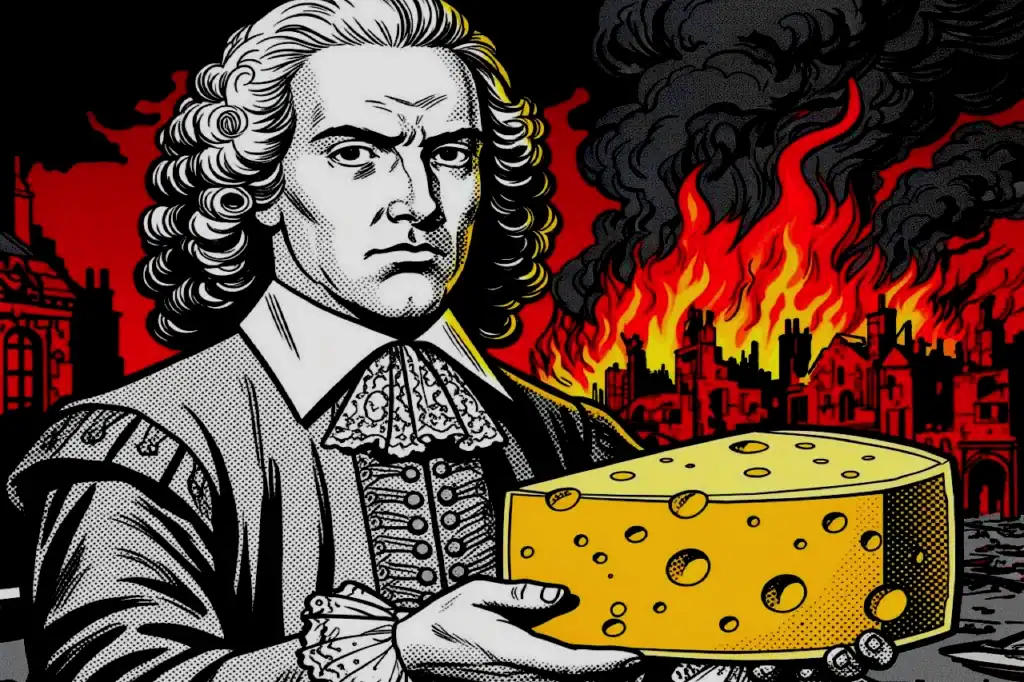
In October 1834, workmen decided to burn them in the underfloor furnaces beneath the House of Lords. The fire got out of control.
The resulting conflagration destroyed the Houses of Parliament. It was the largest fire in London between the Great Fire of 1666 and the Blitz. King William IV and Queen Adelaide could see the flames from Windsor Castle, roughly 20 miles away. Passengers in stagecoaches travelling across the South Downs watched Parliament burn on the horizon.
As the building collapsed, Londoners reportedly cheered. Thomas Carlyle observed the crowd was “rather pleased than otherwise,” shouting “A judgement for the Poor-Law Bill!” and “There go their hacts [acts]!”
A burning seat of government as public catharsis.
Charles Dickens remarked afterwards that the sticks “would naturally occur to any intelligent person that nothing could be easier than to allow them to be carried away for firewood by some of the many miserable creatures in that neighbourhood.” Bureaucratic incompetence crystallised in one devastating statement.
The Deeper History Goes Back 40,000 Years
Tally sticks weren’t a medieval invention. Humans have been notching debt into materials for over 40 millennia.
The Lebombo bone, a baboon’s fibula with 29 distinct notches, dates between 44,200 and 43,000 years old. The Ishango Bone from around 18,000 to 20,000 BC has tally marks carved in three columns. Recording transactions through physical marks predates agriculture. It predates writing. It predates currency itself!
The medieval English system was simply the most sophisticated institutional deployment of a cognitive tool humans had been using since the Palaeolithic.
Modern Banking Was Built On Wooden Sticks
Royal tallies played a direct role in forming the Bank of England at the end of the 17th century. The bank issued £1 million worth of stock in exchange for £800,000 worth of tallies at par and £200,000 in banknotes in 1697.
The foundation of modern British banking was a swap: wooden sticks for paper promises.
The entire financial architecture that followed — central banking, government bonds, stock exchanges all emerged from a system where your thumb width determined national debt and wood grain patterns prevented fraud!
No algorithms. No cryptographic keys. No distributed ledgers. Just split sticks and the biological impossibility of replicating natural patterns…