
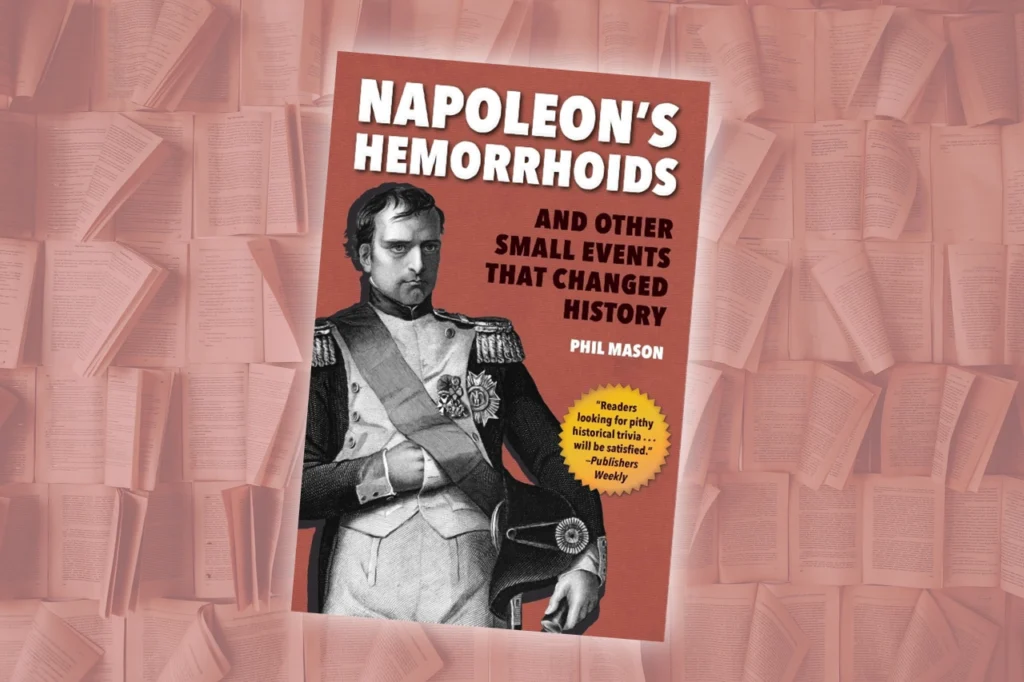

History often parades as a march of great men and epic battles – but ‘Napoleon’s Hemorrhoids‘ flips the script, showing how tiny glitches, bizarre coincidences and oddball accidents have all quietly reshaped our modern world. Phil Mason stitches together a rich tapestry of these overlooked moments, reminding us that everything from the Cuban Missile Crisis to Coke’s most famous ad can hinge on the tiniest twist of fate…
Take the title anecdote: Napoleon, writhing with hemorrhoids on the eve of Waterloo, couldn’t ride out to survey the battlefield. That delay may have tipped the scales, setting the stage for his downfall. Or consider that Communist jets nearly opened fire on American planes – only fuel shortages pulled them back. And did you know an accidental reveal in Nixon’s own house sparked Watergate’s downfall? These are the juiciest examples of the “butterfly effect” in action – small causes, seismic results.
Mason doesn’t stop at just political drama either. He’s got art, literature, science and pop culture in his sights as well. One minor silver-gold vein discovery changed Canada’s financial future. A broken-nose casting decision led Charlton Heston to play Moses. The iconic Coke “I’d Like to Teach the World to Sing” commercial, born on an unexpected layover in Ireland, shows how chance detours can birth global cultural phenomena.
Structured around themed chapters – politics, warfare, invention, art, business, this isn’t just trivia-for-trivia’s-sake. Each story is short, sweet and packed with context, offering easy paths in and out for casual readers. Yet these little detours collectively reveal a profound point: history isn’t always intentional – it’s often accidental!
Mason’s tone is light, sometimes cheeky, but never disrespectful to the often tragic stakes behind the stories. He offers just enough detail to sketch out the stakes, without bogging the reader in dry exposition. By holding the lens on overlooked moments like Einstein’s last words dying in translation, or a golfer smashing a windscreen and demolishing Benin’s air force, he shows how absurdity and gravity often coexist in our past.
On occasion, the trivia thickens and the Brit-centric examples or esoteric sports references may feel less gripping. But even there, the undercurrent remains clear: everything matters, or at least, everything might have. Whether you’re a history buff or a casual curiosity seeker these bite-sized tales are the perfect conversation starters.
Mason collects historical “what ifs” like a curator of chaos and the result feels more vibrant than many standard histories. Through the lens of tales both quirky and consequential, Napoleon’s Hemorrhoids delivers a thrilling reminder: sometimes the mightiest empires crumble not through grand design but because of something as trivial as discomfort or a chance layover. In the end, it’s delightfully humbling – and impossible to read without wondering what tiny coincidences shaped your own life…!
The direction history takes has often hinged on tiny turns of chance or accident. Things that happen just at the wrong time. Small incidents that end up having big consequences. For example, Communist jets were two minutes away from opening fire on American planes during the peak of the Cuban Missile crisis when they had to turn back as they were running out of fuel. Napoleon's Haemorrhoids is all about the small events that make you stop and think how it all might have turned out - luck, coincidence, fate: the tiny ripples that have caused big waves in history's waters...