
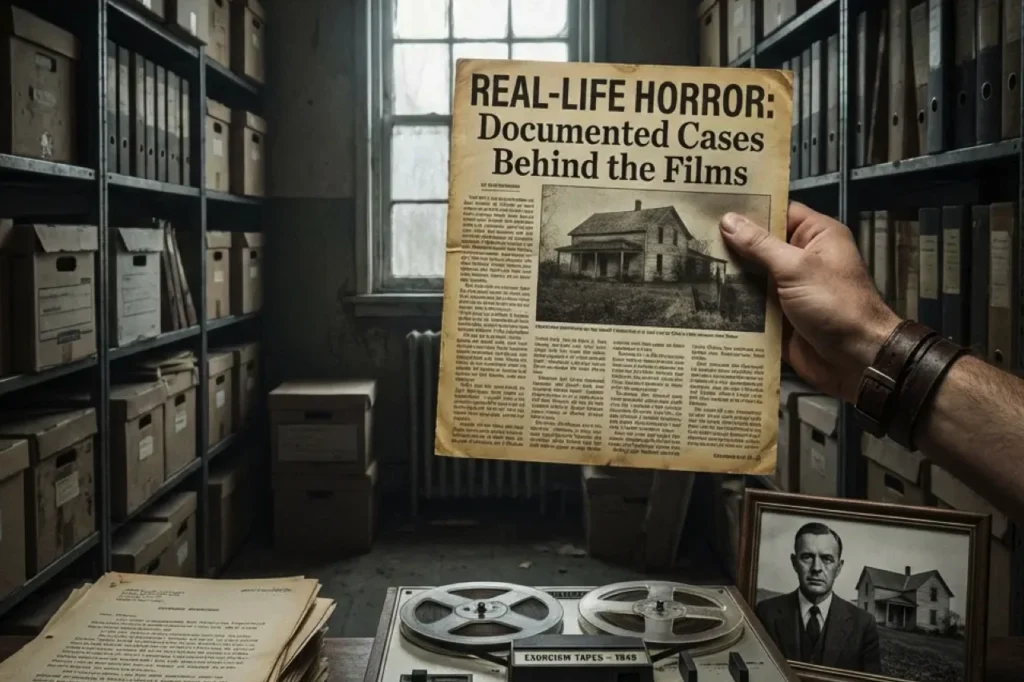

Horror films work because they tap into something primal. The fear feels real. But what happens if the horror on our screens actually is real…?
Here’s what actually happened in each story years before the cameras started rolling…
The Exorcist – The Mother Of All Horror Movies
Roland Doe wasn’t a fictional character. He was a teenage boy from Cottage City, Maryland whose 1949 possession became one of the most documented exorcism cases in American history – Inspiring the best known paranormal film of all time.
The exorcism had to be stopped early. Roland ripped off a piece of mattress spring and threw it at the priest, Father Hughes. The priest required over 100 stitches and never attempted another exorcism on the boy.
During the rituals, Roland allegedly spoke in Latin, urinated, vomited and spoke in a voice that wasn’t his. Over 75 years later, experts identified the real person as Ronald Hunkeler, a former NASA engineer who helped with the 1969 moon landing.
He died in 2020, having lived his entire adult life under the weight of that story.
The counter-narrative exists too. Author Mark Opsasnick proposed that Roland was simply a disturbed child throwing calculated tantrums. A woman who knew Hunkeler later told reporters he had “a terrible life from worry, worry, worry” because of his past.
The truth sits somewhere in documented records. The interpretation remains open.
The Conjuring Franchise: Commercial Success Built on Contested Claims
Ed and Lorraine Warren claimed to have investigated over 10,000 paranormal cases during their career. They became America’s most notorious paranormal investigators.
The majority of their claims have been thoroughly debunked.
In 1979, lawyer William Weber admitted he, author Jay Anson and the Amityville occupants invented the horror story over many bottles of wine. That’s the Amityville Horror case—one of the Warrens’ most famous investigations.
The Enfield Poltergeist case, which inspired The Conjuring 2, tells a similar story. Several independent observers dismissed it as a hoax carried out by attention-hungry children. The Warrens showed up uninvited and were refused admittance to the home.
A researcher involved in the original case said in 2016 that the Warrens “turned up once” and that Ed Warren told him they “could make a lot of money out of” the situation. Despite the controversy, The Conjuring franchise has grossed £2.7 billion against a combined budget of £263 million. It’s the highest-grossing horror franchise ever to date.
Commercial success doesn’t always require factual accuracy. But it does require compelling narrative architecture.
The Exorcism of Emily Rose: Anneliese Michel’s Tragedy
Anneliese Michel was a German woman who underwent 67 exorcism sessions over ten months in 1975–1976.
She died of malnutrition and dehydration in July 1976, weighing just 30 kilograms. The exorcisms were documented on tape. Anneliese spoke in multiple voices, refused food, compulsively performed hundreds of genuflections daily and exhibited behaviour her family couldn’t explain through medical diagnosis alone.
Two priests and her parents were convicted of negligent homicide. The court ruled they should have sought medical intervention instead of continuing the rituals. Medical experts later suggested Anneliese suffered from epilepsy and psychosis. Her devout Catholic upbringing likely shaped how her symptoms were interpreted—possession rather than illness.
The film softened the ending. Reality was far grimmer. A young woman died whilst those around her believed they were saving her soul.
The Silence of the Lambs: Ted Bundy’s Charm Offensive
Hannibal Lecter wasn’t based on one person. He’s an amalgamation.
But Ted Bundy provided the template for how a serial killer could weaponise charm.
Bundy was educated, articulate and outwardly normal. He volunteered at a suicide hotline. He worked on political campaigns. People trusted him—which is precisely how he lured at least 30 women to their deaths between 1974 and 1978.
Author Thomas Harris also drew from real FBI profiler John E. Douglas, who interviewed dozens of serial killers including Bundy. Douglas described how these men could switch personas instantly – charming one moment, cold the next.
A Nightmare On Elm Street: The Sudden Death Epidemic
Wes Craven read a Los Angeles Times article about a cluster of deaths amongst Southeast Asian refugees in the early 1980s.
Young, healthy men were dying in their sleep. No medical explanation. No warning signs. Just… dead.
One family described how their son refused to sleep after experiencing horrifying nightmares. He stayed awake for days. When exhaustion finally overtook him, he died during the night. His family heard him screaming but couldn’t wake him.
The phenomenon became known as Sudden Unexpected Nocturnal Death Syndrome (SUNDS). Medical researchers later linked it to Brugada syndrome—a genetic heart condition prevalent in Southeast Asian populations.
But in the early 1980s, before the diagnosis existed, families only knew that sleep had become fatal. Craven took that documented terror and personified it as Freddy Krueger. The method changed. The core fear of dying whilst you sleep, powerless to stop it, came directly from verified cases.
Do You Dare To Watch…?
Horror works even better when it touches something real.
The films that stay with you, are the ones grounded in documented extremity. They work because your brain recognises that these things actually happened to real people.
So go and watch! The stories are waiting, if you dare…?