
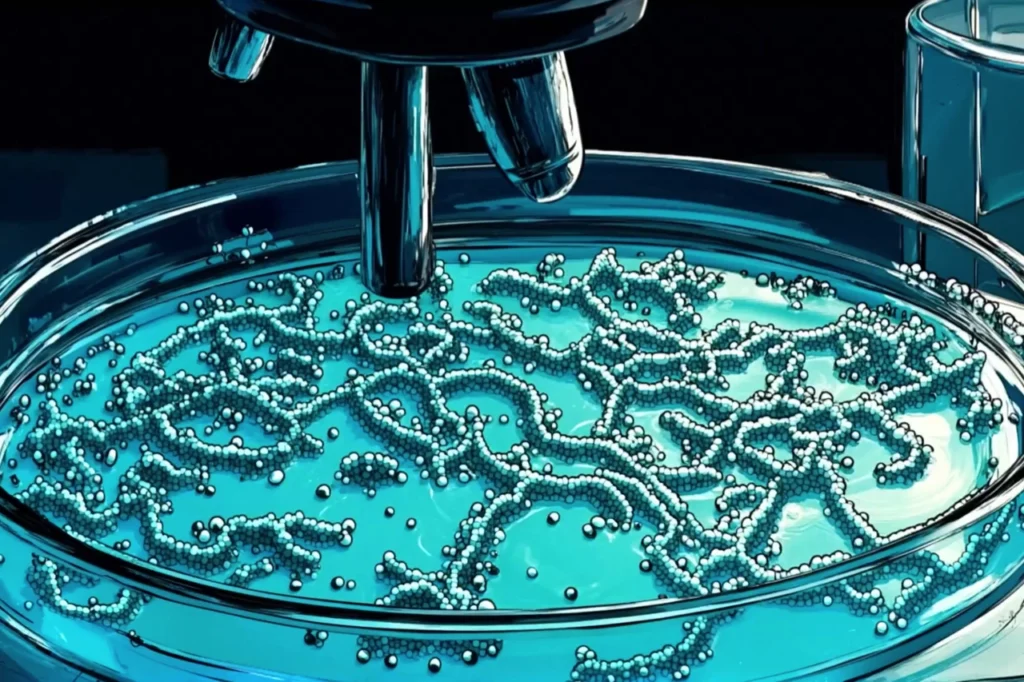

Scientists went looking for microbes in one of Earth’s most hostile environments and accidentally discovered something that broke every rule in the textbook. Bizarre But True! Two miles below the Arctic Ocean’s surface, buried several feet beneath the seafloor, they found 163 different species of chlamydia-related bacteria…!
The location? A hydrothermal vent field called ‘Loki’s Castle’. Almost no oxygen. Extreme pressure. Temperatures that would kill most life instantly.
And yet there it was—thriving one of the world’s notorious STI’s…
The Discovery That Made No Sense
“Finding Chlamydiae in this environment was completely unexpected, and of course begged the question what on earth were they doing there?” says lead researcher Jennah Dharamshi.
The team had been hunting for entirely different microbes and the discovery was a complete accident.
But the scale was absurd. In some samples, chlamydia-related bacteria made up a staggering 43% of all bacteria found. Out of 68 samples tested, 51 contained Chlamydiae. In certain areas, they were even the dominant bacteria.
The Impossible Survival Trick
But here’s what makes this genuinely strange: every known member of the Chlamydiae family depends on living inside other organisms.
They’re parasites. They need hosts to survive – as any red faced patient at the local STI clinic will reluctantly confirm.
But the marine sediments where these bacteria were found? No hosts present.
“All previous studies have pointed out that Chlamydiae need a host organisms in order to survive, and these host organisms are absent in the marine sediments we sampled,” the researchers noted. “Our work would represent the first indication that Chlamydiae are able to survive outside of a host organism.”
Your STI Might Have Marine Origins
The evolutionary timeline gets weirder still…
These Arctic bacteria all share a common ancestry dating back several hundred million years, possibly over a billion years for some lineages. One group discovered is closely related to the bacteria that cause disease in humans and other animals.
The implication? The STI might have marine origins.
Somewhere in evolutionary history, these ocean-dwelling bacteria seem to have made the jump to terrestrial hosts. The mechanism remains unknown, but the genetic relationship is documented.
The Climate Change Complication
Now for the bit that makes this discovery more than just a curiosity.
Arctic ice is melting. Permafrost is thawing. And when frozen environments warm up, they release what’s been locked away deep in the ice.
Due to rising temperatures on earth, approximately 4 × 10²¹ microorganisms are released annually from their frozen confinements. That’s four sextillion (not a pun, but a four with 21 zeros) entering natural ecosystems near human settlements.
And we’ve seen this pattern before. In August 2016, a 12-year-old boy in northern Russia died after being infected by anthrax. The outbreak, which hospitalised up to 20 people, came from a reindeer carcass that had been frozen for over 70 years. Unusually warm weather in the Arctic circle thawed it – and the deadly bacteria woke up.
What Happens Next
These Arctic chlamydia, thankfully, aren’t the same as the human STI. They’re not going to give you an infection just from swimming in cold water.
But they do represent something bigger: our understanding of where bacteria can survive was wrong. The deep ocean isn’t sterile. The Arctic seafloor isn’t lifeless. And the boundaries we thought separated marine microbes from terrestrial ones might be more porous than we realised.
As temperatures rise and frozen environments continue to thaw, previously isolated bacterial communities will start interacting with ecosystems they’ve been separated from for millennia and nobody knows exactly what happens when you mix populations that have been evolving independently for that long.
But we’re about to find out…