

Between 1764 and 1767, something prowled the French countryside that defied explanation. It wasn’t a simple wolf attack. It wasn’t a bear. And it definitely wasn’t normal…
Bizarre But True! ‘The Beast of Gévaudan’ killed 113 documented people, injured 49 more and partially consumed 98 bodies. Church records in Mende, Puy and Aurillac confirmed what the terrified locals already knew: hundreds of people had been slaughtered.
The first official victim was 14-year-old Jeanne Boulet, killed near Les Hubacs. She wouldn’t be the last.
The Attacks Were Surgically Precise
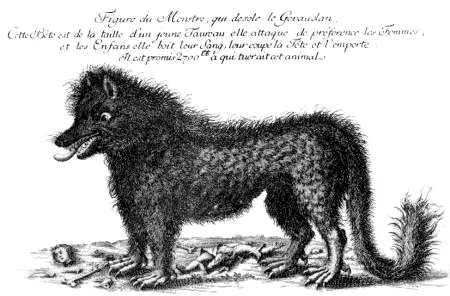
This wasn’t random predation. The Beast targeted heads and necks exclusively. Witnesses reported that victims had their throats torn out or heads completely removed. Some accounts stated the creature “drank all her blood” and left nothing but bones.
Women and children made up the majority of victims. The Beast seemed to select targets deliberately, attacking shepherds and travellers in isolated areas across a territory spanning 90 by 80 kilometres.
It Became History’s First Viral News Story
The Courrier d’Avignon broke the story first. Then Paris picked it up. Then the entire world…
By the end of 1764, people were discussing the Beast in London, Turin, Cologne, Amsterdam, Berlin, Geneva and Boston. This happened largely because the Seven Years’ War had just ended, leaving newspapers hungry for content. The Gazette d’Avignon’s editor embellished reports skilfully, creating enough media pressure that King Louis XV was forced to intervene.
It was one of the first international news phenomena in recorded history. And it was about a monster nobody could identify.
Witnesses Claimed It Defied Physics
The descriptions of ‘The Beast’ were consistent enough to be credible but inconsistent enough to be disturbing…
Multiple witnesses reported the Beast could walk on its hind legs like a human. It performed impossible leaps. It seemed to repel bullets. Hunters fired volleys of musket fire directly into the creature. It fell. Then it stood up and ran off.
The Beast showed no fear of humans. When confronted, it would retreat exactly 40 paces, sit on its hindquarters and wait. If not pursued, it would attack again. This wasn’t animal behaviour. This was something else.
The King Sent An Army
Louis XV didn’t mess about. At one point, 30,000 men were deployed to hunt the Beast. Captain Duhamel organised them along military lines, left poisoned bait and even dressed soldiers as peasant women to lure the creature out.
The reward offered was equivalent to a year’s wages for most men but none of it worked.
A Teenage Girl Wounded It With A Bayonet
Then, on 11 August 1765, Marie-Jeanne Valet was crossing the River Desges with her sister when the Beast attacked. She was 19 or 20 years old. She was armed with a bayonet affixed to a pole.
She impaled the Beast through the chest. The creature escaped, but Valet still became known as the “Amazon” and the “Maid of Gévaudan.” There’s a statue in her honour now.
Three months earlier other local youngsters, Jacques Portefaix and seven friends, aged eight to twelve, fought off the Beast by staying grouped together. Louis XV awarded them 650 livres.
Children were more effective, it would seem, than the king’s professional hunters…(!)
They Killed It. Then The Attacks Resumed.
On 20 September 1765, François Antoine, the king’s 71-year-old gunbearer, shot a large wolf near Chazes. It was assumed to be the Beast. Antoine received money and titles. The corpse was stuffed and sent to Versailles.
Then in December, the attacks started again…
This time, the Beast behaved differently. It showed no fear of cattle, whereas before it had avoided them. Between December 1765 and June 1767, as many as 30 more people were killed.
Either Antoine had killed the wrong animal, or there were two Beasts.
The Carcass Rotted Before The King Could See It
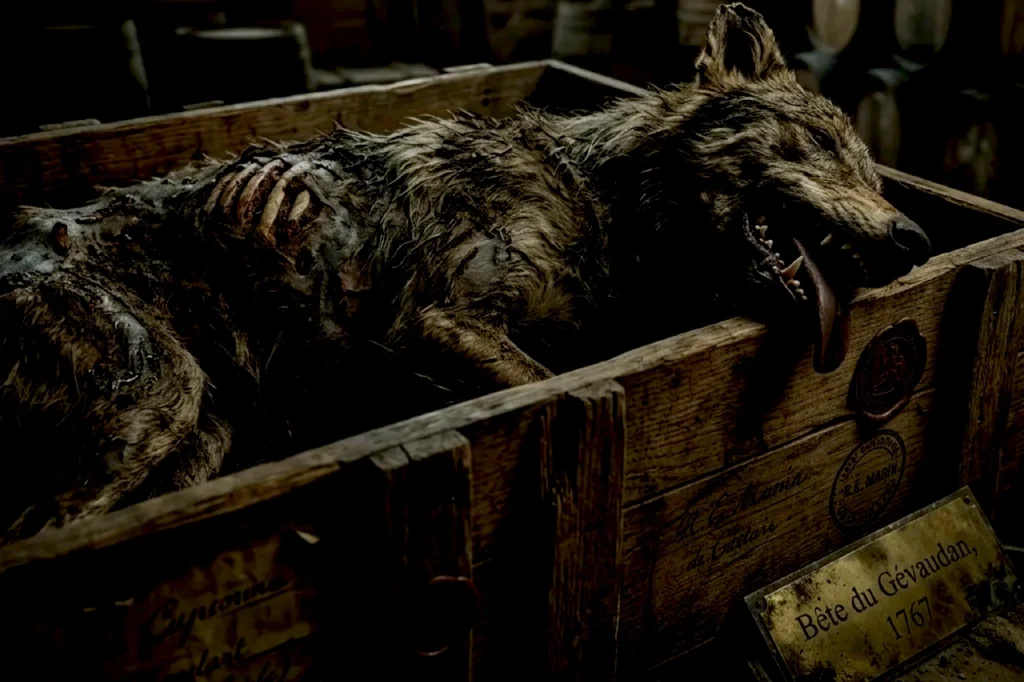
When the second Beast was finally killed on 19 June 1767 by local hunter Jean Chastel, the remains were hastily stuffed and transported to Versailles again. The journey was long. The summer was unusually hot.
By the time it arrived in early August, the carcass had lost its fur and was giving off a sickening stench. Naturalist ‘Buffon’ was tasked with examining it but left no documentation.
The Beast was never presented to the court. It was too decomposed to identify. An autopsy report written by royal notary Roch Étienne Marin on 20 June 1767 described “an animal which seemed to us to be a wolf; But extraordinary and very different by its figure and its proportions from the wolves that one sees in this country.”
The dental formula – 20 teeth in the upper jaw, 22 in the lower, suggested a canid. But the proportions were wrong.
The Silver Bullet Story Is A Myth
There’s a legend surrounding this story that Jean Chastel killed the Beast with silver bullets made from melted medals of the Virgin Mary. It’s a good story. It’s also completely fabricated.
French writer Henri Pourrat invented the detail. In 1889, Abbot Pourcher embellished the tale further, claiming Chastel recited prayers before firing.
Contemporary reports mention none of this. The silver bullet legend was added later to support werewolf theories. What is certain though, after Chastel’s kill, the terror ended.
It Might Have Been A Lion
Biologist Karl-Hans Taake argues The Beast may have been an immature male lion that escaped from captivity.
Lions prey on humans. The famous lions of Tsavo killed over 130 people in under a year. The Beast’s territory, roughly 56 by 50 miles, aligns with a lion’s typical range too.
Eyewitnesses in 18th-century France wouldn’t have recognised a living lion. Their knowledge came from stylised imagery. A sub-adult male doesn’t have a fully developed mane and sometimes has a mohawk-type stripe down its back. The descriptions match. The behaviour matches. The kill pattern matches.
But we’ll never know for certain. The evidence rotted in that summer heat before anyone could examine it properly…