
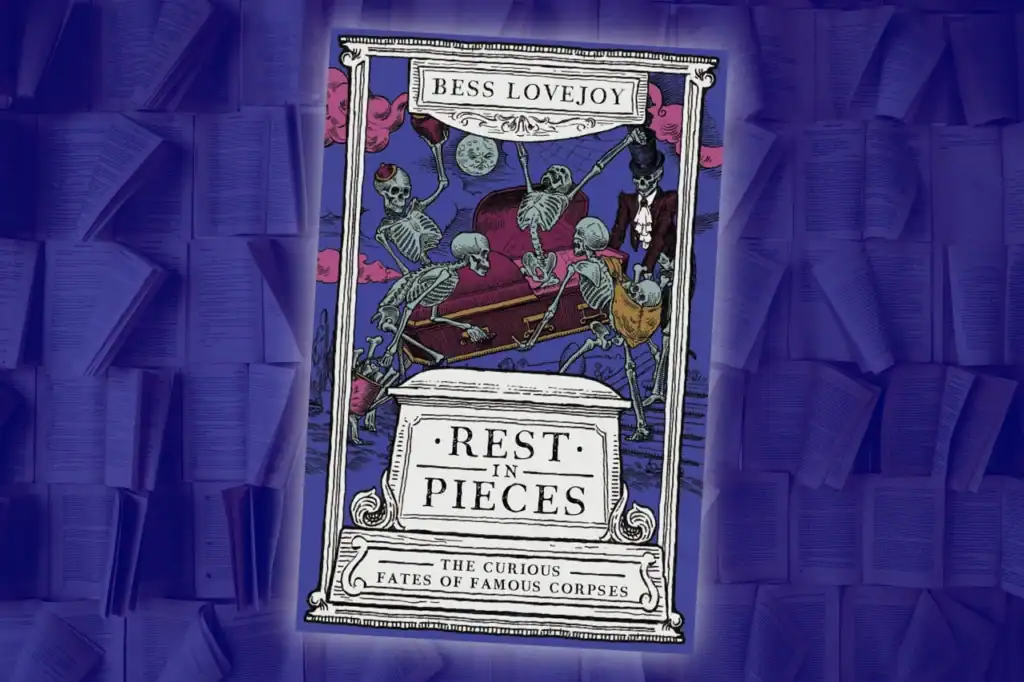
If you thought death was the final curtain call, Bess Lovejoy’s ‘Rest in Pieces: The Curious Fates of Famous Corpses‘ offers an unsettling encore. With an eye for the absurd and a pen dipped in dry wit, Lovejoy leads us on a brisk, darkly comic tour through the post-mortem misadventures of history’s most celebrated cadavers. It’s a book that reminds us, quite persuasively, that death may stop the heart but rarely halts human meddling…
At its core, Rest in Pieces is a morbidly fascinating anthology: brief, sharply sketched vignettes of what became of the remains of the once-great. And what stories they are. Einstein’s brain, spirited away for decades in jars like a traveling curiosity. Lord Nelson’s corpse bobbing across the sea in a cask of brandy – allegedly siphoned off by thirsty sailors. Lincoln’s body, so prized and so imperilled by grave robbers that it was moved, hidden and reburied more than once. And in a detail that manages to be both intimate and ludicrous, the supposed transatlantic journey of Napoleon’s penis, preserved and still on display.
It could easily become a grotesque list, but Lovejoy elevates it beyond the merely ghoulish with her voice: amused, ironic, but never entirely heartless. Each chapter becomes a miniature portrait, not just of the body, but of the living obsessions, political zeal, national pride, sheer opportunism that continued to animate these figures long after their final breath. The tone is that of a slightly sardonic docent at a museum of the macabre, pointing out each exhibit with a raised eyebrow and a faint smirk.
Yet there’s something almost reassuring in the consistency of human absurdity across centuries and continents. Whether it’s the cult-like devotion that sees Eva Perón’s embalmed corpse hidden, displayed, stolen and finally reburied, or the Victorian craze for phrenology that saw heads severed for ‘study’, Lovejoy suggests, gently but unmistakably, that our fascination with death has always been tinged with both reverence and rapacity.
Inevitably, a catalogue like this risks a certain sameness; there are only so many exhumations and trophy hunts before even the most shocking becomes expected. But ‘Rest in Pieces‘ sidesteps real tedium by keeping each tale short, brisk and laced with that wry commentary. It’s the sort of book best consumed in small, unsettling bites rather than a single morbid feast.
In the end, what lingers isn’t so much the horror of desecration but the peculiar poignancy of fame: that even the greatest among us are ultimately reduced to bone, ash and rumour, endlessly shuffled by the living for reasons that have little to do with who they were in life. It’s both funny and faintly tragic.
Lovejoy never moralises, but the message seeps through nonetheless: history doesn’t stop at the grave and the living are never quite done with the dead. Rest in Pieces is as entertaining as it is unsettling, perfect for readers who like their history served with gallows humour and a knowing wink. After all, as this book so wickedly demonstrates, dying may be easy – but staying put is surprisingly hard!
IN THE LONG RUN, WE’RE ALL DEAD.
But for some of the most influential figures in history, death marked the start of a new adventure.
The famous deceased have been stolen, burned, sold, pickled, frozen, stuffed, impersonated and even filed away in a lawyer's office. Their fingers, teeth, toes, arms, legs, skulls, hearts, lungs and nether regions have embarked on voyages that criss-cross the globe and stretch the imagination.
Counterfeiters tried to steal Lincoln's corpse. Einstein's brain went on a cross-country road trip. And after Lord Horatio Nelson perished at Trafalgar, his sailors submerged him in brandy – which they drank. From Mozart to Hitler, Rest in Pieces connects the lives of the famous dead to the hilarious and horrifying adventures of their corpses and traces the evolution of cultural attitudes towards death.