

Bizarre But True! ‘Ghost Hoaxing’ was a real crime category in Australia. Between the 1880s and World War I, people dressed in glowing costumes and terrorised communities…
They wore phosphorescent paint, screamed at strangers, hurled stones and vanished into the night. The phenomenon was so widespread that authorities offered rewards for catching the perpetrators.
This was entertainment before the dawn of Netflix.
The Wizard Bombardier Started It All
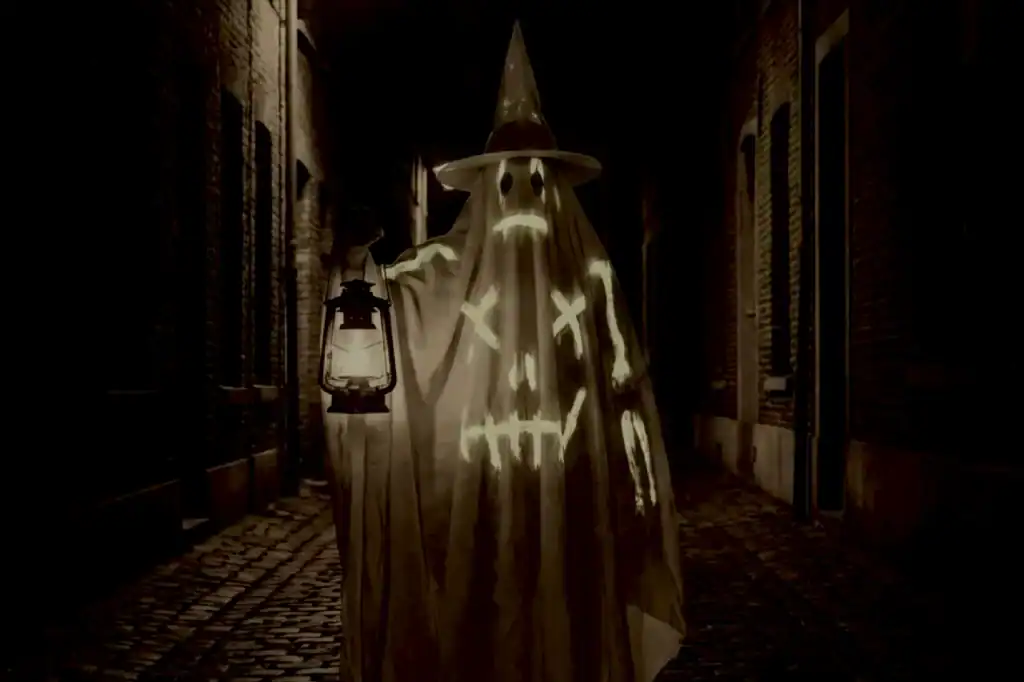
In 1882, southeast Victoria had a problem. A figure called the “Wizard Bombardier” wore white robes and a sugarloaf hat, disorienting people with loud screams before pelting them with stones and missiles.
Then he’d sprint away.
The attacks kept happening. More people joined in. Ghost hoaxing became a pattern across Australia and it was more than just pranks. Dr David Waldron, a Senior Lecturer in History at Federation University Australia with a research focus on folklore and community heritage, notes that the lack of professionalised police meant that Australia had a particular “lawlessness.”
Combine that with leisure time and no affordable entertainment and you get the perfect storm. Phosphorescent paint had also just been invented. People could glow in the dark whilst menacing others. The technology made the hoaxes more terrifying and more tempting.
Ghost Hoaxers Weren’t Just Pranksters
The crimes escalated beyond fear.
Ghost hoaxers committed indecent exposure, sexual assault and theft too. In 1913, vigilantes chased down a man wearing a glowing ghost outfit who’d terrified an old man. They caught him and beat him.
The phenomenon presented real danger. Communities lived in genuine fear of these attacks, which could happen anywhere, anytime. Then, World War I arrived.
Over 60,000 Australian soldiers died in the war. The leisure time vanished. The boredom that fuelled ghost hoaxing disappeared with it. The crime wave ended because the hoaxers had something more serious to occupy their time.
Ghost Hoaxing Had a Much Longer History
But Australia didn’t invent the concept…
On 31st March 1848, two American girls, Maggie (14) and Kate Fox (11), claimed a murder victim’s spirit lived in their Hydesville, New York home. They said they could communicate with him through knocking sounds. The hidden technique started with an apple on a string. The girls learnt how to crack their knuckles and toes to produce popping sounds that imitated knocking.
It launched an entire religious movement.
When Maggie reached her 50s, she revealed the truth. Their communication with the dead was a childhood prank that spiralled out of control. By then, the sisters had fraudulently performed hundreds of séances before the world turned its back on them.
Technology Made Ghost Hoaxing Even More Sophisticated
William Mumler accidentally created the first spirit photograph in 1861.
He made a darkroom mistake, using a plate that hadn’t been sufficiently cleaned. The result looked like a ghostly apparition. Mumler realised he could charge $10 per sitting (over $300 today) to photograph people with their deceased loved ones.
One of his most famous images shows Mary Todd Lincoln posed with the purported spirit of her assassinated husband. The spirits were double exposures from improperly cleaned photographic plates.
In 1869, P.T. Barnum commissioned a fake photograph of himself with Abraham Lincoln’s ghost to present as evidence in Mumler’s trial. The jury was unconvinced. Sure, there were a million ways Mumler could have faked the photos, but no one had caught him in the act.
He walked free.
Even Sherlock Holmes’ Creator Got Fooled
In 1917, two girls in Cottingley, England, took photographs of fairies.
Their technique was basic. Frances Griffiths explained they hand-copied images from Princess Mary’s Gift Book, a children’s book published in 1914. They added wings to cutout figures, used hair pins to hold the “fairies” upright, and snapped photos. Sir Arthur Conan Doyle believed them completely.
The creator of Sherlock Holmes, a trained physician who built a career on logical deduction, was dead-set on the notion. He was a noted spiritualist who saw the photographs as evidence that communication could exist between material and spiritual worlds.
The strangest part wasn’t that two girls pretended they knew fairies. It was that adults desperately wanted their encounters to be true.
Social reformer Margaret Macmillan emphasised the photographers were children and thus without motive or guile. Debate on authenticity continued until well into the 1960s. The hoax wasn’t entirely debunked until the 1980s when Geoffrey Crawley undertook a major investigation.
Elsie finally confessed to the hoax in 1983, probably with some relief.
Harry Houdini Built an Underground Ghost-Busting Network
After World War I and the 1918 influenza pandemic, millions died and spiritualism’s popularity soared.
Desperate to communicate with dead loved ones, the bereaved fell prey to fraudulent mediums. But magician Harry Houdini wasn’t fooled. He recognised the scammers’ methods as conjurer’s tricks and set out to expose them. In his stage show, Houdini revealed the fraudsters’ techniques. He used undercover investigators to collect proof of séance deceptions.
His head secret agent was Rose Mackenberg.
A young New York private detective and disguise expert, Mackenberg continued her ghost-busting career for decades, long after Houdini’s death in 1926.
One of Houdini’s targets was William Hope from Crewe, England. Hope and his “Crewe Circle” of photographers pulled the same tricks as Mumler, preying on despair.
Hope had a powerful defender: Sir Arthur Conan Doyle, who even wrote a book in Hope’s defence. The disagreement between Houdini and Doyle on spirit photography eventually destroyed their friendship.
The Digital Age Made Things Even Worse
In 1992, BBC TV aired Ghostwatch on Halloween night in the UK.
Advertised as a live investigation into supernatural activity at a London house, events quickly spun out of control. A malevolent spirit attacked investigators then manifested in the BBC studio. A terrified reporter warned that by airing the investigation on live TV, they must have created a “massive séance,” unleashing the spirit onto the whole UK.
The programme wasn’t live.
It had been taped months before for Halloween. Many viewers phoned the police in panic. This level of reaction hadn’t been seen since the 1938 radio broadcast of The War of the Worlds.
Here’s the strange part: roughly 40 percent of Americans now say ghosts exist. That’s up from thirty years ago when only a quarter believed in spirits. We still haven’t given up on the idea of technology being objective. We hold equally in our minds the idea that a Ring camera might capture something unusual and that everything we see has been manipulated.
Ghost Hoaxing Thrives on What People Want to Believe
The pattern of Ghost Hoaxing repeats across centuries.
Someone claims supernatural contact. Evidence appears (fabricated or misinterpreted). The narrative amplifies through media or word-of-mouth. People believe because they want to believe.
The Fox sisters wanted attention. Mumler wanted money. The Cottingley girls wanted to play. Australian ghost hoaxers wanted entertainment or stolen goods. The audiences wanted connection to something beyond ordinary life.
That’s why ghost hoaxing works. The hoax succeeds when it fills a gap people already feel. Technology changes. Human nature doesn’t.
The next ghost hoax is already being planned somewhere. Someone will use whatever new technology exists to create something that looks supernatural. And people will still believe it…