
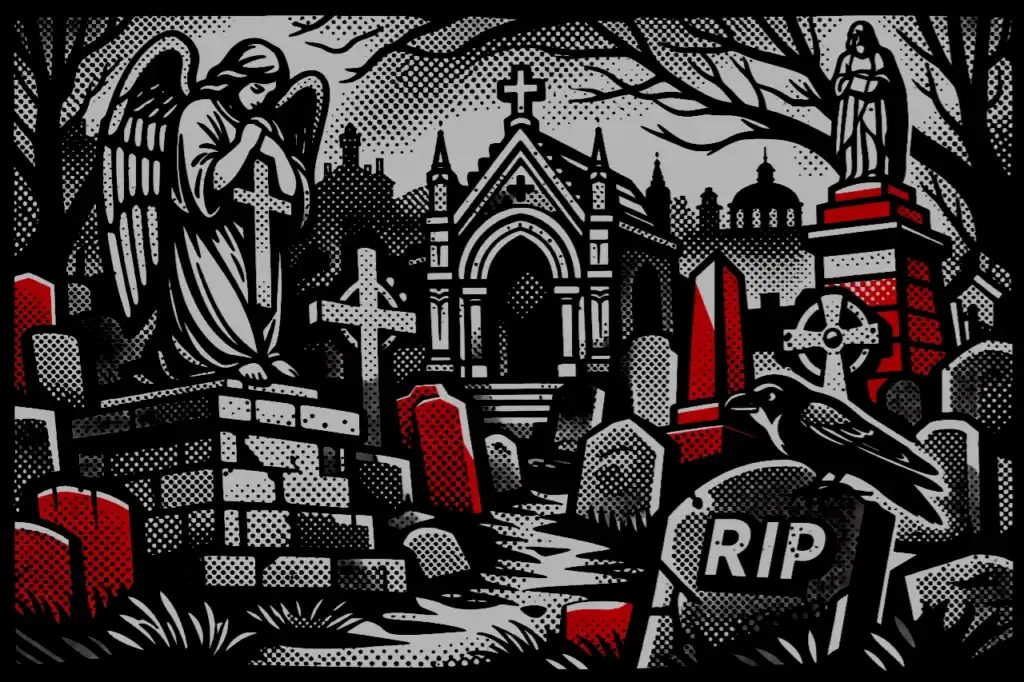

Highgate Cemetery in London doesn’t do subtle. This 37-acre Victorian burial ground holds 170,000 corpses crammed into just 53,000 graves. That’s multiple bodies sharing the same plot, many stacked on stone shelves behind heavy iron doors…
The place went bankrupt in 1960 and turned into an overgrown jungle where vandals ruled and Hammer Horror filmed actual movies. Now it’s one of London’s most visited historical sites.
Here’s what you’ll find when you visit the dead…
Karl Marx: The Philosopher Nobody Showed Up For
Bizarre But True! When Karl Marx died in 1883, exactly 13 people attended his funeral.
They buried him under an unremarkable slab in an ordinary plot. No fanfare. No monument. Just a basic grave (for a bloke who’d spent his life doing a lot of not much, at other people’s expense.)
Fast forward to 1954. The Communist Party decided this wouldn’t do.
They dug up Marx’s body at night and moved it to a more prominent location. Two years later, they installed the massive bronze bust that now dominates the cemetery’s eastern section.
The tomb has survived two bombing attempts in the 1970s and multiple vandalism attacks. Someone took a hammer to the original marble plaque in 2019.
The irony writes itself. A man whose funeral drew barely a dozen mourners now has one of the most visited graves in Britain…
George Wombwell: The Man Who Bred Britain’s First Captive Lion
George Wombwell ran a travelling menagerie in the 1800s.
He toured Britain with elephants, gorillas, giraffes and lions. His collection became so famous that he bred the first lion in captivity on British soil.
He named it William. After William Wallace.
When Wombwell died, they buried him beneath a stone lion monument. The sleeping lion represents one of his animals called Nero. The grave sits in the western section, surrounded by overgrown ivy and crumbling Victorian architecture. It’s one of the few animal-themed monuments in the entire cemetery.
You can still visit it, but only on a guided tour. The western section is too fragile for unsupervised wandering.

Tom Sayers: The Bare-Knuckle Fighter with 10,000 Mourners
Tom Sayers holds the record for Highgate’s largest funeral.
Over 10,000 people showed up when the bare-knuckle boxing champion died in 1865. The procession stretched for miles. His dog, Lion, served as chief mourner.
The statue of Lion still guards the grave today. It’s become one of the cemetery’s most photographed monuments, not because of Sayers’ fighting career, but because of that loyal dog carved in stone.
Victorian England loved a good funeral spectacle. Sayers got the full treatment.
Dante Gabriel Rossetti’s Wife: The Corpse He Dug Up for Poetry
Poet Dante Gabriel Rossetti buried his wife Elizabeth Siddal in 1862.
He placed a manuscript of unpublished love poems against her cheek in the coffin. A grand romantic gesture.
Seven years later, he wanted those poems back.
In 1869, Rossetti had Elizabeth’s grave opened after dark. He didn’t attend himself. He sent others to pry open the casket by bonfire light and extract the manuscript from her decomposed remains. The poems were recovered. They were published.
Rossetti later claimed he regretted the exhumation, but he never returned the manuscript to the grave.
The Egyptian Avenue: Where Coffins Exploded Inside Sealed Tombs
The Egyptian Avenue isn’t a single grave. It’s a hundred-foot passage containing 16 vaults.
Each vault holds 12 coffins stacked on stone shelves. The cast iron doors feature upside-down torches, symbols of extinguished life. Victorian regulations required above-ground tombs to be hermetically sealed in lead. The idea was to prevent “miasma” from leaking out and causing disease.
The problem? Decomposition produces gases.
Those gases built up inside the sealed vaults. The pressure increased. Coffins literally exploded inside their lead-lined chambers.
The avenue was designed in 1839 to evoke “sepulchral temples at Thebes.” It remains one of the most extreme examples of Egyptian Revival architecture in England. The roof has collapsed now. You walk through it during guided tours, surrounded by those heavy iron doors and the knowledge of what happened behind them.
The 1970 Vampire Hunt: When Hundreds Stormed the Cemetery with Stakes
On Friday 13 March 1970, a mob breached police cordons at Highgate Cemetery.
They came armed with wooden stakes, crosses and garlic. They were hunting a vampire.
Two self-proclaimed occultists had appeared on television claiming a medieval vampire was stalking the grounds. One witness reported seeing “something grey moving slowly across the road” whilst hearing “a high pitched noise.”
The hysteria escalated fast.
Real corpses were decapitated. Bodies were staked through the chest. Someone discovered a headless corpse behind a car windscreen. The vampire panic lasted years. People kept breaking into the cemetery, desecrating graves, performing rituals. No vampire was ever found. But the damage to historical graves was extensive and permanent.
The Cedar of Lebanon: A 280-Year-Old Tree That Had to Die
When Highgate Cemetery opened in 1839, designers built 20 burial vaults in a circle around an ancient Cedar of Lebanon tree.
The tree was already old then. By 2019, it had stood for 280 years. Structural decay meant the massive tree posed a “high risk of catastrophic collapse.” It had to be completely removed and replaced.
The circle of vaults remains. But the tree that defined the space for nearly two centuries is gone. Sometimes even the permanent fixtures of a cemetery have an expiration date.
What You Need to Know Before You Visit
The cemetery splits into two sections: East and West.
You can wander the East Cemetery freely during opening hours. Marx’s tomb is there. So is George Michael’s private burial site, though fans leave tributes at a nearby tree instead.
The West Cemetery requires a guided tour. That’s where you’ll find the Egyptian Avenue, the Circle of Lebanon and most of the extreme Victorian architecture. Book tours in advance. They sell out fast, especially during summer and around Halloween.
The cemetery is still operational. People are buried there today, continuing a tradition that started in 1839. Highgate doesn’t sanitise death. It never has.
That’s exactly why people keep coming back…