

Bizarre But True! On the 2nd July 2025, a signal from space pulsed towards Earth for over seven hours straight leaving scientists staring at their instruments in disbelief…
Gamma-ray bursts, like this one, are the universe’s most violent tantrums – cataclysmic explosions that release more energy in seconds than the Sun will produce in its entire 10-billion-year lifetime. They’re typically death throes: massive stars collapsing into black holes, or neutron stars smashing together in cosmic car crashes. They flare. They fade. They’re done.
Except this one wasn’t normal…
The burst, now catalogued as ‘GRB 250702B’, lasted approximately 25,000 seconds, nearly double the previous record. Of the roughly 15,000 gamma-ray bursts observed since scientists first recognised the phenomenon in 1973, only a half-dozen even come close to this duration.
This wasn’t just long. It was incompatible with everything we thought we knew and has some massive implications…
No Single Instrument Could Capture It
Here’s where it gets properly strange.
“The burst went on for so long that no high-energy monitor in space was equipped to fully observe it,” according to astrophysicist Eric Burns at Louisiana State University. Only by combining data from instruments on multiple spacecraft could researchers piece together what had actually happened.
Nothing was ready for something like this…
The scientific paper states the burst’s properties and extreme duration are “together incompatible with all confirmed gamma-ray burst progenitors and nearly all models in the literature.” Another researcher put it more bluntly: it “does not neatly match any other high-energy transients that we have observed in the past 50 years.”
Three Pulses That Shouldn’t Exist
Astronomers observed what appeared to be three distinct pulses across the burst’s nearly day-long duration.
That repetition is bizarre. Gamma-ray bursts are normally so catastrophic that they effectively destroy their astrophysical sources. There’s no encore. No second act. Yet this signal pulsed. Paused. Pulsed again.
And there’s more. China’s Einstein Probe detected soft X-rays over a period extending a full day before the gamma rays arrived. No previous gamma-ray burst has been preceded by X-ray emission over such a period. Standard models don’t predict this. Standard models don’t explain this.
The data simply doesn’t fit…
A Black Hole Eating A Star From The Inside
The leading explanation involves something genuinely unsettling.
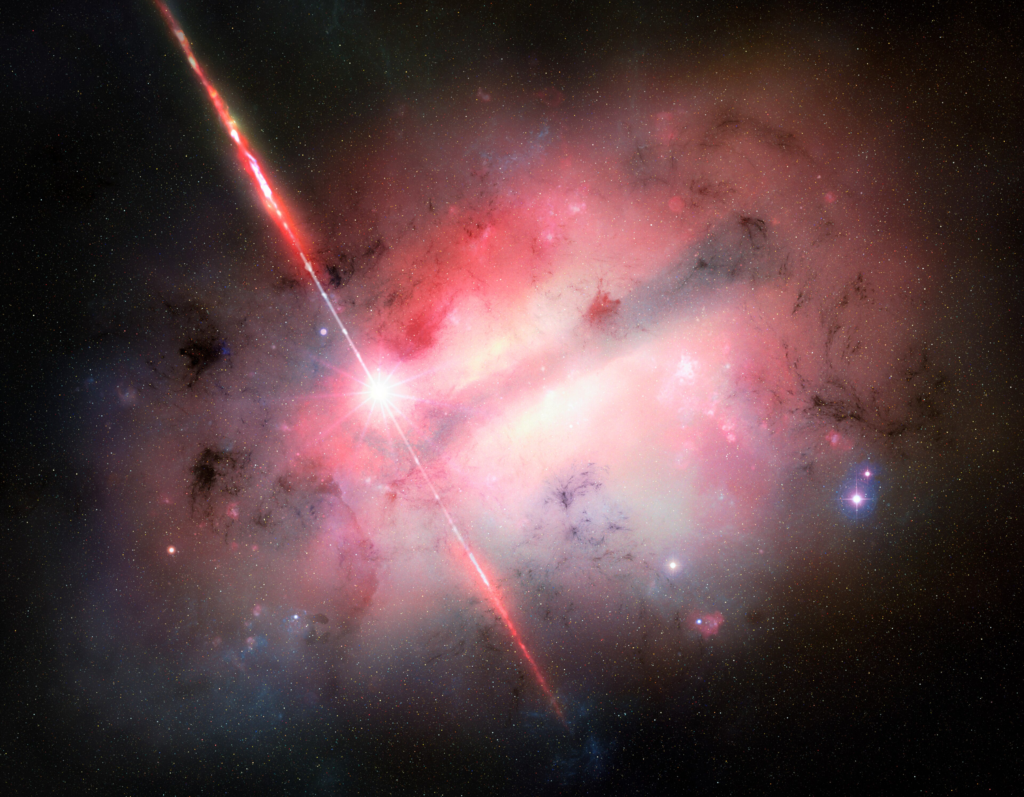
Picture a stellar-mass black hole spiralling into a helium star’s envelope. Not colliding with it from outside—but consuming it from within. Researchers call this the “helium merger model.” Once the black hole is totally immersed within the main body of the star, feasting on it from the inside out, gamma-ray jets blast outward through the stellar material.
It’s like watching something devoured by a predator that’s already inside its body.
The burst originated in a galaxy more than twice the mass of our own Milky Way, surprisingly large compared to the typically small galaxies that host most stellar collapse gamma-ray bursts. The galaxy sits so far away that its light takes about 8 billion years to reach us.
We’re watching ancient violence unfold in slow motion from long happened events…
What Are The Implications…?
GRB 250702B isn’t just an outlier. It’s a signal that our models are incomplete.
For 50 years, we’ve categorised gamma-ray bursts into neat boxes. Short bursts from neutron star collisions. Long bursts from massive star collapses. The physics worked. The predictions held.
Then this signal arrived and refused to fit anywhere…
NASA researcher Eliza Neights stated that this long-lasting GRB was so exceptional that it required a novel physical explanation. The old frameworks don’t stretch far enough. The old assumptions don’t hold.
Scientists aren’t just puzzled. They’re recalibrating on a grand scale…