

The moon isn’t just a barren rock floating in space. Since humans first reached it, it’s become somewhat of a cosmic dumping ground…
In all, humans have left 187,400 kilograms of material scattered across the lunar surface. Some of it makes sense – scientific equipment, rovers, landing modules. But buried in NASA’s 18 page catalogue of Apollo-related debris alone are items so bizarre they sound made up…

96 Bags of Human Poop
Astronauts left behind 96 bags containing urine, faeces and even vomit on the lunar surface.
This wasn’t accidental. Apollo 11 astronauts spent about eight minutes standing on the edge of their lunar module, tossing out anything unnecessary for the return trip. Scientists now want to retrieve this waste to study whether microbes that flourish in human faeces have mutated or survived in dormant state after decades in the harsh lunar environment.
The bags were carefully wrapped to prevent bacteriological contamination. Archaeologists call the area where they were dumped a “toss zone”.

A Family Photograph (Now Bleached White)
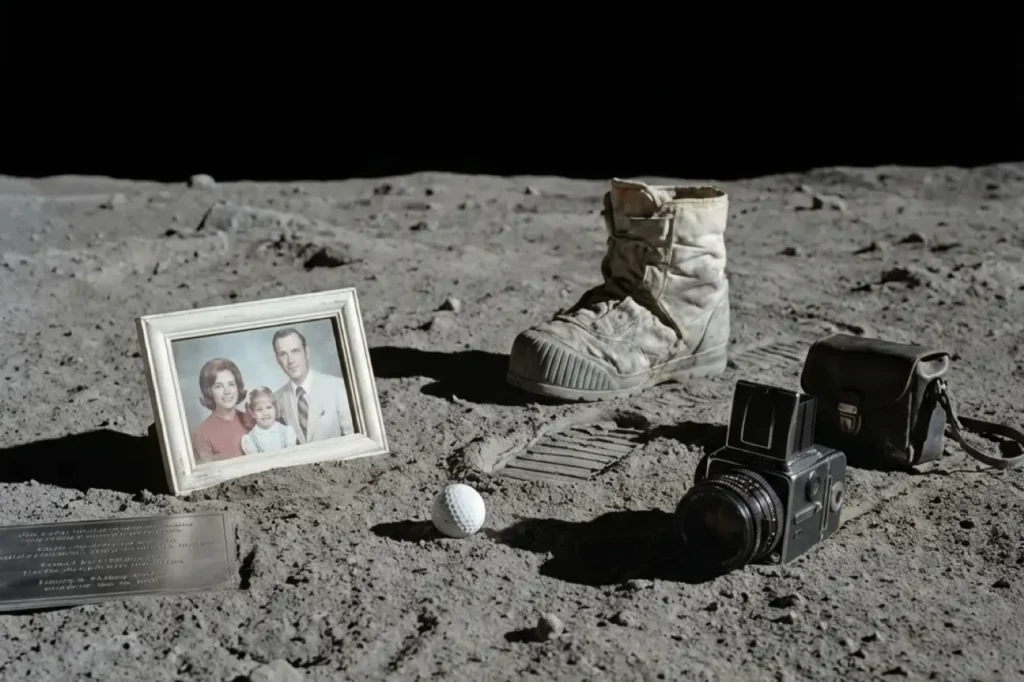
Apollo 16 astronaut Charles Duke left a framed family photograph on the moon’s surface in a plastic sleeve.
The photo shows Duke, his wife and their two sons. On the back it reads: “This is the family of astronaut Charlie Duke from planet Earth who landed on the moon on April 20, 1972.” Duke was the youngest person to walk on the moon at age 36.
Exposure to radiation from the sun has most likely bleached the photo completely white by this point. The photo itself remains – a ghost image on another world.
Two Golf Balls (That Travelled 40 Yards, Not “Miles and Miles”)
Alan Shepard hit two golf balls during Apollo 14, claiming the second went “miles and miles and miles.”
For over 50 years, the actual distance remained unknown. In 2021, imaging specialist Andy Saunders analysed archival photographs and calculated the first ball travelled 24 yards and the second just 40 yards—nowhere near Shepard’s exaggerated claim.
The moon is effectively one giant, un-raked, rock-strewn bunker. Shepard was swinging one-handed in a pressurised spacesuit that severely restricted movement, barely able to see his feet through his helmet’s visor.
12 Hasselblad Cameras
Astronauts had to leave behind 12 of the 14 Hasselblad cameras they brought with them.
Rather than take on too much weight, they brought back only the photographic film, with which they took an average of 1,500 shots. Somewhere on the moon, cameras are still pointed at the horizon, frozen in place as if waiting for their next shot.
In an interview after Apollo 11, Buzz Aldrin explained abandoning the expensive equipment resulted in “gnashing of teeth.”
The Moon Museum (Featuring Warhol’s Phallic Rocket)
A thumb-sized ceramic wafer featuring etched drawings by Andy Warhol and five other prominent artists was smuggled to the moon aboard Apollo 12.
Artist Forrest Myers couldn’t get official approval, so it was covertly attached to a leg of the lunar module by an engineer. Four drawings are abstract, one appears to be a stick-figure mouse and Warhol contributed his initials – which, as the Metropolitan Museum of Art notes, “read as a crude phallic rocket ship.”
There has been no official confirmation from NASA that this was actually transported to the moon.
100 Two-Dollar Bills
Of the 1.4 billion two-dollar bills estimated to be in circulation by the Federal Reserve, at least 100 are reported to be on the surface of the moon.
The Apollo 15 crew brought $2 and $20 bills hidden within their personal belongings, with the original intention of bringing them back to give to friends and family as certifiable Moon-touched souvenirs.
The bills never made it back home.
Oregon Lava Rock (A Geological Confusion Bomb)
Apollo 15 astronaut James Irwin left a small chunk of lava on the moon.
He had taken it from Devil’s Lake near Bend, Oregon, where NASA sent its astronauts to practise taking rock samples. A man named Floyd Watson later sent Irwin a letter along with the lava piece, asking the astronaut to deliver it to the moon for him.
Irwin obliged.
In a move that could seriously confuse lunar geologists of the future, Earth rock now sits amongst moon rock, indistinguishable without testing.

Neil Armstrong’s Boots (And Footprints That Will Outlast Civilisation)
The boots that made those iconic steps were left behind on the moon for practical reasons.
Astronauts were deliberately trying to lose mass because they were very limited in fuel to get back off the lunar surface. The bootprints remain intact, as there is no wind or atmosphere on the moon to disturb them.
Eventually, the prints will be buried under lunar soil displaced by meteorite impacts in a “very slow process” – one that will take at least a few million years. That is unless humans have more of a presence on the moon…
Fallen Astronaut Sculpture (Placed Face-Down Against the Artist’s Wishes)
Lying in lunar dust for more than 50 years, the small 3-inch tall Fallen Astronaut aluminium statuette was designed by Belgian artist Paul van Hoeydonck.
Deposited by the Apollo 15 mission in 1971, the artwork was intended to commemorate the 14 astronauts who gave their lives for the conquest of space. Despite the honour of having the first sculpture on the moon, Van Hoeydonck said he wanted it to be placed upright and that it represents all humanity – but it was placed face-down instead.
A Goodwill Disc with Messages from 73 Nations
Apollo 11 carried a tiny silicon disc etched microscopically with goodwill messages from 73 world leaders, including four U.S. presidents and Pope Paul VI.
About the size of a half-dollar coin, the disc was transported in an aluminium capsule that Neil Armstrong and Aldrin left on the Sea of Tranquillity. Buried in the lunar dust, it’s essentially a cosmic time capsule meant to show that humanity’s first lunar steps were for all nations.
The moon remembers everything we left behind. It has no wind to erase, no rain to corrode, no atmosphere to burn through. Every discarded object remains exactly where it landed – a permanent archaeological record of what humans valued enough to carry 384,400 kilometres, then considered disposable enough to abandon…