

Bizarre But True! The scent of eternity smells like fresh asphalt mixed with expensive incense…
Scientists have successfully recreated the exact fragrance used to embalm Senetnay, an ancient Egyptian mummy who served as wet nurse to King Amenhotep II over 3,500 years ago. The woman who once breastfed royalty and held the title “Ornament of the King” now offers the modern world something far stranger than her royal connection.
She lets us smell death itself…
The Jars That Survived A World War
Howard Carter discovered Senetnay’s remains in the Valley of the Kings in 1900, decades before his famous discovery of Tutankhamun’s tomb.
Her canopic jars, the vessels that held her preserved organs, contained residue that would remain unanalysed for over a century.
Two of those jars survived World War II by hiding in a salt mine. Researchers used advanced analytical methods to identify the fragrance notes even though the actual contents had long since disappeared. What they found challenges everything previously understood about ancient Egyptian trade networks and preservation techniques.
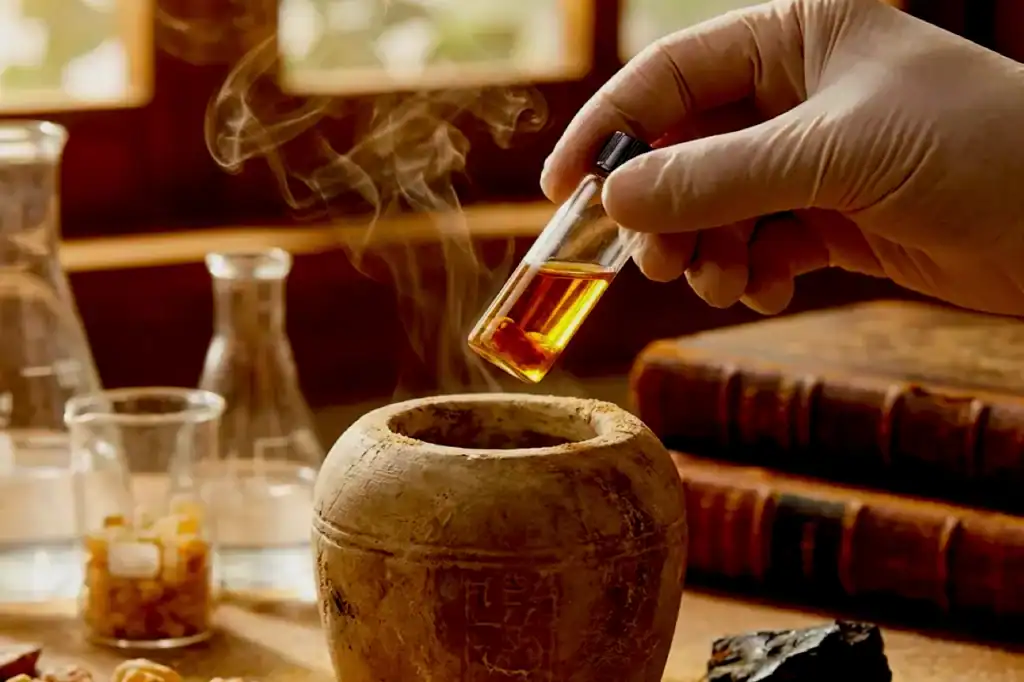
The ingredients read like a Global Shopping List. The balm contained frankincense, myrrh and potentially dammar resin from Southeast Asia. If tests confirm the presence of dammar, it means the ancient Egyptians had access to Southeast Asia almost 1,000 years earlier than previously thought.
Strangely, the balms differed between the two jars, which suggests different ingredients were used depending on which organ was being preserved. The Egyptians weren’t just embalming bodies. They were customising their preservation formulas based on biological tissue types..
What Death Actually Smelled Like
Out of twenty formulas tested, perfumer Carole Calvez selected one that she described as “woody, resinous, balsamic, aldehydic, very warm, powerful.”
The scent also features a distinct aroma similar to modern asphalt roads. (That’s the bitumen). Ancient Egyptians used it during mummification to insulate organs from moisture and insects. The result is a fragrance that registers simultaneously as ancient incense and fresh roadwork.
Experts working with mummified bodies reported their smell mostly as hedonically pleasant with “balsamic” descriptors. 78% described the scent as “woody,” 67% as “spicy,” and 56% as “sweet.”
It turns out, death, properly preserved, smells rather nice!
Ancient Egyptian texts state that when “people die, they rot, they decay, they stink and they will become countless worms.” If you stink it means your body is already decaying. That’s a bad thing when you’re trying to live for eternity.
The specific blend of scents wasn’t chosen for aesthetic reasons. It was chosen for its perceived ability to preserve the body and aid the deceased in their journey to the afterlife. Smelling good meant your body wasn’t rotting. Not rotting meant you could live forever. The fragrance functioned as proof of successful preservation…