
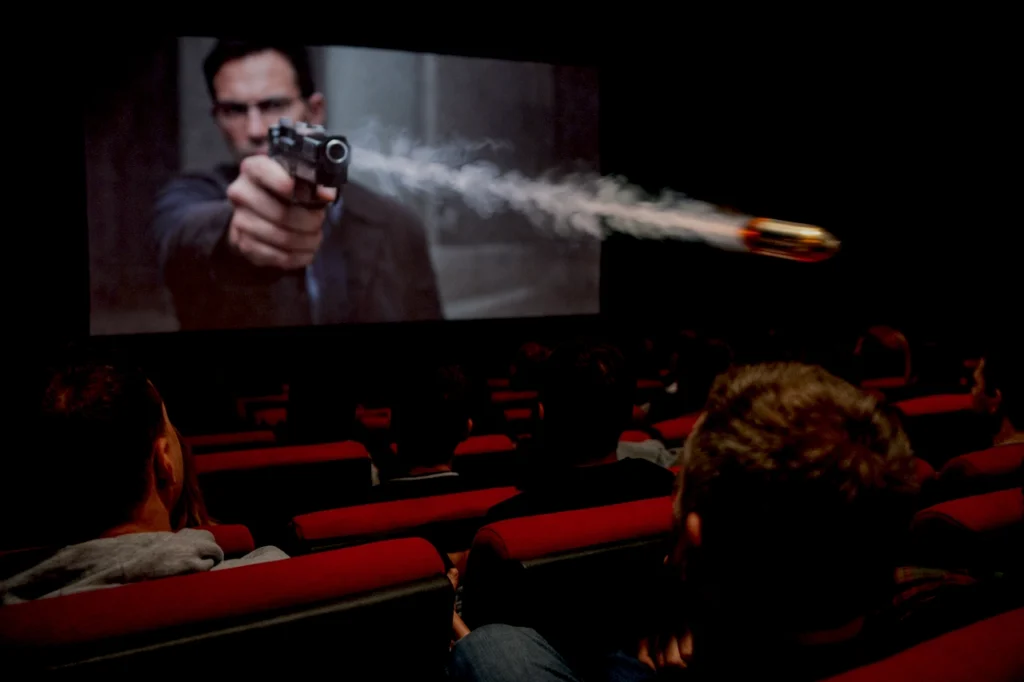

The lines between fact and fiction sometimes gets pretty blurry and nowhere else is that more relevant than in the world of Hollywood. Some films have predicted disasters with unsettling precision. Others have inspired copycat violence so disturbing they earned their own Wikipedia pages. A few have even became cultural blueprints for events that hadn’t happened yet….
Check out our picks of movies where fiction and reality intersected in ways that will leave you questioning what’s real…!
The China Syndrome: Twelve Days Before Meltdown
The China Syndrome hit theatres on 16 March 1979. Nuclear power executives called it “sheer fiction” and “character assassination of an entire industry.”
Twelve days later, Three Mile Island melted down.
The film showed a nuclear plant crisis where an official warns that an explosion “could render an area the size of the state of Pennsylvania permanently uninhabitable.” Then the Three Mile Island accident happened in Dauphin County, Pennsylvania.
At the New York Daily News, the managing editor shouted to his newsroom: “Who here has seen The China Syndrome?”
Three hands went up. All three were immediately sent to Harrisburg.
Bruce Lee’s Game of Death: The Bullet That Waited
In ‘Game of Death’, an assassin posing as a stuntman swaps a blank round for a real bullet. The shot doesn’t manage kill the protagonist.
Twenty years later, Bruce Lee’s son Brandon Lee died on the set of The Crow when a prop assistant loaded blanks into a gun – not knowing a real bullet was lodged in the barrel.
The Crow’s plot? A man returns from the dead seeking revenge. The parallel is so precise it appears to be no coincidence.
Contagion: The Pandemic Blueprint
Released on 9 September 2011, Contagion mapped out social distancing, conspiracy theories and the public response to a global panic well before COVID-19 existed.
The film predicted how humans would react to a pandemic with disturbing accuracy. From the science of viral transmission to the breakdown of social order, it felt like a documentary filmed ten years too early.
When COVID-19 hit in 2020, Contagion almost became required viewing. Not for entertainment—but for preparation.
Natural Born Killers: The Film With Its Own Crime Page
In 1995, Sarah Edmonson and Benjamin Darras took LSD and binge-watched Natural Born Killers. Then they shot two victims. One died.
Author John Grisham tried to argue the teens had diminished responsibility because of the film. Four years later, Columbine shooters Eric Harris and Dylan Klebold kept diaries where they referenced “going NBK.” Several other murders followed – so many that Natural Born Killers copycat crimes has its own Wikipedia page.
The Poltergeist Curse: Four Deaths in Six Years
Between the first and third Poltergeist films, four cast members died. Two were children.
Dominique Dunne, who played the eldest daughter, was strangled by her ex-boyfriend on 4 November 1982. She was twenty-two.
Heather O’Rourke, who played Carol Anne in all three films, died on 1 February 1988 from complications of an acute bowel obstruction. She was twelve.
The rumoured curse gained traction when it emerged that the production used real human skeletons during the pool scene – bizarrely they were cheaper than artificial ones. The same skeletons appeared in Poltergeist II.
Whether curse or coincidence, the pattern remains deeply unsettling.
Scream: When Meta-Horror Became Real
On 22 September 2006, Cassie Jo Stoddart was murdered by classmates Brian Draper and Torey Adamcik in Pocatello, Idaho. They recorded documentary-style videos explaining they were horror fans, especially of Scream and wanted to reenact a similar murder.
They became known as “The Scream Killers.”
In Belgium, twenty-four-year-old Thierry Jaradin killed a teenager whilst wearing a Ghostface costume. He later confessed the crime was premeditated and inspired by Scream.
The film’s self-aware commentary on horror violence became the blueprint for actual violence.
Taxi Driver: The Obsession That Reached the White House
John Hinckley Jr. watched Taxi Driver obsessively. He styled himself after Travis Bickle, drank the same peach brandy and became fixated on Jodie Foster.
When Foster enrolled at Yale in 1980, Hinckley followed her and stalked her on campus. In the film, Travis nearly assassinates a presidential candidate to impress a woman. On 30 March 1981, Hinckley attempted to assassinate Ronald Reagan outside the Washington Hilton Hotel.
The logic was simple: if Travis could do it in fiction, Hinckley could do it in reality.
The Pattern Nobody Wants To Acknowledge…
These aren’t just random incidents. They’re data points in a larger pattern where fiction doesn’t just predict reality – sometimes it actively shapes it.
Films act as cultural mirrors. When audiences see their anxieties reflected on screen, something shifts. Sometimes it’s cathartic. To some, it’s instructional…