

Bizarre But True! The forbidden fruit wasn’t an apple. The Bible never says it was. Genesis uses the Hebrew word ‘peri’, which actually means any fruit whatsoever. So how did the apple become the default fruit in every Sunday school illustration, Renaissance painting and garden-variety sermon for the past thousand years..?
The Latin Pun That Broke History
In Latin, the word for apple is malum. The word for evil is also malum. Different origins, identical spelling. It was a linguistic accident waiting to happen.
The fruit caused humanity’s expulsion from paradise. It’s evil. It’s malum. So what better candidate than the malum apple?
Except the Vulgate translation, the Latin Bible that shaped Western Christianity, actually used fructus (fruit) in Genesis 3, not malum for the fruit itself. The apple association appears to be a cultural phenomenon rather than a direct translation error. The pun stuck anyway.
What Art Did To Scripture
An apple already appeared in one of the earliest depictions of the Fall of Man from the 2nd century CE in the catacombs of San Gennaro in Naples.
But what truly sealed the apple’s fate? A popular 16th-century engraving by German artist Albrecht Dürer. Completed in 1504, it became the template for masterpieces by painters such as Lucas Cranach the Elder. Cranach’s depiction of Adam & Eve includes a smattering of apples hanging from the tree above the couple – vibrant and misunderstood temptations.
Before Dürer’s 1504 work, the fruit’s identity remained far more ambiguous in artistic representations. Art created doctrine. Painters made theological decisions that scholars never did.
The Fig Theory: Biblical Evidence in Plain Sight
Here’s what the Bible actually says happened immediately after Adam and Eve ate the fruit: “And the eyes of them both were opened, and they knew that they were naked; and they sewed fig-leaves together and made themselves girdles.”
Fig leaves.
Rabbi Nehemiah Hayyun supports the idea that the fruit was actually a fig. The logic is simple: they covered themselves with leaves from the very tree whose fruit they’d just consumed.
Since the fig is a long-standing symbol of female sexuality, it enjoyed a run as a favourite understudy to the apple as the forbidden fruit during the Italian Renaissance. Michelangelo Buonarroti depicted it as such in his fresco on the Sistine Chapel ceiling.
The evidence was always there. People just preferred the apple.
The Pomegranate Connection: Jewish Scholars’ Alternative
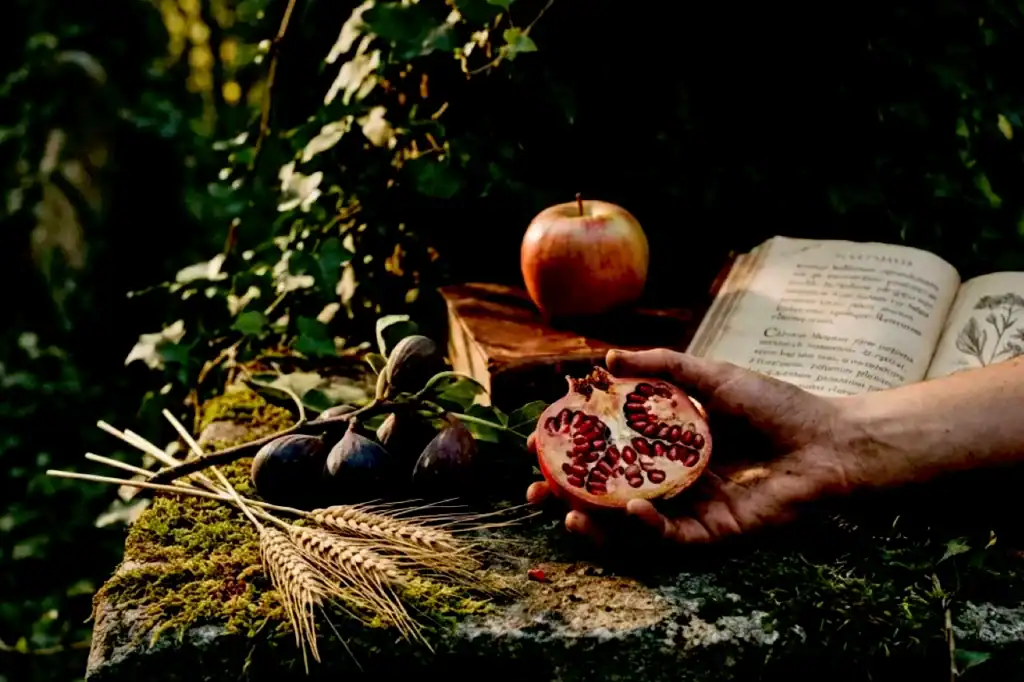
Many Jewish scholars believe that the pomegranate was the forbidden fruit of the Garden of Eden.
The symbolism runs deep: Jewish tradition teaches that the pomegranate is a symbol of righteousness because it is said to have 613 seeds, which corresponds with the 613 mitzvot, or commandments, of the Torah.
However, the tradition that the pomegranate has 613 seeds is a late development based on misunderstanding of the Gemara. Different pomegranates have different numbers of seeds. The symbolism is beautiful. But the maths doesn’t work.
Why The Apple Won
The apple didn’t win because of scripture. It won because of art, language accidents and cultural momentum.
Dürer’s engraving became the visual standard. The Latin pun became the linguistic shorthand. The golden apple motif in Classical myth, like the Apple of Discord described in the Iliad, gave it mythological weight. By the time anyone thought to check the original Hebrew, the apple was already embedded in Western consciousness.
The forbidden fruit could have been a fig, wheat, pomegranate, or something else entirely. We’ll never know for certain…