
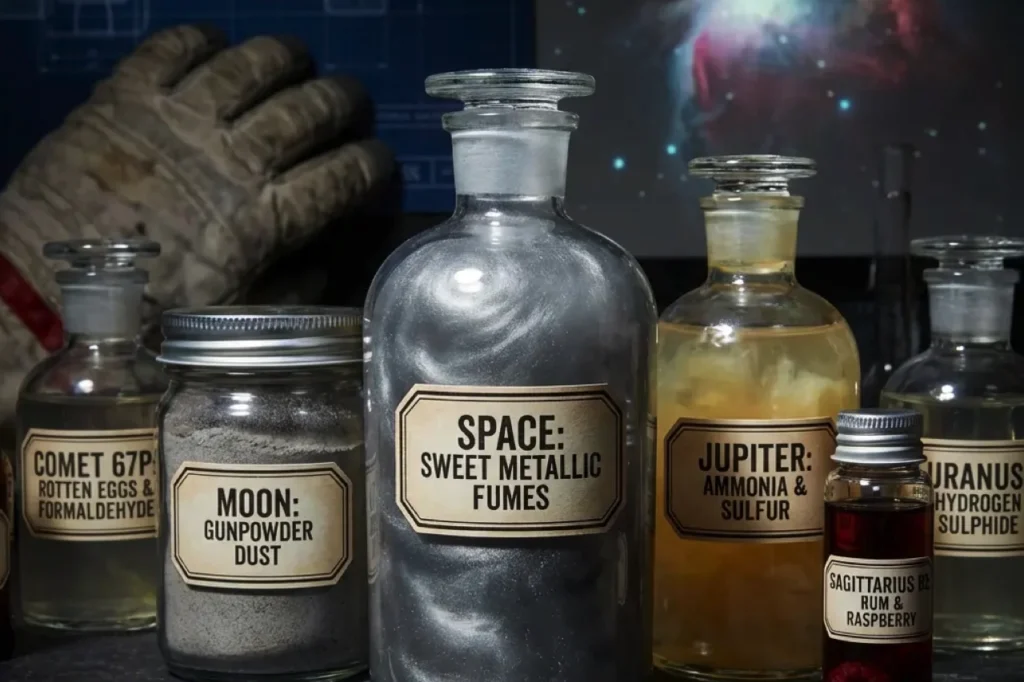

Bizarre But True! Space isn’t quite the odourless void you might think it is. Astronauts who’ve been there report something unexpected: space has a smell. And it’s not just them who say so either…
Here’s what different bits of the universe would smell like if you could take a whiff, without your lungs exploding, that is.

Space Itself: Sweet Metallic Welding Fumes
Astronaut Don Pettit described the smell of space as “metallic; a rather pleasant sweet metallic sensation” reminiscent of “pleasant sweet smelling welding fumes”.
Other astronauts have compared it to burning metal, walnuts and brake pads and even burnt almond biscuits.
The cause? One theory points to dying stars. Stellar explosions generate polycyclic aromatic hydrocarbons (PAHs), the same compounds found in coal, food and oil.
The Moon: Gunpowder That Isn’t Gunpowder
Apollo 17’s Harrison ‘Jack’ Schmitt said “everyone’s instant impression of the smell was that of spent gunpowder”, despite lunar dirt being completely different to gunpowder.
Moon dust contains silicon dioxide glass, iron, calcium and magnesium. Modern gunpowder is nitrocellulose and nitro-glycerine. They share nothing chemically.
The twist? Jack Schmitt became the first human to have extraterrestrial ‘hay fever’. After removing his helmet, his nose stuffed up quickly, lasting a couple of hours. It repeated each time he breathed in fresh Moon dust from his suit, though lessened as his body developed immunity.
Jupiter: Sweaty Urine Mixed With Rotten Eggs
If you had a leak in your protective suit on Jupiter, you’d encounter a pungent mixture of sweaty urine and sickeningly sweet rotten eggs.
Ammonia, one of the main smell generators of urine, sits at 700 parts per million in Jupiter’s atmosphere. Humans can detect it at 5 ppm. At 50 ppm it becomes “highly penetrating”, very dangerous and especially irritating to the lungs and eyes.
Hydrogen sulphide occurs on Jupiter at 77 ppm with that classic rotten egg smell. Humans detect it at 0.5 ppm, find it offensive at 4 ppm, and “sickeningly sweet” above 30 ppm.
Comet 67P: The Worst Perfume Ever Made
Scientists describing Comet 67P called it “strong, with the odour of rotten eggs (hydrogen sulphide), horse stable (ammonia) and the pungent, suffocating odour of formaldehyde”.
Add in the faint, bitter, almond-like aroma of hydrogen cyanide, plus a whiff of alcohol (methanol), paired with the vinegar-like aroma of sulphur dioxide and a hint of the sweet aromatic scent of carbon disulphide.
European Space Agency officials once wrote: “If you could smell the comet, you would probably wish that you hadn’t”.
Uranus: Confirmed Flatulence
In 2018, researchers from Oxford University confirmed that the upper atmosphere of Uranus contains hydrogen sulphide.
The icy planet smells like flatulence. Officially.
Sagittarius B2: Boozy Raspberries & Rum
In 2009, astronomers detected ethyl formate in Sagittarius B2—a giant interstellar molecular cloud less than 400 light-years from the Milky Way’s centre.
This is the chemical that gives raspberries and rum their sweet fragrances and taste. The same chemical is used to make beer.
This discovery inspired a 2020 perfume by former NASA chemist Steve Pearce called ‘Eau de Space’.
NASA Made Space Smell Real
To help make astronaut training more realistic, NASA commissioned Pearce in 2008 to create a scent that mimicked the odour astronauts described.
They ‘bottled space’. So if you ever wondered what the universe smells like, the answer is: metallic, burnt, occasionally boozy, and sometimes like the worst toilet you’ve ever encountered.
Space is strange. And now you know it stinks…