

In 1945, a farmer in Fruita, Colorado, swung an axe at a chicken’s neck and accidentally created one of the strangest survival stories in recorded history…
Lloyd Olsen wasn’t trying to make history. He was trying to impress his mother-in-law, who loved roast chicken neck. So he aimed high with the axe, hoping to leave most of the neck intact.
He missed…
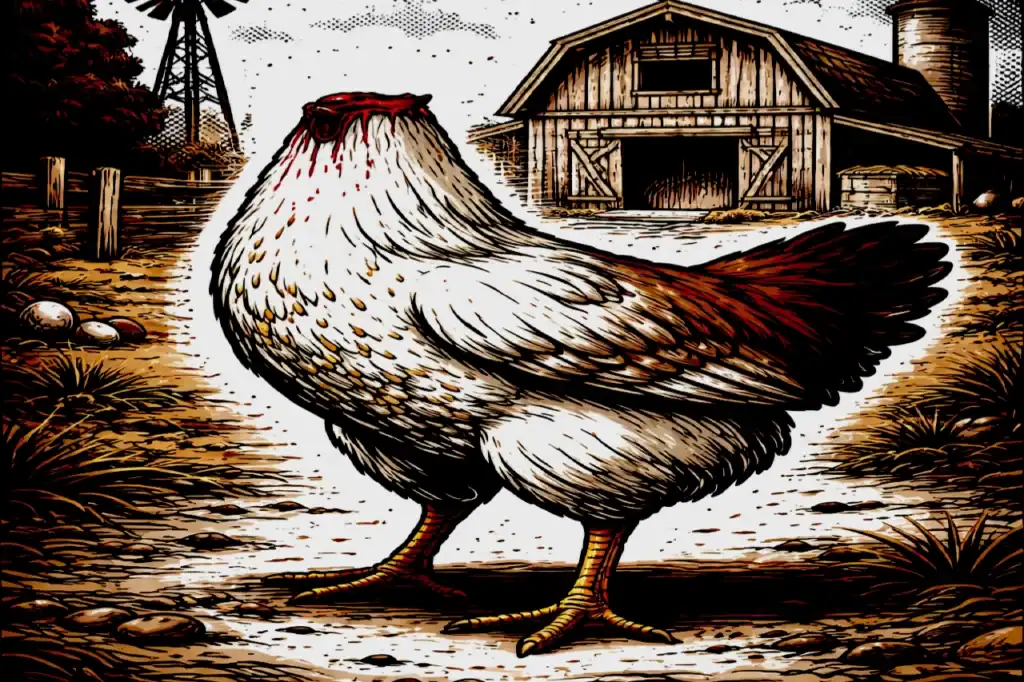
Or rather, he succeeded in the worst possible way. The blade took off most of Mike’s head but left one ear and, crucially, most of the brain stem attached. A blood clot formed immediately, preventing Mike from bleeding out.
Mike didn’t die. He kept walking around the farmyard… like nothing happened.
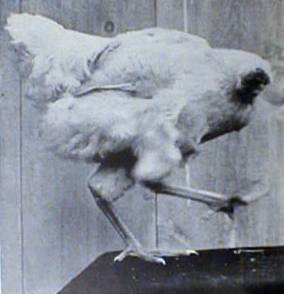
The Anatomy of an Impossible Survival
But here’s the thing about chicken skulls: they’re mostly empty space.
A chicken’s skull contains two massive holes for holding its eyes. The brain squeezes into the remaining space at a 45-degree angle. You could slice the top portion off and still leave the cerebellum and brain stem intact.
That’s exactly what Olsen did.
The brain stem controls breathing, heart rate, digestion and most reflexive behaviours. Mike’s body didn’t know it was supposed to be dead. It just kept running the programme.
Birds also possess something called the lumbosacral organ, a secondary balance system in the pelvic region that controls walking independently from the vestibular organ used for flight. This explains why Mike could still walk about relatively normally, despite having no head.
Feeding A Chicken Without A Beak
The Olsens realised they had something unusual on their hands…
Mike kept attempting to preen. He tried to peck at food. He even made gurgling sounds that resembled crowing, though without a head, the acoustics were off.
Lloyd and his wife Clara started feeding Mike with an eyedropper, pushing a mixture of ground grain and water directly into his oesophagus. They used a syringe to clear mucus from his throat to prevent choking. It worked.
Mike didn’t just survive. He thrived. Over 18 months, he grew from 2.5 pounds to nearly 8 pounds. The headless chicken was gaining weight faster than most chickens with heads.
Fame, Fortune And Copycat Failures
Word spread fast. Mike became a touring sensation. The Olsens took him on the road, charging admission for people to witness the headless wonder.
Magazines and newspapers featured him. He even had his own manager.
At the height of his popularity, Mike earned the Olsens $4,500 per month – equivalent to $63,400 in 2024. Mike himself was valued at $10,000 (about $140,800 today). His success triggered a wave of imitators.
Farmers across the country started attempting to replicate the feat, swinging axes at precise angles, hoping to create their own headless cash chickens. None of the unfortunate birds lived more than a day or two. Turns out, accidentally severing a chicken’s head in exactly the right way is harder than it looks.
The End Came Down To A Forgotten Syringe
In March 1947, Mike was on tour in Phoenix, Arizona.
In the middle of the night, he started choking on mucus. The Olsens had left their cleaning syringes at the previous day’s sideshow. Without the tools to clear his airway, they couldn’t save him. After 18 months of meticulous care, a single logistical oversight ended Mike’s run.
Mike holds the Guinness World Record for the longest surviving headless chicken. His bizarre achievement remains officially documented.
Fruita Still Celebrates The Headless Legend
Mike became a cultural institution. Since 1999, Fruita has held an annual “Mike the Headless Chicken Day” every third weekend in May.
Events include the “5K Run Like a Headless Chicken Race”, egg tosses, “Pin the Head on the Chicken”, the “Chicken Cluck-Off”, and “Chicken Bingo”—where chicken droppings on a numbered grid pick the winning numbers.
The town turned a macabre accident into a celebration of resilience, strangeness and the unpredictable nature of biology!