

Thirty metres below New Zealand’s North Island, something beautiful is hunting in the dark…
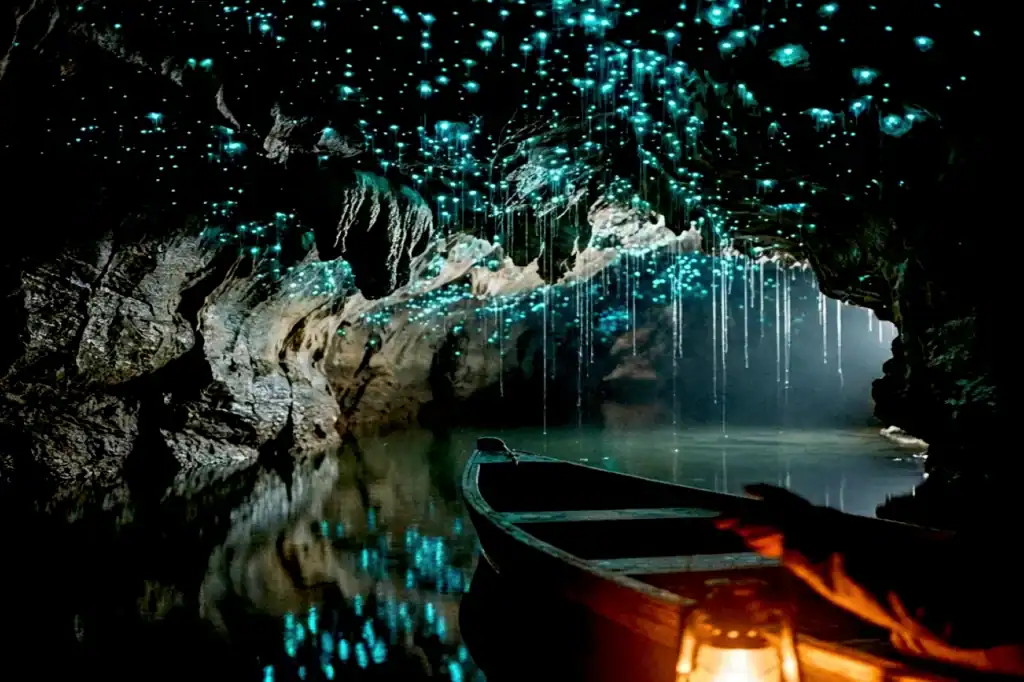
The Waitomo Glowworm Caves don’t just glow. They operate as a subterranean killing field where thousands of bioluminescent larvae dangle sticky fishing lines from the ceiling, waiting for prey to stumble into their traps. The blue-green light you see isn’t decoration – it’s bait.
And the mechanism is absolutely Bizarre But True!
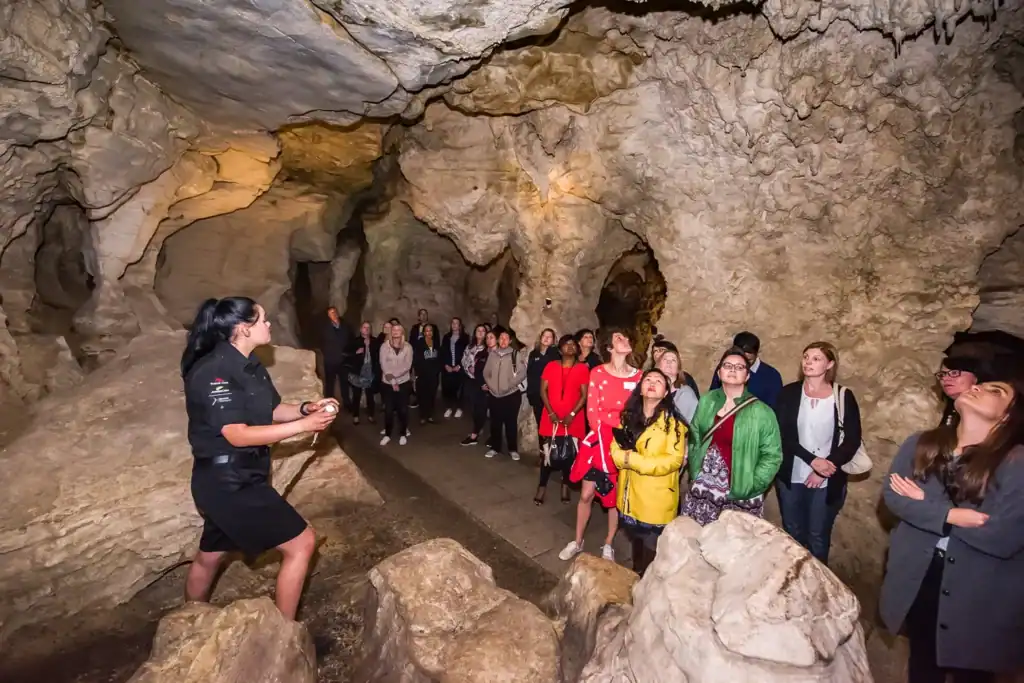
The Cave That Shouldn’t Exist
The limestone forming these caves started as compressed marine organisms – fossilised corals, seashells, fish skeletons, all accumulating on the ocean floor 30 million years ago when this entire region lay beneath the sea. Over the millennia, volcanic and geological activity carved out around 300 known caves in the Waitomo region.
The formations you see today? The average stalactite grows just one cubic centimetre every 100 years.
That means the structures surrounding you took millions of years to develop. You’re standing inside geological time made visible. But the real story isn’t the rocks. It’s what lives on them…
Bioluminescent Efficiency That Breaks Physics
The glowworms – technically Arachnocampa luminosa, a species of fungus gnat found only in New Zealand, produce light through a biochemical reaction so efficient it makes human technology look primitive.
The bioluminescent process converts 90% of energy directly into light. Your LED bulbs? They’re nowhere close to the same energy efficiency.
The blue-green glow reaches a maximum wavelength of 487 nanometres, produced through a ‘luciferase enzyme’ and luciferin molecule synthesised from xanthurenic acid and the amino acid tyrosine. This system diverged from fireflies 330 million years ago during the Carboniferous period – meaning these organisms evolved completely separate solutions to the same problem.
And they synchronise…
Larvae detect each other’s glows and adjust their light output to create coordinated displays. The peak of this diurnal cycle varies seasonally between 5pm in early spring and 8pm in summer. Thousands of individual organisms timing their bioluminescence together.

The Predatory Mechanism Is Disgusting
Here’s where it gets properly bizarre.
Each glowworm larva creates up to 70 silk threads coated in mucus droplets, suspending them like fishing lines that extend up to 50 centimetres in length. The sticky droplets are hygroscopic meaning they rehydrate after dry spells, maintaining adhesion in the cave’s humid environment.
When prey becomes entangled, the larva pulls it up by ingesting its own snare – at speeds of up to 2 millimetres per second, and feeds on the prey alive.
The silk has intentionally poor tensile strength. This functions as a safety mechanism ensuring the entire nest isn’t pulled down by prey that’s too heavy. The threads can only support about 15 milligrams before snapping.
It’s a calibrated system: strong enough to catch midges and mayflies, weak enough to fail gracefully under excessive loads.
A Life Cycle Built on Extremes
The larvae spend 6 to 12 months in their glowing, predatory stage. They grow from 3-5 millimetres at hatching to 30-40 millimetres before pupation. Then they transform into adult fungus gnats.
And here’s the mad bit: adults live only 2-3 days. Males survive up to 96 hours. Females manage 76 hours. They cannot feed. They exist solely to mate and lay eggs before dying.
When resources are scarce, the larvae even exhibit cannibalism – consuming other larvae, pupae, or even adult flies of their own species. Survival trumps kinship.
Discovery Through Darkness
In December 1887, Māori Chief Tane Tinorau and surveyor Fred Mace built a raft from flax stems and entered the cave through the stream entrance, exploring by candlelight.
They discovered the Glowworm Grotto and were astounded by both the twinkling ceiling and the limestone formations surrounding them. The Māori had known about the cave for approximately a century before 1887, but there’s no evidence they ever ventured inside it. The interior remained unexplored until Tane Tinorau and Fred Mace made their journey.
By 2013, Waitomo Glowworm Cave was described as “the most visited glowworm display in the world”. Before the COVID-19 pandemic, approximately 500,000 tourists visited annually.
Environmental Monitoring at Scale
The caves are continuously monitored by a Scientific Advisory Group using automated equipment tracking air quality, carbon dioxide levels, rock and air temperature and humidity.
This data determines how many visitors can enter at any time.
The cave’s humidity must remain above 80% for the glowworm capture system to function properly. The adhesive droplets can rehydrate after dry spells, but the system may not recover to initial strength if conditions deteriorate.
In 2022, koi carp mysteriously appeared in the stream within the Glowworm Grotto, prompting scientific investigation about whether installing a fish weir might cause increased flooding. Even in a tourist-managed cave system, nature finds ways to disrupt equilibrium.
Why You Need To See This…
You can read about bioluminescence. You can watch documentaries about predatory larvae. You can study the geological formations online. But you can’t replicate the experience of floating silently through a subterranean chamber whilst thousands of glowing organisms hunt above you!
If you’re looking for something amazing to do in New Zealand, the Waitomo Glowworm Caves 45-minute experience takes you through the cave system by boat, ending in the Glowworm Grotto where the ceiling transforms into a living constellation. Guides explain the geology, the biology, and the history whilst you drift through darkness punctuated only by bioluminescent light.
Tours run year-round. Bookings are available through GetYourGuide by booking below now…