
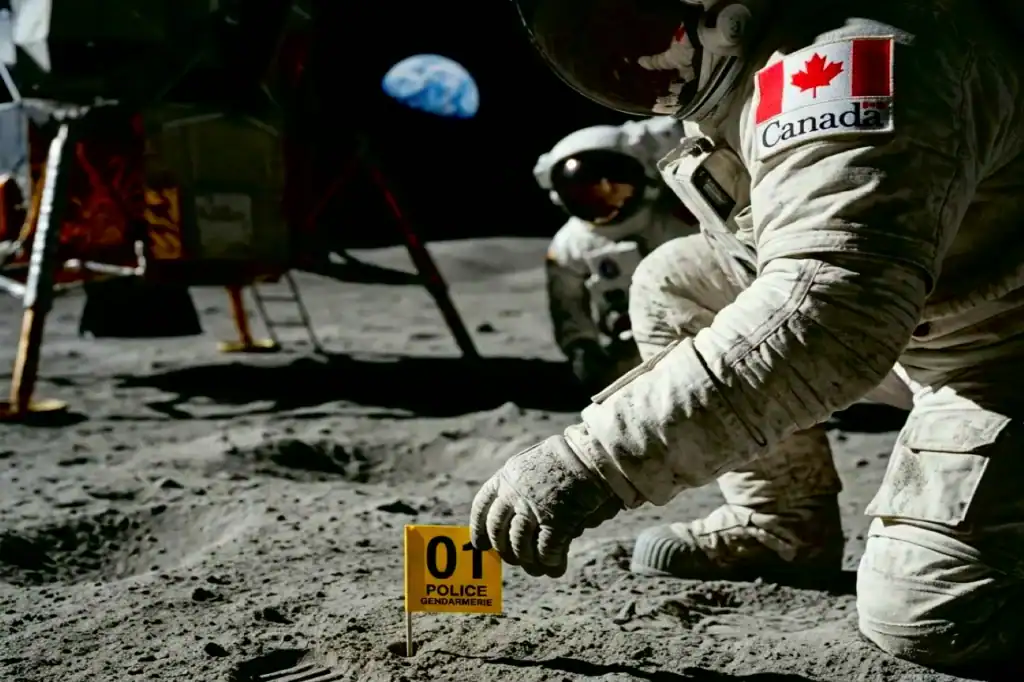

Space isn’t lawless. But it’s not exactly governed either. The moon has no police force. No courts. No prisons. Bizarre But True! Canada extended its Criminal Code to the lunar surface in 2022, making it the first country to explicitly state: commit a crime on the moon, face charges back home…
The question isn’t theoretical anymore. With NASA’s Artemis programme aiming to establish a permanent lunar presence and private companies racing to commercialise space, the moon is about to get crowded. And crowded places have problems…
The First Alleged Space Crime Wasn’t Even Real
In 2019, NASA astronaut Anne McClain was accused of accessing her estranged spouse’s bank account from the International Space Station. The media ran with it. First crime in space, they said.
Except it wasn’t.
McClain was cleared. Her ex-wife was later charged with making false statements to federal authorities. The first alleged space crime turned out to be the first false accusation of a space crime. But the case exposed something real: nobody knew how to handle it.
The ISS operates under a 1998 agreement where each country retains jurisdiction over its own modules and nationals. If a Canadian astronaut assaults a Swiss astronaut, jurisdiction depends on which module the incident occurred in and whose equipment was involved.
Your Passport Follows You Into Space
Here’s and even stranger bit: an 18-year-old British astronaut can legally drink alcohol on the moon. An American teenager of the same age cannot. Space follows your passport, not your location.
This is called extraterritorial jurisdiction. When you’re in international waters, Antarctica, or outer space, you’re bound by the laws of your home country and the moon, it seems, is no different.
Canada made this explicit in 2022. Under the new law, if a Canadian crew member commits an indictable offence on the Lunar Gateway or the moon’s surface, it’s deemed to have been committed in Canada. So, you can’t even escape Canadian law by fleeing 384,400 kilometres..!
The Outer Space Treaty Has A Loophole
The 1967 ‘Outer Space Treaty’ is the foundation of space law. It says no nation can claim sovereignty over the moon or other celestial bodies. Exploration must be peaceful. International cooperation is encouraged.
But here’s what it doesn’t say: anything meaningful about private citizens or companies.
The treaty was drafted during the Cold War when only governments had the resources to reach space. Nobody imagined wealthy individuals or corporations launching missions. The treaty explicitly forbids national appropriation. Some legal scholars argue this leaves a grey area for private actors. Could a company claim territory if no nation does?
The treaty doesn’t answer that.
And there’s another problem: enforcement doesn’t exist. There’s no space police. No international judicial system with coercive power. A country, individual, or company could simply ignore the treaty if they wanted. Who’s going to stop them..?
Forensics Don’t Work On Mars
Want to take space crime to another level again…?! If a murder occurred on Mars, investigators would face challenges Earth-based forensics never anticipated.
Blood spatter analysis depends on gravity. Mars has 38% of Earth’s gravitational pull. Patterns would look completely different. Bodies decay at different rates depending on bacterial availability and environmental conditions. Mars has neither Earth’s bacteria nor its atmosphere.
Crime scene procedures developed over a century of Earth-based investigation simply wouldn’t translate. And that’s assuming investigators could even reach the scene. A Mars mission takes seven months. Evidence degrades and memories fade…
The Moon Needs Rules Nobody’s Written Yet
Back on the moon, where people will actually be living soon (probably), there’s an attempt to prevent chaos before it starts…
The Artemis Accords, signed by 61 nations as of January 2026, propose establishing “safety zones” around lunar operations. The idea: create buffers that prevent interference and potential conflict. The problem: nobody’s defined what a safety zone actually is.
How large? Who enforces them? What happens if two nations’ zones overlap?
China and Russia haven’t signed the accords. Russia condemned them as “a blatant attempt to create international space law that favours the United States.” Critics argue safety zones could become territorial claims in disguise. The Outer Space Treaty forbids national appropriation, but a permanent “safety zone” around a base starts to look a lot like controlled territory.
Five years after establishment, these questions remain unresolved.
The First Lunar Crime Is Probably Already Planned
Nobody’s been charged with a space crime yet. But that’s mostly because nobody’s had the opportunity.
The moment permanent lunar habitats exist, the calculations change. Resource theft becomes profitable. Corporate espionage becomes viable. Jurisdictional arbitrage becomes strategic.
Someone will test the boundaries – and soon. Maybe a mining company extracts materials from a contested zone. Maybe a crew member sabotages a rival nation’s equipment.
The first lunar crime won’t be a mistake or a moment of passion. It’ll be calculated. Someone will commit an act knowing full well that enforcement is impractical, extradition is implausible and the legal framework is too fragmented to respond. And when that happens, the moon won’t just need lawyers. It’ll need a decision about what kind of place it’s going to be…