

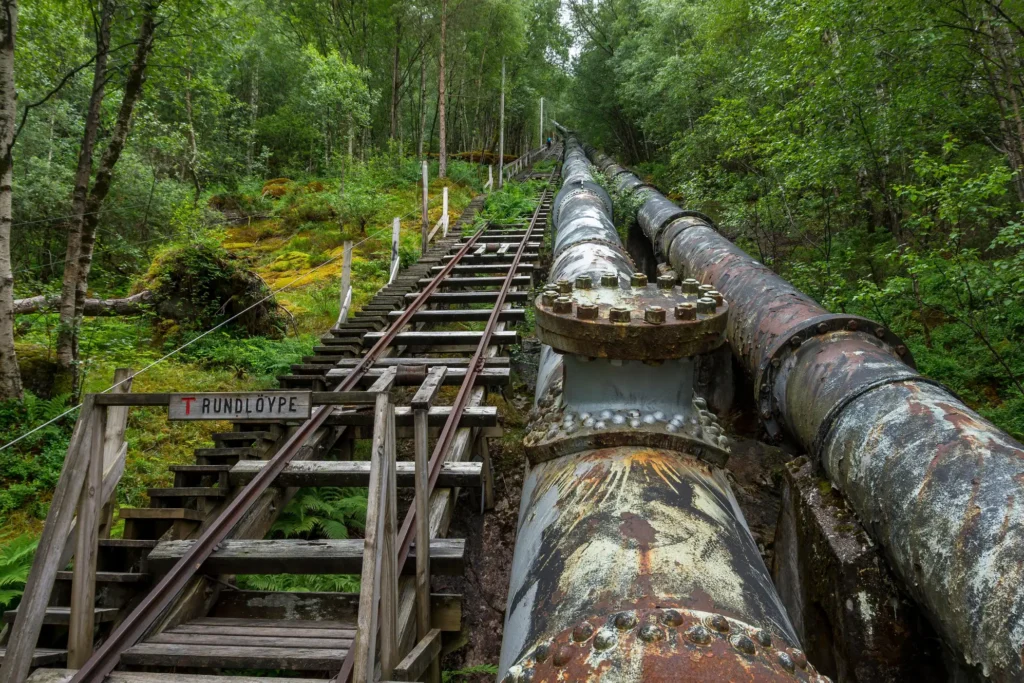
Norway’s Flørli Stairs hold a record most people wouldn’t want to break. Bizarre But True! At 4,444 wooden steps, they’re recognised as the world’s longest wooden staircase…
Built in the early 1900s to service water pipelines for the Flørli power plant, these stairs weren’t designed for tourists. They were functional infrastructure for an industrial operation that demanded steel production for the German arms industry.
The village itself is car-free and accessible only by ferry – a remote location that once bustled with 142 construction workers and their families. Today, only two permanent residents remain.
The Construction Story Nobody Talks About
Building stairs up a 740-metre mountain without machinery sounds impossible.
Workers carried materials purely by human power because the terrain was too steep for horses. The average payload was 80 kilos. One local, Nils Helmikstøl, reportedly carried 135 kilos on his back uphill, a feat beyond comprehension for most people today.
Despite harsh and dangerous working conditions, no one died during construction. That fact alone separates this project from most industrial endeavours of its era.
But there was one incident that traumatised workers permanently. A railway trolley carrying nine people rushed downhill at full speed when the winch failed. The men managed to jump off in time, but from that day on, some refused to ever mount the trolley again…
The Rule That Surprises Every Climber
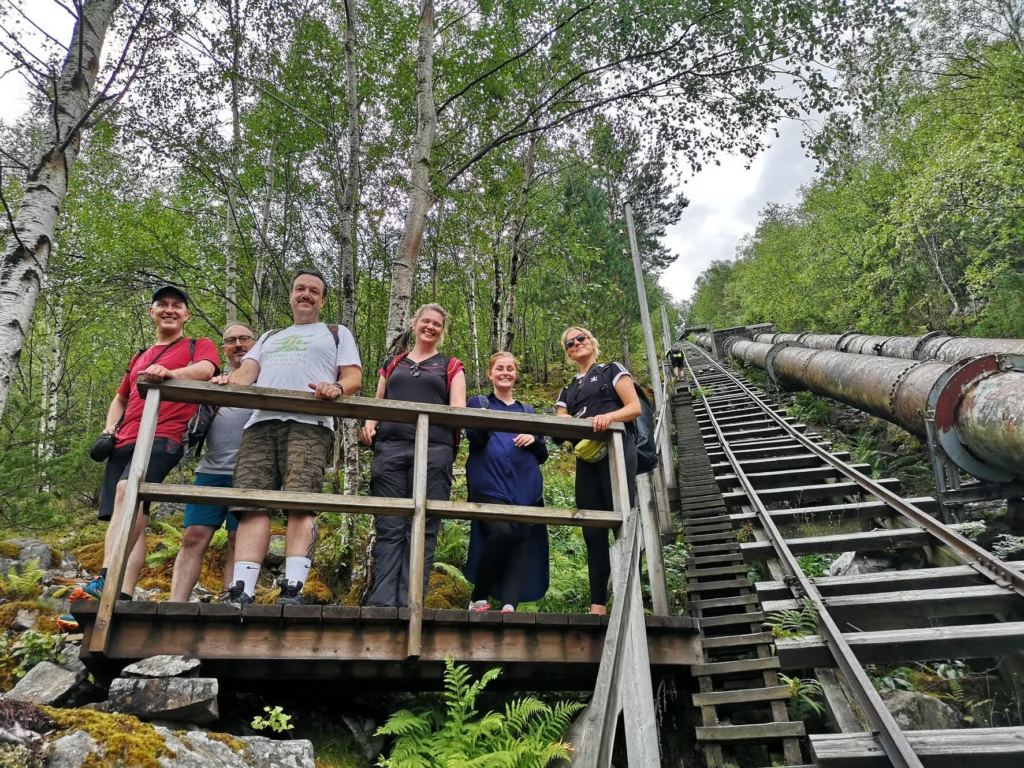
And now, you too can climb up the Flørli Stairs. (But you cannot come back down them…!)
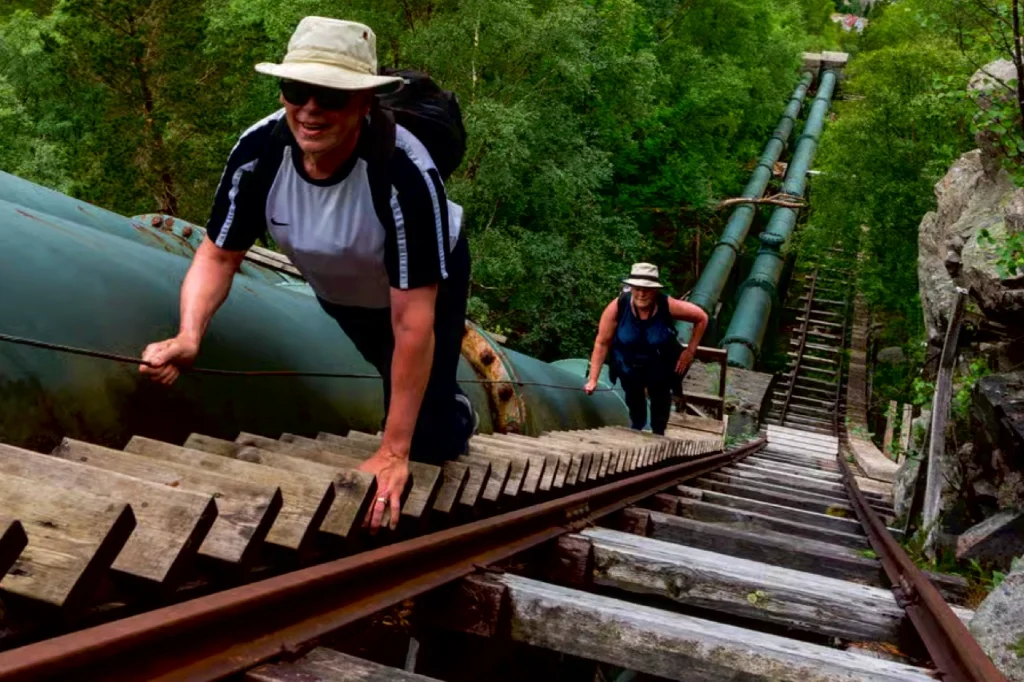
The stairs are up to 50 degrees steep with wire railings above 1,000 steps. Passing other hikers on the narrow path is difficult and dangerous, so climbers are directed to take an alternative three-hour mountain path down instead.
Normal hikers take about two hours of hard work to reach the top. Records for climbing all 4,444 steps sit around 30-34 minutes, part of the Tripp Trapp Triathlon’s “running” section. Climbing it is equivalent to scaling the Empire State Building almost twice or the Eiffel Tower more than 2.5 times!
A Village That Powered A City But Went Bankrupt
The Flørli power station started production in 1918 to supply Stavanger with electricity.
By 1928, the company’s debts reached 5.7 million crowns. It was bankrupt – selling for only 3.75 million crowns, about half the original asking price. The village that powered Stavanger for 25 years never made the profit it hoped for.
During peak construction in summer 1917, as many as 47 people were living in just 12 small rooms, a claustrophobic existence in an already isolated location. The village witnessed a massive exodus by the turn of the 21st century, what remains is a secluded resort.
The Rule That Surprises Every Climber
And now, you too can climb up the Flørli Stairs. (But you cannot come back down them…!)
The stairs are up to 50 degrees steep with wire railings above 1,000 steps. Passing other hikers on the narrow path is difficult and dangerous, so climbers are directed to take an alternative three-hour mountain path down instead.
Normal hikers take about two hours of hard work to reach the top. Records for climbing all 4,444 steps sit around 30-34 minutes, part of the Tripp Trapp Triathlon’s “running” section. Climbing it is equivalent to scaling the Empire State Building almost twice or the Eiffel Tower more than 2.5 times!Ready For Your Turn..?
The Flørli 4444 RIB Hike combines a thrilling RIB boat ride through the Lysefjord with the challenging climb up the world’s longest wooden staircase.
This guided tour takes you through stunning Norwegian scenery whilst teaching you more about the area’s industrial past. You’ll push your limits on stairs that most certainly weren’t built for comfort…!