
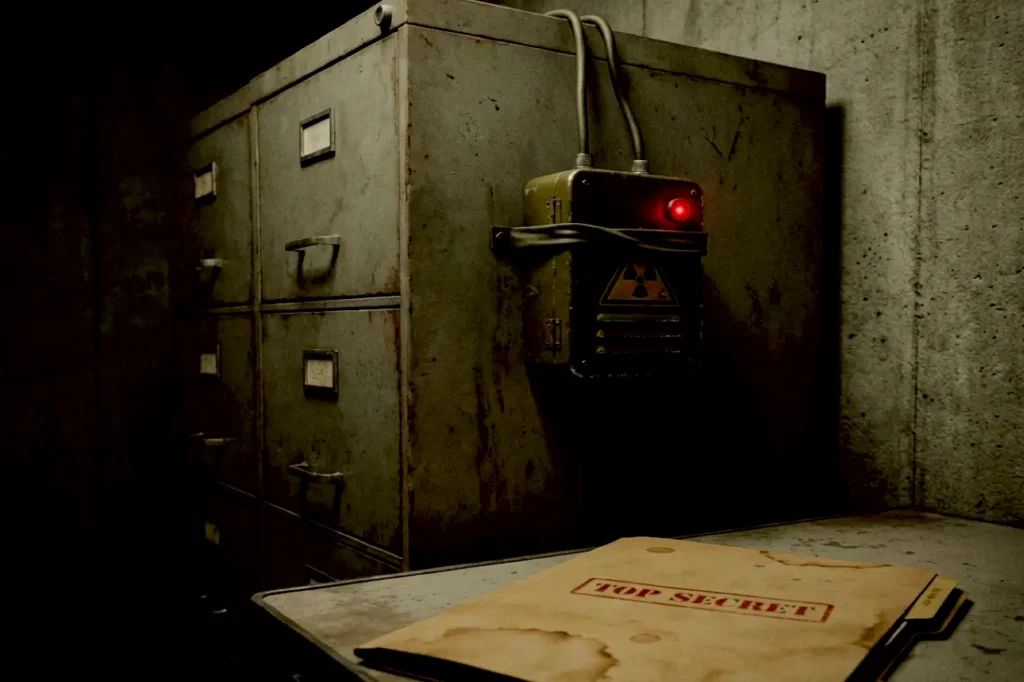

Bizarre But True! The United States government once considered using nuclear weapons to destroy filing cabinets. Not enemy bunkers. Not military installations. But standard office filing cabinets. Read on to discover the full Bizarre But True! story…
During the Cold War, the fear of classified documents falling into Soviet hands was so intense that planners explored every possible destruction method. When traditional approaches seemed too slow, they looked at the most extreme option available: small nuclear devices that could instantly vaporise sensitive paperwork before enemy forces arrived.
The Problem That Haunted Every Embassy
A declassified National Security Agency document reveals the core issue: “The problem of destroying Classified paper” in minimal time when facing imminent capture had plagued intelligence operations for as long as warfare existed.
The sheer volume made it impossible. Burning took too long. Shredding was labour-intensive. And if Soviet tanks were rolling through West Germany at the pace military planners expected, there wouldn’t be time for either method.
The agency noted grimly: “The day when the problem could be solved by the courier’s swallowing the notes has long since passed.”
When Extreme Becomes Standard Operating Procedure
Scientists experimented with mixing classified paper with sodium nitrate to create rapid burning that would produce liquid sodium carbonate at high temperatures. This would actually dissolve the ash, eliminating “the danger of text being recovered as ghosts on the white flaky ash.”
But even chemical solutions felt inadequate when planners imagined Soviet forces advancing faster than paperwork could burn.
The nuclear option emerged from this paranoia spiral. If small atomic devices could reshape terrain and destroy bridges, why couldn’t they eliminate filing systems?
And it wasn’t just theoretical posturing. The military had already deployed backpack-sized nuclear weapons weighing around 150 pounds. Special Forces trained to parachute behind enemy lines with these devices strapped to their backs, knowing full well it was essentially a suicide mission.
The Smallest Nuke Ever Built
The W-54 warhead measured just 24 inches long by 16 inches wide.
It holds the distinction of being the smallest nuclear weapon ever fielded by the United States. Around 300 were produced between 1964 and 1966, with selectable yields of 0.1 or 0.2 kilotons.
These weren’t designed for filing cabinets specifically, but the technology existed. Planners knew they could theoretically deploy similar devices in embassy basements or military command centres where classified materials were stored.
The weapons used mechanical locks rather than electronic ones because radiation could interfere with electronic mechanisms. That level of detail shows how seriously the military took miniaturised nuclear deployment.
Nuclear Landscaping And Other Rational Ideas
The filing cabinet plan fits within a broader pattern of Cold War nuclear thinking that seems absurd now but was considered perfectly rational strategy at the time.
The US Army developed an entire doctrine around “nuclear landscaping”—using small atomic bombs to reshape terrain and create radioactive obstacles. Field manuals taught soldiers to use atomic demolition munitions for “stream cratering,” whereby nuclear explosions near small waterways would form temporary dams and create effective water obstacles for enemy forces.
During a 1955 test, an 8,000-pound device with a yield of 1.2 kilotons created a crater 300 feet wide and 128 feet deep. If you’re willing to detonate nuclear weapons to redirect streams, vaporising classified documents doesn’t seem like much of a stretch, right?
Why The Plan Never Happened
The risks were too massive, even by Cold War standards.
Detonating nuclear devices in populated areas or near allied forces created unacceptable collateral damage. The political fallout would be catastrophic. And the practical reality was that if you’re at the point where you’re nuking your own filing cabinets, you’ve already lost operational control of the situation.
By 1987, military leaders were publicly admitting that some atomic demolition strategies were “pretty dumb.” General Louis Menetrey, the US commander in Korea, used exactly those words when discussing nuclear land mines stored near the Korean Demilitarised Zone.
The same recognition applied to document destruction plans. Alternative conventional methods were refined and implemented instead. Phew..!