
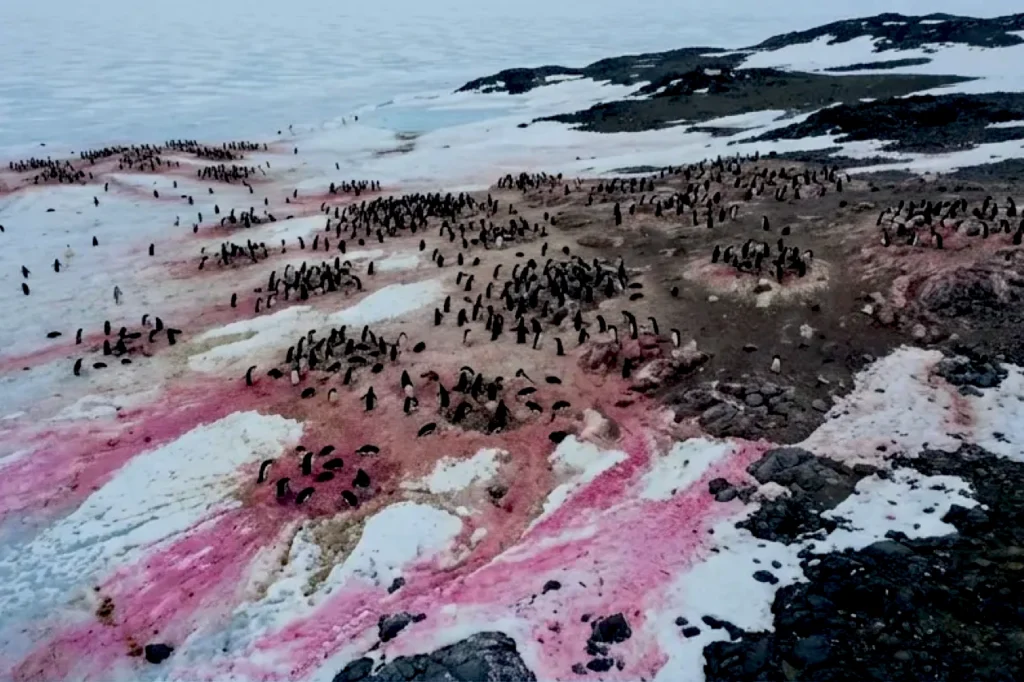

Satellites orbiting Earth track penguin colonies by spotting bright pink stains on Antarctic ice. The stains are penguin poop. And they’re visible from space…
Scientists discovered 1.5 million previously undocumented Adélie penguins through satellite imagery that detects their distinctive guano. White poop signals a fish diet. Pink to dark red means the penguins are eating krill.
This isn’t just amusing trivia. Penguin guano has become one of the most valuable diagnostic tools for understanding ecosystem health, historical climate patterns and even atmospheric chemistry.
Bizarre But True! Penguin poop tells stories that nothing else can.
The Laughing Gas Problem
King penguin guano releases nitrous oxide. Laughing gas.
Scientists studying penguin colonies found high levels of the compound in the air around nesting sites. One researcher reported: “After nosing about in guano for several hours, one goes completely cuckoo. One begins to feel ill and get a headache.”
The ammonia concentrations skyrocket to 13.5 parts per billion near colonies – 1,000 times higher than baseline.
This ammonia doesn’t just make researchers dizzy. It boosts particle formation rates in the atmosphere up to 10,000 times. Those particles create low-lying clouds that reflect sunlight back into space.
Penguins might be actively cooling Antarctica back down through their poop.
Projectile Defecation Physics
Humboldt penguins shoot their faeces up to 1.34 metres.
The birds generate rectal pressures between 10 kPa and 60 kPa to expel material at speeds of nearly 5 mph. That’s the equivalent of an adult human shooting their faeces more than 3 metres.
The physics matter because the distance determines colony hygiene and nest cleanliness. Penguins that can’t generate enough pressure end up sitting in their own waste. Evolution optimised for poop trajectory.
A Gentoo penguin produces 84.5 grammes of guano every single day. Multiply that across a colony of thousands and you’re looking at tonnes of material that needs to land somewhere other than the nest.
The 6,000-Year Archive
Some Antarctic islands have layers of guano spanning 2,900 years!
Penguins return to the same nests year after year. Their poop accumulates. The layers freeze. And researchers can read them like tree rings. Adélie penguin guano is helping scientists study 6,000 years of environmental and biological changes along Antarctica’s Ross Sea coast.
The chemical composition of each layer reveals past climate conditions, pollution levels and ecosystem dynamics. The guano preserves what ice cores can’t capture, biological response to environmental shifts.
Researchers even used the 84.5 grams of daily Gentoo guano production to investigate the impact of volcanic eruptions on penguin colony size from 8,500 years ago! The poop layers showed population crashes that matched volcanic activity.
Krill Can Smell Death
Antarctic krill panic when they detect penguin guano in the water.
The krill swim faster. They make more turns over greater angles. They reduce their rate of ingesting algae by 64% when penguin poop enters their environment. An adult Adélie penguin eats up to 1.6 kilogrammes of krill per day.
The krill evolved to recognise the chemical signature of penguin waste as a predator signal. The moment they smell it, they scatter. This creates a feedback loop. Penguin colonies concentrate in areas with high krill density. The krill flee the guano. The penguins follow. The ecosystem shifts.
What The Colour Tells You
Penguin poop colour reveals diet composition in real time.
Pink guano means krill. White means fish. Dark red means the penguins are consuming massive amounts of krill with high carotenoid content. Changes in colour over time signal alterations in prey availability. If a colony’s guano shifts from pink to white across a season, the krill population has crashed or migrated.
Scientists don’t need to track individual penguin diets. They just need to look at the stains. The satellite imagery that detected 1.5 million undocumented penguins works because the pink guano contrasts sharply against white ice and dark rock. The brighter the stain, the larger the colony.
From Gunpowder to Climate Models
Penguin guano also has another claim to fame – it’s been used to manufacture gunpowder!
The nitrogen content made it valuable for explosives production before synthetic alternatives existed. Historical guano mining operations stripped entire islands of accumulated deposits.
Now the guano serves a different purpose. Climate models incorporate penguin poop data to understand atmospheric chemistry changes. The ammonia release rates, particle formation impact, and cloud albedo effects all feed into predictions about Antarctic temperature regulation.
The poop that once made bombs now helps predict ice melt.
Researchers combine satellite detection of guano stains with ground-level chemical analysis to track colony health across decades. When guano production drops, penguin populations are declining. When it increases, the ecosystem is supporting more birds.
The stains from space tell you what’s happening on the ground without ever visiting the colony.
Why This Matters…
Penguin poop is rewriting climate science – from orbit.
Those pink stains shooting 1.34 metres and visible from space? They’re not just bizarre. They’re actively cooling Antarctica whilst simultaneously revealing 6,000 years of climate history. The future of the planet might just depend on tracking penguin poop…