

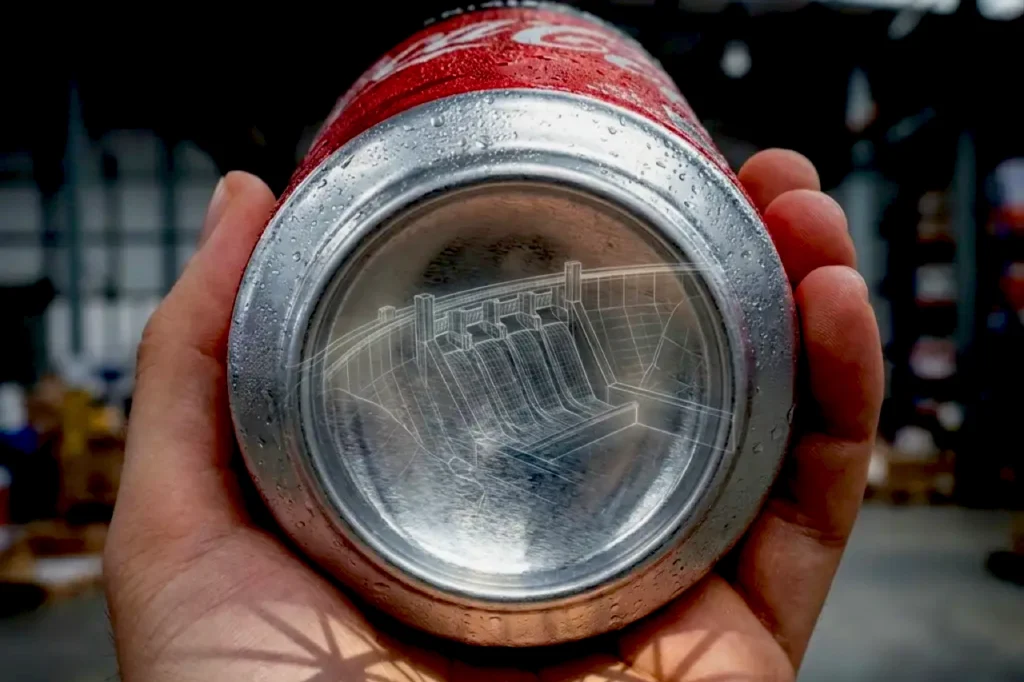

You’ve held thousands of soda cans in your life. But have you ever wondered about that curved, bevelled bottom and why it isn’t just flat? Bizarre But True! It’s not there to look pretty. It’s stopping your drink from literally exploding in your hand…
The concave dome at the base of every aluminium can’s an architectural marvel disguised as disposable packaging. Engineers borrowed the same principle used in dam construction and rotated it around its centre creating an inverted arch that transforms vertical pressure loads into horizontal forces.
The Pressure Problem Nobody Talks About
Bizarre But True! Modern soda cans are thinner than human hair – roughly 0.1mm thick. Yet they contain carbonated liquid pressurised to 90 pounds per square inch.
That’s six times normal atmospheric pressure.
Without the dome geometry, a flat bottom would bulge outward under that force and rupture. The curvature distributes stress evenly across the entire base, eliminating weak points where failure begins.
An empty can crushes in your hand. A sealed can resists the same force. The carbonation itself creates rigidity in walls that would otherwise collapse.
Temperature Makes Everything Worse
Leave a can in a hot car and the physics get brutal…
A refrigerated can at 4°C contains roughly 120 kPa of internal pressure. The same can at 34°C reaches approximately 380 kPa—more than triple the pressure!
Rising temperature simultaneously increases internal force whilst decreasing the can’s structural resistance. At 90°C, can ends lose 5% of their buckle strength compared to room temperature performance.
The dome geometry compensates for this compound vulnerability. It’s engineered to withstand minimum pressures of 620 kPa providing safety margins that prevent catastrophic failure during transport and storage.
The Shape Engineers Actually Wanted
A sphere would use the least material for maximum volume.
Pressure would stress walls uniformly. No weak points would exist. But spheres roll off tables, occupy only 74% of transport volume when packed, and can’t be manufactured at speed.
The cylinder emerged as the compromise geometry. It occupies 90% of box volume when packed, withstands substantial pressurisation through its circular cross-section, and permits high-speed fabrication.
The dome bottom solves the cylinder’s one structural flaw – the flat end that can’t handle internal pressure without deforming.
Manufacturing Speed Approaches Impossibility
That dome formation happens in one-seventh of a second!
A flat aluminium disc transforms into a pressure-resistant concave base faster than your eye can register the change. A single machine produces approximately 100 million cans in six months through this process.
The entire sequence – cupping, drawing, ironing, doming, necking, occurs at speeds where human perception can’t distinguish individual stages. Engineers reduced can weight from 60g in early stainless steel versions to 15-21g in modern aluminium, all whilst maintaining equivalent pressure resistance. Material cost represents the largest portion of final container cost, so every gram removed increases profit margins.
So next time you crack open a cold one, you’re holding the world’s most abundant pressure vessel – engineered to tolerate forces that would rupture flat-bottomed containers, manufactured at speeds that defy visual perception, and designed with tolerances measured in fractions of a millimetre. All so you can enjoy a fizzy drink without thinking about the physics trying to tear the can apart from the inside…