
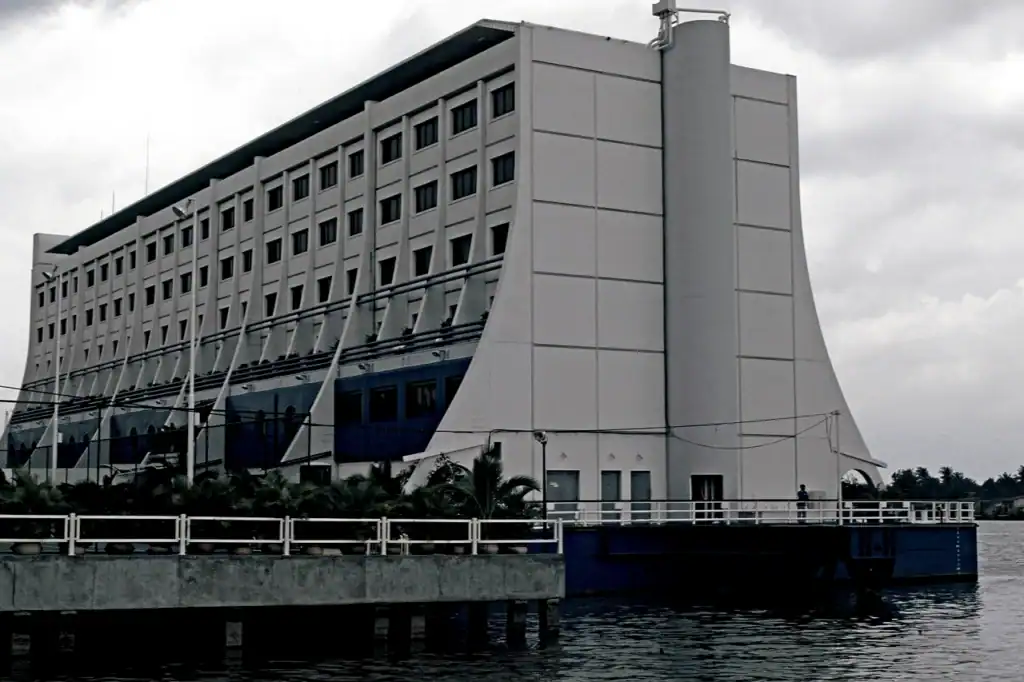

A seven-storey floating hotel opened on the Great Barrier Reef on 9 March 1988. It opened six months behind schedule…
The Four Seasons Barrier Reef Resort could accommodate 356 guests across 176 rooms. Built at Bethlehem Shipyard in Singapore at a cost of $45 million, it was transported by heavy-lift ship.
The journey to John Brewer Reef, 70 kilometres northeast of Townsville, took 18 days. When it arrived, there was one problem. The opening in the reef was only 60 metres wide.
Workers cropped the coral to squeeze the massive structure through. Seven huge anchors then fixed it to the ocean floor, positioned to minimise further reef damage.
The Luxury Promise That Lasted One Year
The resort promised underwater viewing chambers accessed by a submersible called The Yellow Submarine, a nightclub, two restaurants, a research lab, a library, a shop selling diving gear, tennis courts and a helipad. Guests would helicopter out from Townsville for $350 per round trip or take a two-hour catamaran ride. Once there, they’d experience the reef without ever touching land.
It failed spectacularly.
One week before opening, Cyclone Charlie struck, damaging the swimming pool and underwater observatory. Four months later, workers discovered over 100,000 pieces of World War II ammunition and mines just five kilometres from the hotel. Then an unrelated floating platform in the same reef sank during a storm.
Weather proved disruptive. When conditions turned rough, helicopters couldn’t fly and catamarans couldn’t sail, trapping guests onboard. Staff hung an empty whisky bottle from the ceiling in their quarters swaying to gauge how sick everyone would soon feel.
In July 1988, Barrier Reef Holdings announced a $7.89 million loss. By September, the hotel was for sale. It closed in April 1989 without ever reaching full occupancy.
Vietnam Became The Second Stop
The floating hotel was sold to Japanese company EIE International and refitted in Singapore. In August 1989, it was towed to Ho Chi Minh City 3,400 miles northward. Moored on the Saigon River along Ton Duc Thang Street, it became the city’s first five-star hotel.
Vietnam was experiencing a post-war tourism boom. Ho Chi Minh City was flooded with foreign visitors, quickly overwhelming the small number of aged hotels. The floating structure arrived as a pre-packaged, ready-to-use luxury facility.
Locals called it “The Floater.”
The hotel’s two bars the Downunder Disco and Q Bar became two of the hottest nightspots in Ho Chi Minh City. Despite charging $300 per night, occupancy rates held between 80 and 100 percent for the first four years. It was a commercial success.
But competition increased. Through the 1990s, more hotels opened and were renovated in Ho Chi Minh City. By 1996, the floating hotel faced major financial problems. It closed on 31 August 1996 and was towed out into the Pacific Ocean.
That’s when North Korea entered the picture…
North Korea Wanted A Tourist Attraction
EIE International sold the floating hotel to South Korean company Hyundai Asan for around $18 million. It was towed back to Singapore for repairs and renovations, then made another 2,800-mile journey to Mount Kumgang in North Korea.
It was renamed Hotel Haegumgang and opened in October 2000.
North and South Korea were experiencing a thaw in bilateral relations. Hyundai Asan invested in large-scale tourism projects in the North. Purchasing a floating hotel was cheaper and easier than initiating a brand new construction project.
Mount Kumgang, near the South Korean border, became a joint tourism venture. The floating hotel would accommodate South Korean tourists visiting the scenic mountain region. Hyundai Asan managed the hotel and operated other facilities in the area.
It worked… For a while.
Over 2 million tourists visited Mount Kumgang between 2000 and 2008. The floating hotel operated as part of this programme. It also served as a reunion centre for families separated by the Korean War.
Then on 11 July 2008, a 53-year-old South Korean woman named Park Wang-ja was shot twice and killed by a North Korean soldier. She had wandered beyond the resort boundaries, crossing over a sand dune into a military area.
Tourism Collapsed Overnight
Hyundai Asan suspended all operations. South Korea suspended all tours to Mount Kumgang.
The floating hotel sat empty. Hyundai Asan hoped tourism would eventually resume. It never did.
The structure remained docked at Mount Kumgang for over a decade. Paint gradually wore off the exterior. In 2019, North Korean leader Kim Jong Un visited Mount Kumgang and criticised the facilities as “shabby” and lacking “national character.”
He ordered them demolished.
Intelligence reports from South Korea confirmed that Hotel Haegumgang was destroyed by the North Korean government in March 2022. A luxury resort built for the Great Barrier Reef that became Vietnam’s first five-star hotel ended up demolished in North Korea.
The world’s first floating hotel travelled over 14,000 kilometres across three decades, serving three countries, before being scrapped as politically inconvenient architecture…
(Photo Credit: Wiki Commons / Hans-Peter Grumpe)