
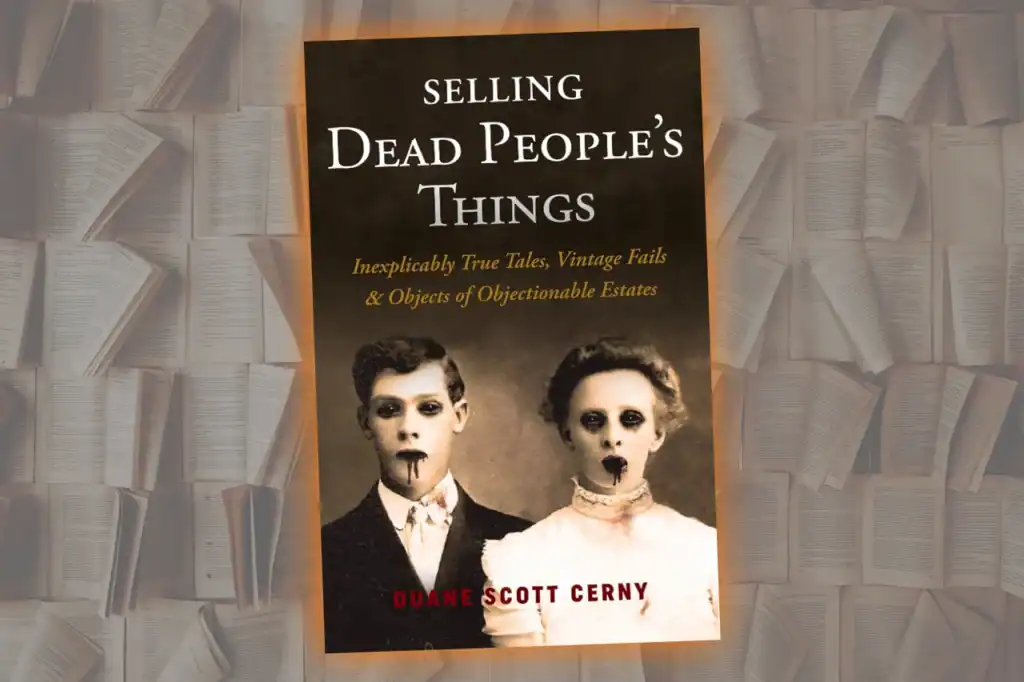

It turns out rummaging through dead people’s closets makes for surprisingly good reading. ‘Selling Dead People’s Things‘ by Duane Scott Cerny isn’t some dry trade manual for antique hunters; it’s a mischievous, unexpectedly touching journey into the forgotten corners of other people’s lives and the bizarre, oddly beautiful objects they leave behind…
Cerny has spent decades scouring attics, basements and storage units for anything that might catch the eye of the next curious buyer. What he’s found ranges from the heartbreakingly ordinary to the deliciously strange: haunted hospital desks, two-headed taxidermy curiosities, ventriloquist dummies with unsettling grins and occasionally, a piece of jet wreckage someone decided to keep as a personal souvenir. Each chapter is a sharply drawn vignette, alive with eccentric characters: Goth couples bargaining over cult relics, sisters who believe they share blood with Mussolini and the unseen armies of hoarders whose lifelong collections are finally up for grabs.
The stories work because Cerny isn’t just cataloguing oddities; he’s telling us about people, both living and long gone, with equal measures of humour and empathy. His voice is wry without slipping into mockery, gently philosophical without ever feeling self-important. He knows exactly how absurd it sounds to be selling crucifixes at a shiva and yet, in the telling, it becomes strangely human.
It helps that Cerny writes like someone who’s had to develop a quick wit to survive the chaos of estate sales, where you might go from negotiating over a cracked teapot to hauling away boxes of unspeakable junk in the space of an hour. The book’s style mirrors that unpredictability: a conversational, anecdotal mix of first-person confession and storyteller’s distance. One moment, you’re laughing at the sheer weirdness of what people keep; the next, you’re reminded that behind every tarnished trinket was a life, a set of memories, a final goodbye.
Part of the charm is the uneasy intimacy of the whole trade. The very objects we call “dead people’s things” once sat on kitchen tables, kept secrets in bedside drawers, or gathered dust in forgotten corners. In Cerny’s hands, they become accidental autobiographies, each telling a story the owner can no longer share themselves.
And then there’s the unspoken question running through every page: what will someone think of your possessions one day? Will they laugh, recoil, or quietly wonder who you were? It’s a thought that’s as unsettling as it is strangely comforting.
By the end, Selling Dead People’s Things isn’t really about antiques at all. It’s funny, a little bit macabre, often unexpectedly moving and always aware that clutter isn’t just clutter, it’s proof that we were here, for however briefly. For anyone who’s ever slowed down at a yard sale, peered into a dusty shop window, or wondered about the strangers whose lives now sit on a folding table marked “Everything Must Go,” this book is both an invitation and a gentle warning: be careful what you collect – because one day, your story might be told by the person selling it…
Selling Dead People’s Things is a wry behind-the-curtain peek into the world of antiques and their obsessive owners—while still alive and after their passing. An amusing observer of the human condition, author Duane Scott Cerny entertains in illuminating, scary, sad, or frightfully funny resale tales and essays. Whether processing the estate of a hoarding beekeeper, disassembling the retro remains of an infamous haunted hospital, or conducting an impromptu appraisal during a shiva gone disturbingly wrong, every day is a twisted treasure hunt for this 21st-century antiques dealer.
While digging deep into the basements, attics, and souls of the most interesting collectors imaginable, traveling from one odd house call to the curious next, resale predicaments will confound your every turn. Be careful where you step, watch what you touch, and gird your heart—Antiques Roadshow, this ain’t!