

Japan hosts somewhere between 100,000 and 300,000 festivals every year. That’s the cultural equivalent of running a permanent carnival across an entire nation…
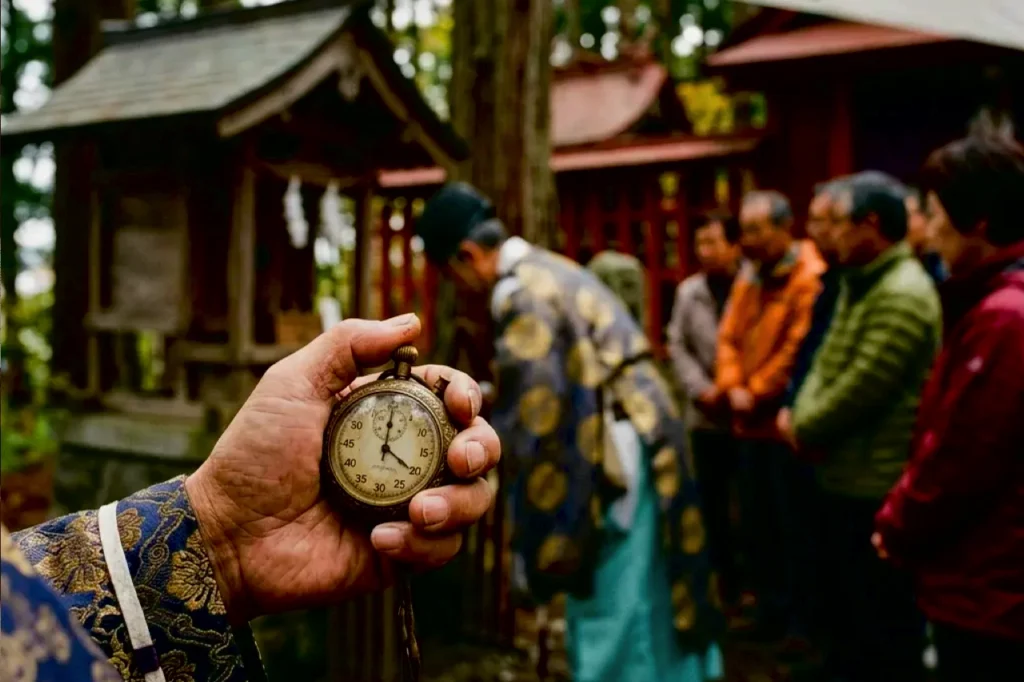
Most of these festivals stretch for hours. Some span days. A few drag on for weeks. Then there’s the Enrei Onodachi Memorial Festival, which wraps up in 20 seconds..!
The Festival That Refuses To Waste Time
The Enrei Onodachi Memorial Festival happens twice a year in Nagano Prefecture. It commemorates imperial visits to the region. That’s it. No processions. No elaborate performances. No drawn-out rituals.
The entire ceremony takes 20 seconds.
In October 2023, organisers briefly shortened it to 15 seconds before returning to the standard 20-second format in 2024. Even by Japanese efficiency standards, that’s extreme.
Spectators turn up knowing they’ll witness something that’s over almost as soon as it begins. The appeal isn’t the spectacle. It’s the strangeness of the event itself.
When Festivals Become Infrastructure
Japan’s festival economy generated 530 billion yen as of 2019. Nearly every shrine celebrates its own ‘matsuri’. Festivals aren’t occasional events. They’re cultural infrastructure. But that infrastructure is ageing out.
The 1,000-year-old Sominsai “Naked Men” festival held its final celebration in February 2024. Despite drawing 9,000 attendees and hundreds of loincloth-clad participants, organisers at Kokusekiji Temple in Iwate couldn’t sustain the behind-the-scenes work. The festival required days of preparation and at least one sleepless night. The people capable of managing that workload no longer exist in sufficient numbers.
The Enrei Onodachi Memorial Festival sidesteps that problem entirely.
You can’t exhaust organisers with a 20-second ceremony. You can’t lose institutional knowledge when the entire event fits inside a single breath. The constraint isn’t a limitation – It’s a survival mechanism!
The Festivals That Defy Efficiency
Not every Japanese festival embraces brevity though. The Saidai-ji Eyō Hadaka Matsuri sees 9,000 near-naked men compete for two sacred wooden sticks in complete darkness. After hours of preparation, temple lights are extinguished at 10pm. Participants engage in a 30-minute melee, wrestling to secure the shingi sticks believed to bring a year of prosperity.
The 200-year-old Akutai Matsuri actively encourages Japanese people to shout insults at priests disguised as Tengu demons. Hundreds trek for 40 minutes to Mount Atago in Ibaraki to swear at religious figures. Popular curses include “bakayaro” (idiot) and “konoyaro” (bastard). The tradition originated when stressed garment workers found catharsis through cursing.
The Nakizumo “Baby Crying Festival” has been making infants weep for 400 years. Two sumo wrestlers face off holding babies aged 6-18 months, employing tactics like pulling faces and shouting “naki” (cry) to make them burst into tears first. The first baby to cry wins. Crying supposedly scares away evil spirits and indicates the child will grow up strong.
These festivals survive because they’re too strange to replicate. The Enrei Onodachi Memorial Festival survives because it’s too short to fail!
What a 20-Second Festival Actually Proves
The Enrei Onodachi Memorial Festival doesn’t prove that brevity is superior. It proves that constraints sharpen focus.
When you’ve got 20 seconds, you can’t pad the ceremony with filler. You can’t stretch tradition for the sake of spectacle. You strip everything down to the essential act: commemoration.
Japan’s shortest festival isn’t a gimmick. It’s a case study in what survives when everything else gets cut away…