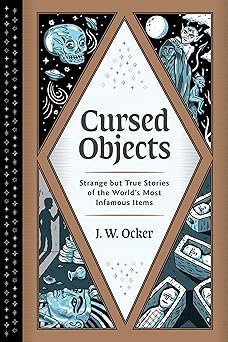



If you’ve ever side‑eyed a cracked porcelain doll on a shelf and thought, “Well, that thing’s probably cursed,” J.W. Ocker’s ‘Cursed Objects: Strange but True Stories of the World’s Most Infamous Items‘ is here to confirm all your worst suspicions – though perhaps with a wink rather than a gasp…
Rather than drenching the reader in gothic melodrama, Ocker opts for an almost conversational irreverence, inviting us on a brisk tour of humanity’s fondness for blaming tragedy on things that can’t talk back. The Hope Diamond? Doomed everyone who dared wear it. Annabelle the doll? Allegedly a conduit of demonic malice (now safely locked away by paranormal celebrity couple Ed and Lorraine Warren). The Dybbuk Box? Said to ruin the lives of its owners, though not so much that anyone could resist buying it on eBay.
And these are just the headliners. Ocker’s real joy seems to lie in the forgotten, faintly ridiculous footnotes of the cursed object hall of fame: the Basano Vase, supposedly a death sentence to any bride who touches it; the Crying Boy painting, blamed for a spate of house fires in 1980s Britain; and even James Dean’s Porsche, which carried its fatal reputation with almost cinematic flair.
What sets Cursed Objects apart from your standard campfire collection is Ocker’s tone – a wry, gently skeptical voice that never quite tips over into smugness. He’s happy to indulge the chill of a well‑told ghost story, but equally happy to point out how the curse usually arrives second, after a few tragic coincidences and a public hungry for drama. In his telling, curses become less supernatural punishments and more reflections of our need to wrap chaos in a neat narrative bow.
The book itself is structured like a cabinet of curiosities, each chapter a short, self‑contained tale designed for dipping into over coffee or a dark, windy night. It’s handsomely produced, with vintage‑style illustrations that lend just the right air of turn‑of‑the‑century séance chic.
Does it go deep? Not especially. Some may find the tone a little too breezy, or the research skimming the surface rather than diving into scholarly depths. But to criticise Cursed Objects for being more amusement than academia feels rather like complaining that a ghost train doesn’t explain the mechanics of ectoplasm. It’s there to entertain, unsettle just enough and move on before the chill wears off.
And it succeeds. You’ll finish it with a raised eyebrow, an armful of cocktail‑party trivia and maybe a small, irrational suspicion about that heirloom vase on your grandmother’s mantel. After all, as Ocker shows with a sly grin, sometimes the only thing more dangerous than the curse itself is our eagerness to believe in it…
Beware...this book is cursed! These strange but true stories of the world's most infamous items will appeal to true believers as well as history buffs, horror fans, and anyone who loves a good spine-tingling tale.
They're lurking in museums, graveyards, and private homes. Their often tragic and always bizarre stories have inspired countless horror movies, reality TV shows, novels, and campfire tales. They're cursed objects, and all they need to unleash a wave of misfortune is...you!