

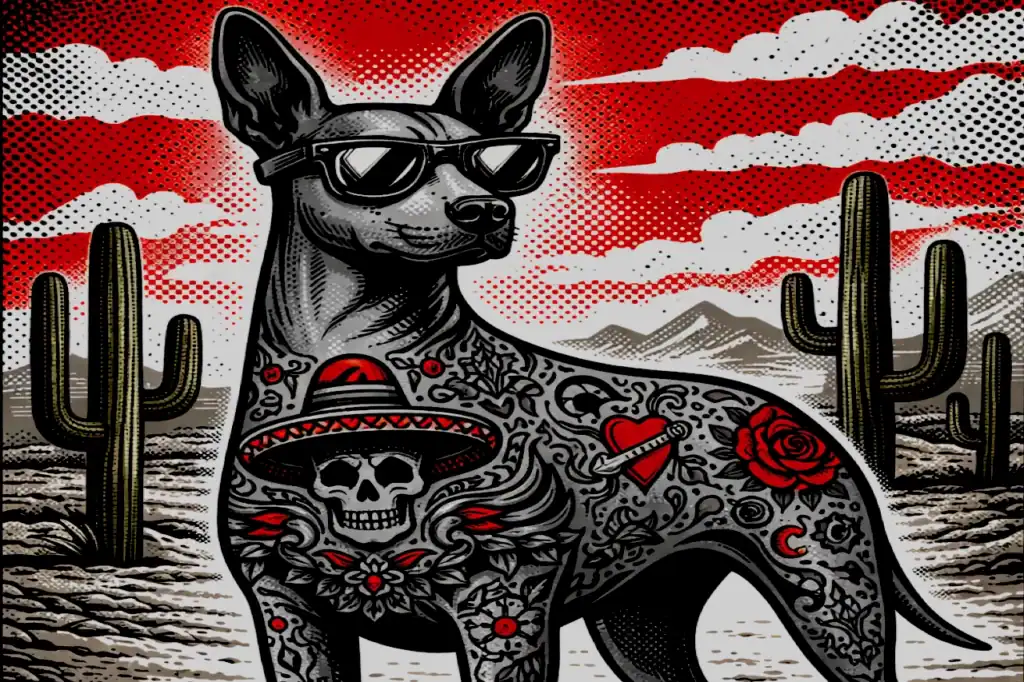

Bizarre But True! A Xoloitzcuintli appeared at Pet Fair Asia in Shanghai with a full back tattoo. The crowd went silent. Then the backlash exploded…
The owner lifted the dog by its neck scruff to demonstrate it “feels nothing.” He insisted the Mexican Hairless breed has less sensitivity to pain. Veterinary science says otherwise. There’s no basis for that claim.
The tattoo artist later stated the procedure happened in June 2024 at a pet hospital with a veterinarian present. He claimed liquid anaesthetic was administered. But the owner’s demonstration at the show told a different story. Event organisers barred him from returning.
The Legal Patchwork That Protects Almost Nothing
Only two US states explicitly ban cosmetic tattooing and piercing of pets.
New York and Pennsylvania passed laws after a Pennsylvania groomer sold “goth kittens” online. Kittens pierced down their spines, ears and necks.
New York Governor Andrew Cuomo signed legislation in 2014 stating: “This is animal abuse, pure and simple.” Penalties include up to 15 days in jail and a £250 fine.
But here’s where it gets bizarre…
PETA advocates tattooing dogs for identification through the National Dog Registry. The line between protection and cruelty depends entirely on aesthetic intent. Medical identification under anaesthesia by professionals? Acceptable. Cosmetic tattoos for visual appeal? Abuse. Hmmm.
Manhattan legislator Linda Rosenthal explained it simply: “While people can choose the pain of tattoos or piercings to satisfy their own aesthetic predilections, companion animals don’t have that luxury.”
The Ancient Guardian Turned Modern Canvas
But the Xoloitzcuintli breed carries weight beyond its hairless appearance.
The name derives from Xolotl, the Aztec god of death and “itzquintli” meaning dog. Aztec creation stories state humans and xoloitzcuintlis were formed from the same Bone of Life.
According to Aztec belief, humans travelled through eight levels of the underworld on a four-year journey. They required the xoloitzcuintli to ferry them across the unswimmable Apanohuacalhuia River. Statues identical to the hairless variety date back over 3,000 years, found in Mayan, Colima and Aztec tombs.
The breed even nearly vanished…
Spanish conquistadors consumed them so enthusiastically they almost drove the breed to extinction. Christopher Columbus wrote in his diary about these “strange hairless dogs.”
By the 1950s, the breed faced complete extinction until the “Xolo Expedition of 1954” discovered just 10 surviving dogs in remote Mexican locations. Those 10 dogs formed the foundation for revival. Now one appears at a pet show with a full back tattoo. Not a good look.
The Consent Paradox Nobody Wants to Discuss
The tattoo artist stated he “did not view the act as cruelty at the time” but apologised if the dog or anyone online was harmed. Another tattoo artist noted “it was hard to imagine any dog tolerating the repeated pain of tattoo needles.”
The owner claimed his dog has less pain sensitivity and reportedly treats his dog “like his own child.” He thought the dog would look cooler with a tattoo. And those are the exact psychological justifications humans use…
The Trend That Won’t Stop
This isn’t isolated. In Detroit in 2007, at least seven pet shops sold tattooed Parrot Cichlid fish for Valentine’s Day. They were tattooed with pink lips and ‘I (heart) U’ text using injection or laser. Purely for aesthetics.
Piercing and tattooing pets occurs frequently enough that it gained attention from PETA and animal rights organisations. The “punk/goth pet” trend remains popular in Russia, particularly on hairless animals. Social media amplifies the pressure. Unique pets generate attention. Attention generates engagement. Engagement generates revenue. The feedback loop intensifies.
The Shanghai incident forced a confrontation with uncomfortable questions. What constitutes acceptable treatment of animals? Where does pet ownership end and exploitation begin? How much pain is permissible for aesthetic preference?
Event organisers made their decision by banning the owner. Two US states made their decision through legislation. The rest of the world watches as the trend continues, unregulated and unchecked…