

Bizarre But True! Between 17 and 21 million Americans suffer from ‘paraskevidekatriaphobia’. That’s the fear of Friday the 13th. The condition is so widespread that businesses lose an estimated $800-900 million on this date as people avoid flying, driving, or conducting normal activities…
The fear is irrational. Ironically, Dutch insurance data from 2006-2008 showed Friday the 13th is actually safer than other Fridays – 7,500 traffic accidents versus 7,800 on regular Fridays. Fewer people drive and those who do are more careful.
So where does this terror come from..?
The Superstition Has No Ancient Origins
Friday the 13th wasn’t considered unlucky until shockingly recently.
There’s no record of the date being viewed as particularly dangerous before the 19th century. An 1834 article in French literary magazine Revue de Paris references a Sicilian count who killed his daughter on Friday the 13th, stating “It is always Fridays and the number 13 that bring bad luck.”
That’s it. That’s the earliest documented reference.
The superstition didn’t exist in medieval times. It wasn’t whispered about in ancient Rome. It’s a Victorian invention that somehow became the most feared date in modern history.
The Number 13 Carried Different Meanings
Ancient Egyptians saw 13 as transformative. They believed in 12 stages of life, with the 13th representing a joyous ascension to eternal afterlife. The deceased soul passed through twelve gates before arriving at the thirteenth realm of Osiris, where the heart was weighed against a feather of truth.
Death, yes. But glorious eternal life.
In ancient cultures, 13 represented femininity because it corresponded to the number of lunar cycles in a year (13 × 28 = 364 days). As the solar calendar triumphed over the lunar, the number thirteen became anathema. Patriarchal systems eliminated the feminine calendar marker.
Norse mythology offers another origin point. Twelve gods dined at Valhalla when Loki arrived uninvited as the 13th guest. He arranged for Höðr, the blind god of darkness, to shoot Balder the Beautiful with a mistletoe-tipped arrow. Balder died, triggering suffering across the world.
Thirteen guests. One death. Eternal consequences.
Friday Carried Its Own Baggage
Friday was considered unlucky in Christian tradition because Christ was crucified on a Friday.
The combination of Friday and 13 created a superstition multiplier effect. Two separately unlucky elements merged into something culturally powerful enough to affect business operations and travel patterns over a century later.
The statistical reality contradicts the fear. The 13th day of the month is mathematically more likely to be a Friday than any other day of the week. Any month starting on a Sunday contains a Friday the 13th, and there’s at least one in every calendar year.
You can’t escape it…
The Rebellion Against Superstition
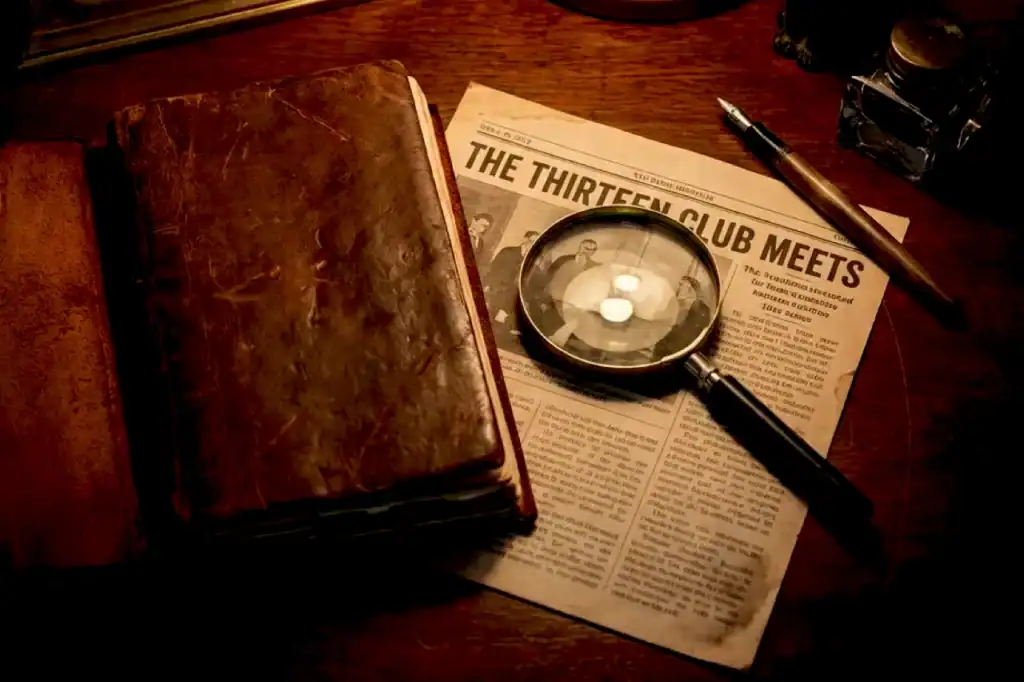
In the late 19th century, Civil War veteran Captain William Fowler founded the Thirteen Club.
This exclusive society of 13 members gathered for 13-course meals on the 13th of each month in room 13. The inaugural meeting was held at 8:13 pm on Friday, January 13, 1882.
Before dining, members passed under a ladder with a banner reading “Morituri te Salutamus”—Latin for “Those of us who are about to die salute you.” None of them died. The club attracted prominent members including five US presidents. They were deliberately confronting irrational fear with theatrical defiance, proving that superstition held no actual power over outcomes.
Jason Voorhees Wasn’t The Original Killer
The Friday the 13th franchise created its own mythology separate from the superstition.
Jason Voorhees wasn’t meant to be the main antagonist. In the original 1980 film, his mother Pamela was the killer, taking revenge on neglectful camp counsellors who let her son drown.
Jason was born on June 13, 1946. He suffered from hydrocephalus and mental disabilities causing major facial and physical deformities. He drowned at Camp Crystal Lake in 1957 when two counsellors were too busy fooling around to notice he was struggling.
The iconic hockey mask didn’t appear until the third film in 1982—midway through Friday the 13th Part III. Jason takes the mask off one of his victims and puts it on. It’s remarkable that the franchise’s most recognisable symbol appeared this late.
The Superstition Varies Globally
Friday the 13th isn’t universally feared.
In Hispanic countries, Tuesday the 13th (martes trece) is considered unlucky instead. Greeks also consider Tuesday, especially the 13th, unlucky because it’s dominated by Ares, god of war. The fall of Constantinople occurred on Tuesday 13 April 1204, and its fall to the Ottomans on Tuesday 29 May 1453.
In Italian popular culture, Friday the 17th carries the bad luck designation.
Finland took a different approach entirely. A consortium of governmental and nongovernmental organisations promotes National Accident Day (kansallinen tapaturmapäivä) to raise awareness about automotive safety. It always falls on a Friday the 13th.
They turned the superstition into a public safety campaign.
Real-World Friday the 13th Incidents
Some documented cases feed the superstition though…
According to legend, in 1976, a paraskevidekatriaphobic New York City resident vowed to spend Friday the 13th in bed to avoid misfortune. He died when the floor of his apartment complex unexpectedly collapsed.
In 2010, a thirteen-year-old boy from Suffolk, England, was struck by lightning on Friday the 13th at 1:13 in the afternoon, at the 13th minute of the day’s 13th hour.
These incidents are statistically inevitable. With millions of people experiencing Friday the 13th multiple times per year across decades, extraordinary coincidences will occur. They become memorable precisely because they confirm existing fear patterns.
The Phobia Has a Cure…
Therapist Donald Dossey coined the term paraskevidekatriaphobia.
It combines Greek words for “Friday” (Paraskevi), “thirteen” (triskaideka), and “fear” (phobos). The alternative term friggatriskaidekaphobia comes from Old Norse Frigg, the goddess of wisdom after whom Friday is named.
Dossey claimed anyone who can pronounce the word would be instantly cured of their irrational fear!
The cure is linguistic confrontation. If you can master the terminology of your fear, you’ve already demonstrated the cognitive control required to overcome it.
Friday the 13th remains the most feared date in history despite having no ancient origins, no statistical danger increase and no logical basis.
The fear is real. The danger isn’t either…