
The espresso martini wasn’t born in a test kitchen or invented by a celebrity mixologist chasing Instagram fame. It supposedly started with a young model walking into a bar in London circa 1983 and making a very specific request to bartender Dick Bradsell: something to “wake me up and f**k me up.”
The woman was widely rumoured to be a top model. Some say Marie Helvin. Others claim Naomi Campbell or Kate Moss, but the timeline doesn’t work – they were too young.
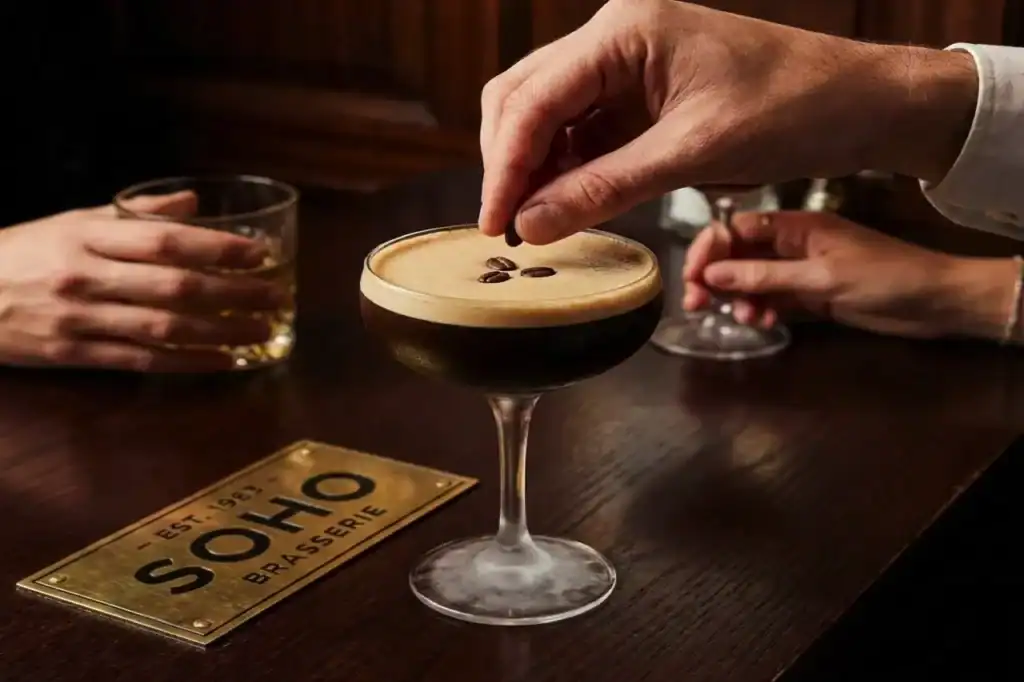
What matters is the drink Bradsell created that night became a global phenomenon. And somewhere along the way, it picked up three coffee beans floating on top. Not two. Not four. Always three. Here’s why…
The Beans Weren’t Part Of The Original Recipe
Bradsell didn’t initially include the three-bean garnish when he invented the drink at the Soho Brasserie.
The cocktail went through multiple name changes – first the “Vodka Espresso,” then the “Pharmaceutical Stimulant,” before finally landing on “Espresso Martini.” It wasn’t until the 1990s that Bradsell borrowed from Italian drinking traditions and added three coffee beans as a garnish representing “health, wealth and happiness.”
But the real origin of those three beans goes back to a prank from Italian cinema’s golden age…
The “Con La Mosca” Prank From La Dolce Vita
During the filming of Federico Fellini’s La Dolce Vita, film stars drinking Sambuca at a café on Via Veneto started dropping coffee beans into each other’s drinks.
They’d shout “C’è una mosca!”—which means “There’s a fly!”
The prank caught on with socialites and paparazzi. The three beans became known as “con la mosca”—literally “with the fly” in Italian. What started as a joke then became a tradition.
And that tradition carried a very specific rule: always three beans.
Even Numbers Are a Curse
In Italian folk belief, even numbers are associated with bad luck, mourning and incompleteness. Odd numbers are viewed as auspicious. Three is regarded as “il numero perfetto”—the perfect number.
Serving a guest a drink with two or four beans is considered a social slight. An eight-bean espresso martini? That’s a curse, not a cocktail. Suitable only for funerals.
The Beans Do More Than Look Pretty
But the three beans aren’t just symbolic decoration either. They’re a sensory engineering mechanism that transforms the drinking experience before the first sip.
The roasted coffee scent hits right as you lift the glass. Without them, the initial scent is dominated by vodka.
The beans also act as a test for the mixologist. If they sink, the foam wasn’t thick enough. If they’re placed carelessly, the bartender doesn’t know the tradition.
The Drink Bartenders Love To Hate
The espresso martini saw 50% growth in just the last year alone. Online searches for “espresso martini” grew by 89% amongst Gen Z in 2024, reaching 1.3 million per month by January 2025.
It climbed five spots in popularity rankings in the past year and now sits amongst the top six most-ordered drinks in the U.S.
But there’s a problem…
Around the world, people celebrate the espresso martini as their drink of choice, except for the bartenders who make it. The surge in popularity has caused widespread criticism from bartenders because of the effort it takes to make each drink. The cocktail customers love most is the one bartenders increasingly dread.
So the next time you order an espresso martini and see three coffee beans floating on top, you’re not just getting a garnish. You’re getting a piece of verified bizarreness that started with a rude request, evolved through a cinema prank and became a global standard through the power of Italian superstition.
Our signature cocktail, now in a ready-to-drink can.
We've been serving espresso martinis in our cafés for over a decade. Now, we've crafted one that you can enjoy on the go or at home, using premium ingredients for a smooth, rich flavour.