

During both World Wars, intelligence agencies discovered something bizarre: the most effective cover for gathering military secrets wasn’t a false identity or forged papers. It was knitting…!
Women, often dismissed as harmless, sat in cafés, railway stations and occupied homes, needles clicking away whilst they encoded troop movements, artillery positions and supply routes into fabric. The activity was so mundane that enemy soldiers never thought to search the knitting bag.
This created a massive security blind spot.
A 23-year-old woman parachutes into Nazi-occupied Normandy carrying 2,000 one-time codes wrapped around a knitting needle concealed in a shoelace that ties her hair. German soldiers search her. They never think to examine the hair tie.
She poses as a teenage soap seller, cycles around chatting with Wehrmacht troops, and transmits 135 coded messages before D-Day. Phyllis Latour Doyle helped pave the way for the Allied invasion using yarn and a bicycle.
This is the Bizarre But True! story of what happened when intelligence agencies realised the most dangerous weapon in wartime isn’t always a gun, sometimes it’s two needles and a ball of yarn!

The Binary System Hidden In Plain Sight
Knitting operates on a binary system. Two stitches: knit and purl. One creates a smooth, v-shaped surface. The other produces a bumpy, horizontal texture.
Morse code operates the same way. Dots and dashes. On and off.
Spies didn’t need sophisticated equipment to encode lengthy intelligence reports. They needed needles, yarn and the ability to sit in public without arousing suspicion. A scarf could contain troop movements. A hat could detail artillery positions. A pair of socks could map railway schedules. The brilliance wasn’t the code itself. The brilliance was that nobody searches a grandmother’s knitting bag looking for it!
When Governments Banned What They Simultaneously Weaponised
During WWI, the UK banned knitting patterns due to fears they contained hidden messages.
Simultaneously, they hired spies to use knitting as cover…
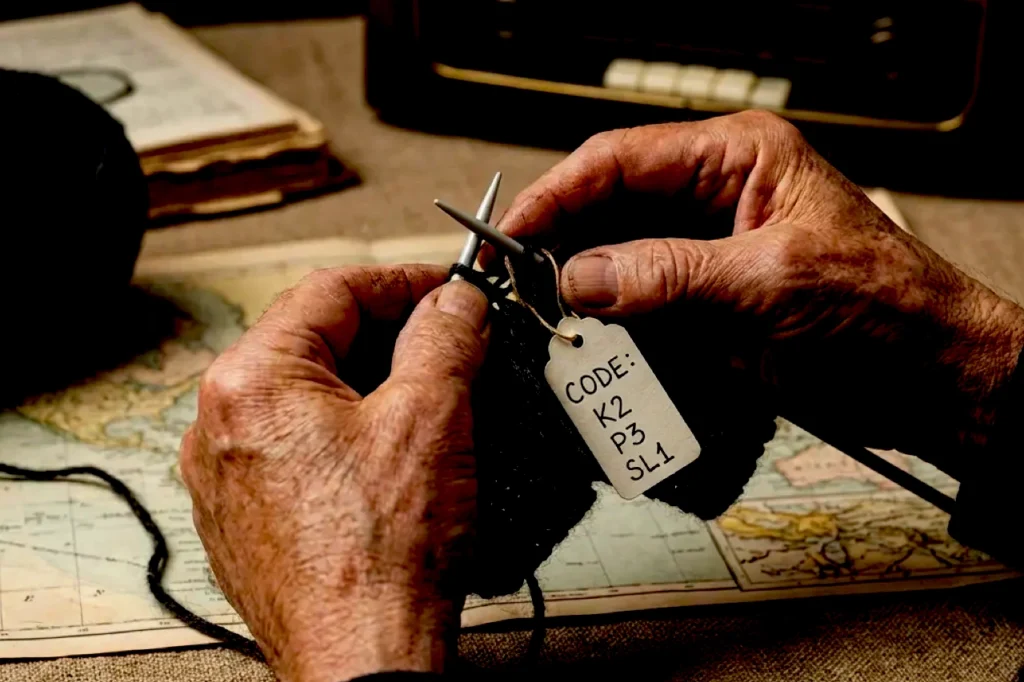
By WWII, both the United States and UK banned posting knitting patterns abroad. The repetitive abbreviations – K2, P3, slip 1 – could easily disguise military secrets too easily. The same governments that prohibited pattern-sharing were training operatives to encode intelligence into fabric themselves.
The cognitive dissonance was intentional. If your enemy thinks knitting is dangerous enough to ban, they’re less likely to suspect the women actually doing it as working for you.
The Woman Who Tapped Morse Code With Her Feet
Madame Levengle sat at her upstairs window in Lille, France, knitting and watching trains pass below.
A German marshal stayed in her home.
Whilst she knitted, she tapped Morse code messages with her feet to her children doing “homework” in the room below. The children copied down the encrypted messages. Resistance operatives collected them. The intelligence reached Allied headquarters. The marshal never noticed.
In Belgium, another grandmother monitored trains for the resistance from her window. When an artillery train passed, she knitted a bumpy purl stitch. When troop carriages rolled by, she dropped a stitch, creating an intentional hole in the fabric. She handed the coded textile to fellow resistance members, risking execution with every handoff.
The Belgian resistance network La Dame Blanche supplied an estimated 70% of all tactical intelligence reaching Allied army headquarters from behind enemy lines by 1918. Women comprised potentially 30% of the personnel. Many sat by railway windows knitting codes into fabric.
The Revolutionary War Yarn Ball Drop
But using knitting as a cover during wartime started even earlier…
During the American Revolutionary War, Molly “Old Mom” Rinker eavesdropped on British soldiers quartered in her Philadelphia home. She wrote intelligence on tiny scraps of paper, wrapped them inside balls of yarn, then sat knitting on a cliff. She casually dropped the yarn balls to George Washington’s men waiting in the woods below.
The method worked because it exploited a perceptual blind spot. Soldiers din’t monitor elderly women knitting. They monitored suspicious behaviour.

When Your Knitting Bag Contains Bomber Plans
Elizabeth Bentley, the American spy dubbed “the Red Spy Queen,” smuggled stolen B-29 bomber plans and classified aircraft manufacturing secrets to the Soviet Union. She travelled by train between Washington D.C. and New York with the materials hidden in her knitting bag amongst skeins of yarn, needles, and patterns.
Again, nobody searched the knitting supplies…
The assumption that domestic activities pose no threat created a gap in security protocols wide enough to move strategic military intelligence across state lines. Bentley exploited the gap repeatedly.

The Resistance Knitted Into Socks
Women prisoners at Ravensbrück concentration camp took knitting ‘warfare’ a step further (no pun intended) when they were forced to knit socks for Nazi soldiers. They committed subtle acts of resistance by deliberately shaping narrow heels.
The result? The wearers got blisters…
The defiance wasn’t symbolic. It was tactical. Blistered feet slow down soldiers. Slowed soldiers are less effective combatants. The women weaponised the only tool available to them: their knitting needles.
The Fatal Risk Behind Every Stitch
During WWI, German forces captured 235 Allied spies. Execution was standard procedure. If a spy or the soldier receiving the coded garment were discovered, both faced death. Phyllis Latour Doyle carried cyanide pills in case of capture. The women monitoring trains from Belgian windows knew discovery meant firing squads. Madame Levengle tapped Morse code with a German marshal sleeping in her home.
They did it anyway. The cognitive calculation was simple: the intelligence was worth the risk. Troop movements, artillery positions, railway schedules—this information altered battle outcomes. A scarf could save hundreds of lives. A hat could prevent an ambush.
Why Steganography Works
Steganography – hiding messages in ordinary objects, dates back to 440 BCE in Ancient Greece.
A slave’s head would be shaved, a message tattooed on his scalp, then after his hair grew back he’d be sent to the recipient who would shave his head again to read it. The method persists because it exploits a fundamental weakness in security systems: you can’t search what you don’t suspect. Knitting codes represent a centuries-long tradition of embedding intelligence in plain sight.
The pattern holds across contexts. If the cover activity is sufficiently mundane, the hidden message remains invisible. Spies didn’t need advanced technology. They just needed patience, precision, and the ability to blend into domestic environments… The simplicity was the sophistication…