
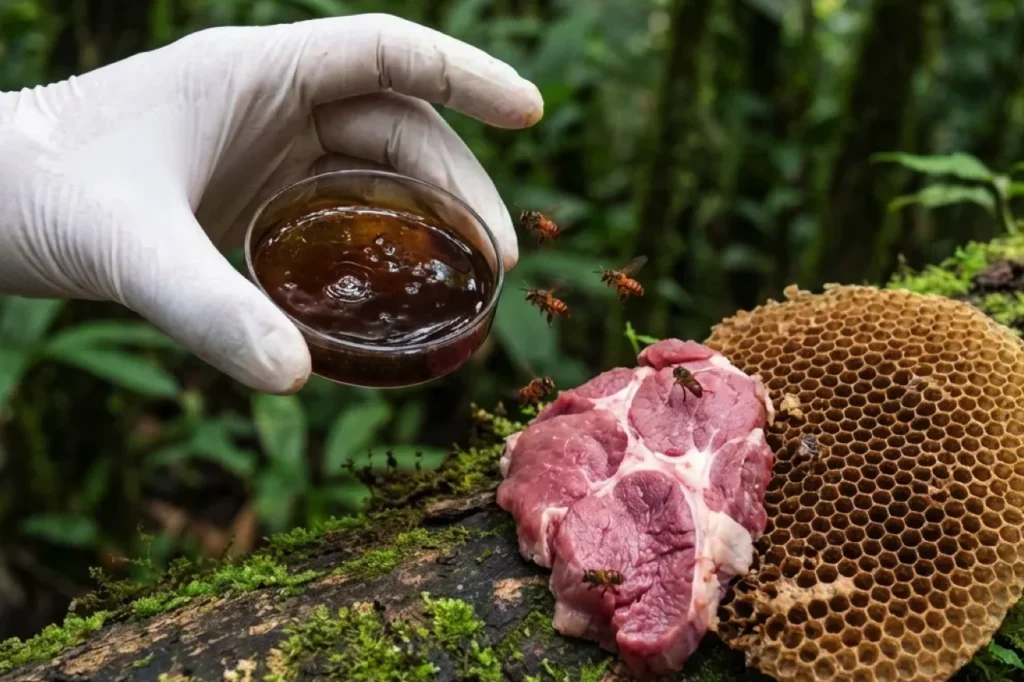

Bizarre But True! There are bees in the rainforests of Costa Rica that don’t visit flowers. Instead, they land on dead animals. They crawl inside through the eye sockets. They use specialised teeth to carve chunks of rotting meat off bones…
And then they fly back to their hive and turn that flesh into something you could technically call honey…
The Discovery That Took 80 Years
Vulture bees were first classified scientifically in 1902. But it wasn’t until 1982 that researchers actually figured out what they were eating.
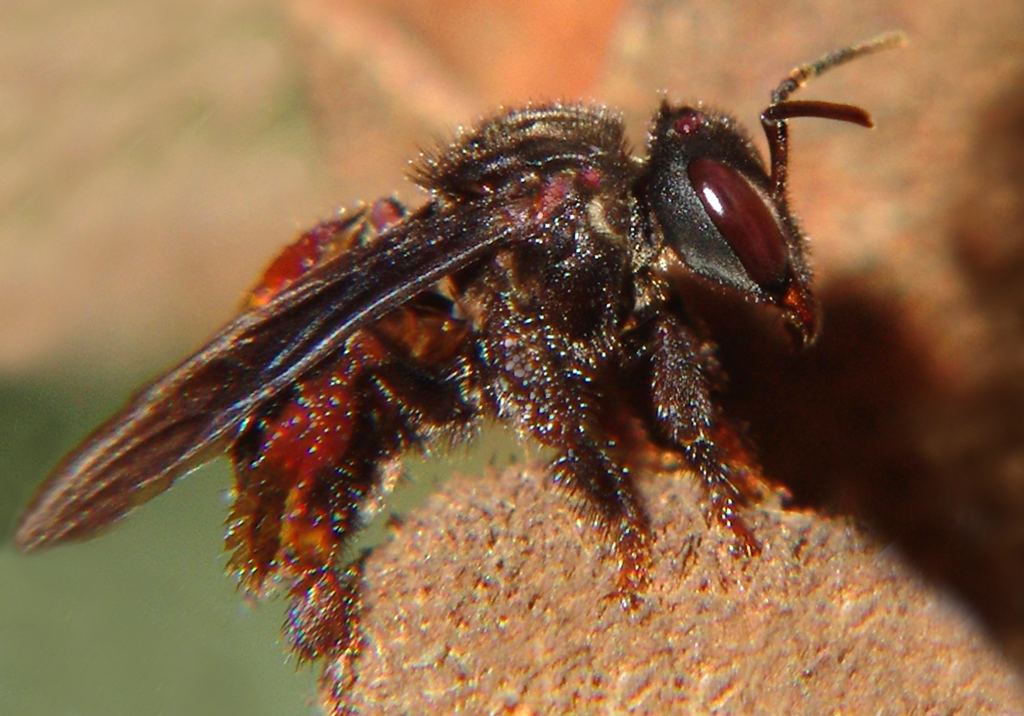
Nearly two centuries of observation. And nobody noticed these bees had abandoned nectar entirely. Only three species are known to exist: Trigona hypogea, Trigona necrophaga and Trigona crassipes. All of them live in the tropical rainforests of Central and South America.
They represent the only bees in the world that use food sources not produced by plants.
Extra Teeth For Extra Work
Evolution gave vulture bees something their flower-visiting cousins don’t have.
An extra tooth on each mandible. Five large, pointed teeth total. Sharp enough to slice through decomposing tissue. Strong enough to tear meat efficiently from carcasses ranging from 8 to 22 millimetres in body length.
Their bodies are reddish-brown. Their behaviour is methodical.
They enter through the eyes first. Then the nose. Then the mouth. They root around inside, removing suitable chunks of flesh. Depending on the size of the animal, they can strip everything down to bare skeleton in a few hours or a couple of days.
Researchers have documented them scavenging over 75 vertebrate species. Birds, reptiles, mammals. If it’s dead and it’s got meat on it, vulture bees will find it.
The Gut That Digests Death…
Rotting flesh is toxic.
Most insects that try to eat it get sick. The bacteria that form on decomposing tissue produce compounds that shut down normal digestive systems.
Vulture bees don’t have that problem.
Their stomachs are packed with acid-loving bacteria that allows them to process meat without poisoning themselves. Lactobacillus – the same bacteria found in sourdough bread and Carnobacterium — associated with flesh digestion.
Most bee species have retained the same five core gut bacteria over roughly 80 million years of evolution. Vulture bees threw that system out and rebuilt it from scratch.
From Carcass To Hive
Once a vulture bee locates a dead animal, it doesn’t keep the discovery to itself.
It deposits a trail of pheromones on plants along its flight path back to the nest. Chemical signals that tell the rest of the colony exactly where to go. Within eight hours, dozens of bees converge on the corpse.
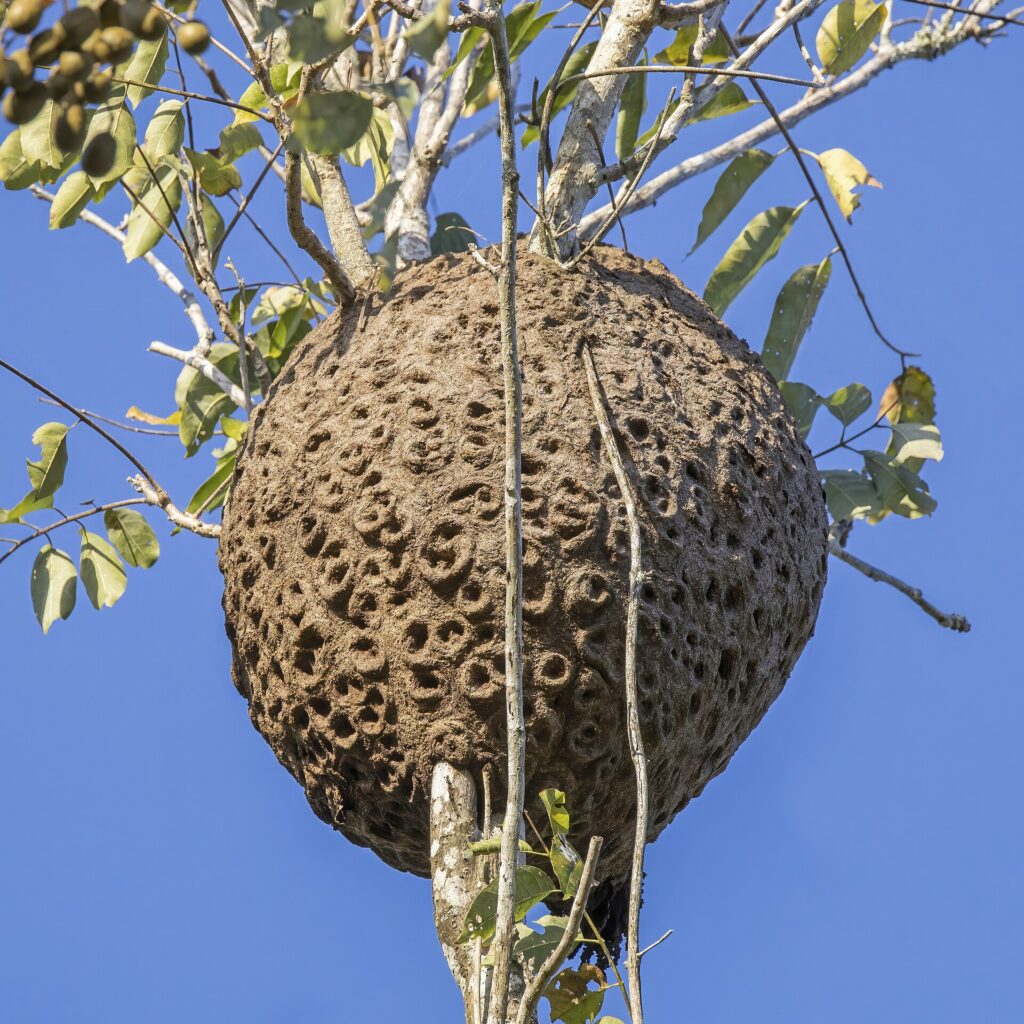
They salivate on the flesh. They consume it whilst storing it in their crop — a specialised pouch separate from their stomach. When they return to the hive, they regurgitate the masticated meat into storage pots.
The pots stay open for about a day. The meat gets mixed with sugary plant products. Then the pots are sealed.
Two weeks later, the substance inside has transformed.
The Honey Question
What vulture bees produce isn’t technically honey in the traditional sense.
But it becomes honey-like. Initially, it’s paste-like. Over time, it becomes viscous. Eventually, it turns into a homogeneous, yellowish fluid that’s sweet enough to eat. People have tasted it. The descriptions vary: smoky, intense, salty, uniquely sweet.
The meat is stored in special chambers, sealed off and kept separate from where traditional honey is stored. After two weeks of fermentation, it’s safe to access.
The bees don’t just eat it themselves. They feed it to their larvae.
Not Just Scavengers
In 2004, researchers made another discovery.
Vulture bees don’t only feed on dead animals. They also prey on living wasp brood. Using well-developed prey location behaviours, they find recently abandoned wasps’ nests. Within hours, they descend and consume all the immature wasps inside.
Why Did This Happen?
The leading theory points to competition.
Tropical rainforests are packed with bees. Thousands of species competing for the same nectar sources. The pressure to find alternative food became extreme. So three species evolved backwards.
Bees originally descended from carnivorous wasps millions of years ago. They shifted to plant-based diets and built an entire. evolutionary identity around flowers.
Vulture bees reversed that trajectory.
They went back to meat. They developed the anatomy to process it. They rebuilt their gut microbiome to tolerate it. They created storage systems to ferment it. All because the competition for nectar was too intense to survive without doing this.
Defence Without Stingers
Vulture bees are also stingless. That doesn’t mean they’re harmless. Many species bite when provoked. A few produce blister-causing secretions in their jaws that make skin erupt in painful sores. They’re still thoroughly unpleasant when threatened.
What This Means…?
Vulture bees prove something important about evolutionary flexibility. When environmental pressures becomes extreme enough, species don’t just adapt incrementally. Some totally rewrite their entire biological operating system.
They abandon the behaviours that defined them for millions of years. They develop new anatomical structures. They recruit entirely different bacterial communities to live inside their bodies. And they do it successfully enough to survive in one of the most competitive ecosystems on Earth.