

Horror doesn’t always need to be scary to be effective. Sometimes the strangest films leave the deepest marks. These aren’t your standard horror films. They’re not even the goriest, not the scariest, but absolutely the weirdest. And most importantly – they’re still good…
Here’s our list of five of the weirdest horror films, that won’t disappoint..!
Hausu (1977): When an 11-Year-Old Writes Your Nightmare
Director Nobuhiko Obayashi had a radical idea for his first feature film. He asked his 11-year-old daughter what scared her.
She told him: getting her fingers caught in piano keys, a pile of futons falling on her and a house that literally eats girls. So he made that film.
Hausu (House) is what happens when childhood fears get a production budget. The plot follows seven schoolgirls visiting a haunted house where furniture attacks, severed heads bite bottoms and a cat painting watches everything with glowing eyes. It’s psychedelic, it’s incomprehensible, and it’s absolutely mesmerising.
The studio read the script and told Obayashi they were “tired of losing money on comprehensible films” anyway. They had no idea what they were funding, but they funded it.
Obayashi shot without a storyboard for two months, using techniques from his career directing 3,000 television commercials. The film reportedly became the first Japanese production to use video effects – one girl dissolves underwater through low-fidelity chroma key that looks like a fever dream.
Obayashi marketed the unmade film himself – business cards, bumper stickers, a manga, even a radio drama. The radio adaptation’s success finally convinced the studio to let him direct it.
The film also carries weight beneath the chaos. Obayashi was born in Hiroshima and lost all his childhood friends to the atomic bombings. The aunt’s ghost devours girls “who were unaffected by the bombings” – making it a horror film about generational war trauma disguised as psychedelic pop art.
Tetsuo: The Iron Man (1989): £1,200 & 18 Months Of Madness
Shinya Tsukamoto made Tetsuo: The Iron Man with a budget of ¥200,000. That’s roughly £1,200.
He shot the entire film in lead actress Kei Fujiwara’s apartment over 18 months. The crew wore down so badly that most quit before filming wrapped. By the end, only star Tomorowo Taguchi remained alongside Tsukamoto.
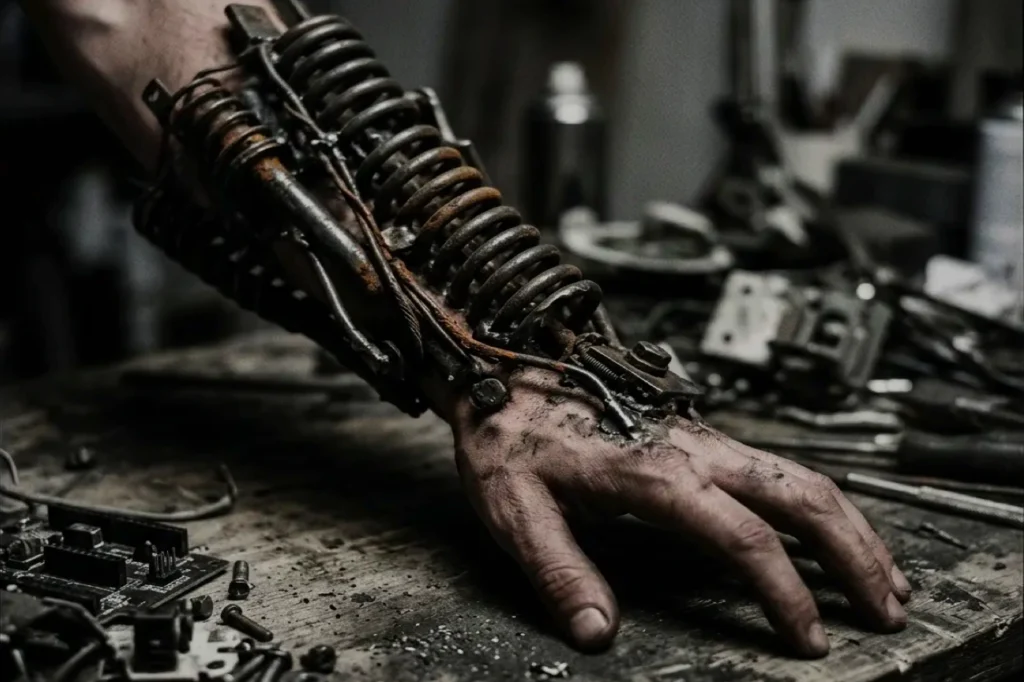
The film is 67 minutes of body horror cyberpunk – a man slowly transforms into a metal monstrosity after a hit-and-run accident. Metal bursts through his skin. His body fuses with scrap. He becomes more machine than human, and the transformation is nauseating.
Tsukamoto literally cobbled together television parts to create the Iron Man costume – metal tubes, coils and wires piled thicker and thicker until very little organic body remained. The costume was so intricate that getting into it every day became an ordeal.
When it screened at the 1989 Fantafestival in Rome (which it won), the film had no subtitles. Tsukamoto couldn’t afford them. Japanese film critic Ken Okubo said: “It was a great surprise, not just for me but for everybody in Tokyo.”
The film has been described as “possibly the closest cinema has ever come to capturing a migraine on film.” You don’t watch it. You survive it.
Begotten (1990): Eight Months To Destroy Every Frame
E. Elias Merhige spent 8-10 hours re-photographing each minute of Begotten. The total post-production period for the 72-minute film was eight months.
He built his own optical printer over eight months because hiring one would have cost a fortune. Then he used it to degrade every single frame until the film looked like a cinematic Dead Sea Scroll buried in sand.
The result is stark, black-and-white nightmare fuel. No dialogue. No conventional narrative. Just surreal, disturbing imagery that presents a vision of creation and destruction through avant-garde techniques.
At its 1989 Montreal World Film Festival premiere, The Gazette described the majority of the audience as “too stunned by what they’d seen to react.” Marilyn Manson was such an admirer that he had the film played on loop during the entire recording of his album ‘Antichrist Superstar’. He hired Merhige to direct music videos and had album designer P.R. Brown view the film whilst developing the cover art.
Nicolas Cage later advocated hiring Merhige to direct ‘Shadow of the Vampire’ based on his positive impression of Begotten. The film is experimental horror at its most uncompromising. You either commit to the experience or you walk out. There’s no middle ground.
Rubber (2010): A Tyre With Psychic Powers And A Point To Prove
Quentin Dupieux made a film about a sentient tyre that develops psychokinetic powers and goes on a killing spree. That’s the entire premise of Rubber…
The film opens with a sheriff emerging from a car boot after the vehicle navigates through an obstacle course of chairs. He delivers a monologue explaining that the film is “an homage to ‘no reason'” – citing examples of inexplicable moments in cinema history.
The entire premise exists to challenge the idea that films need logical justification. Why does the tyre kill people? No reason. Why are you watching? No reason. Why does any of this exist? No reason.
Making a remote-controlled tyre was particularly difficult. Dupieux noted the inherent “emptiness” of a tyre—”you can’t really hide the mechanisms.” The tyre movements were achieved through practical effects using remote controls, not CGI. Every roll, every turn, every psychic explosion was manually operated.
At the film’s end, Robert the tyre is reincarnated as a tricycle and recruits an army of tyres on his way to Hollywood. During the credits, the opening scene replays from different angles, revealing the sheriff wasn’t speaking to anyone at all.
Dupieux is primarily known as musician Mr. Oizo, who scored a massive hit in the late 1990s with “Flat Beat.” He also composed Rubber’s electro/experimental soundtrack. The film is absurdist, self-aware, and deliberately ridiculous. It knows exactly what it is and commits fully.
Mandy (2018): Psychedelic Revenge Painted in Neon Blood
Panos Cosmatos made a film that looks like a heavy metal album cover came to life and decided to murder everyone.
Mandy is set in 1983 and stars Nicolas Cage as a man who seeks vengeance on a religious cult that murdered his girlfriend. The film is visually stunning – vibrant colour palettes, heavy metal soundtrack, surreal imagery that creates a nightmarish and hallucinatory experience.
Cage’s performance is unhinged in the best possible way. He forges a custom axe. He fights demonic bikers. He screams in his underwear whilst covered in blood. It’s peak Cage and the film knows it.
The cinematography is drenched in neon reds, deep purples, and sickly greens. Every frame looks like it was designed to be a poster. The pacing is deliberate, the violence is extreme and the atmosphere is suffocating. This isn’t a film about revenge. It’s a film about descending into madness and dragging everyone else down with you.
The soundtrack features King Crimson, heavy drone metal and ambient noise that builds tension until it’s almost unbearable. You don’t just watch Mandy. You feel it in your chest. Cosmatos created something that sits between arthouse cinema and grindhouse exploitation. It’s beautiful and brutal in equal measure.
The Verdict..?
You won’t forget a house that eats schoolgirls, a man fusing with scrap metal or a psychic tyre on a murder spree. These are films that burrow into your brain and refuse to leave.
If you want weird and you want quality, these five deliver on both counts. Are you brave enough to watch one…?