
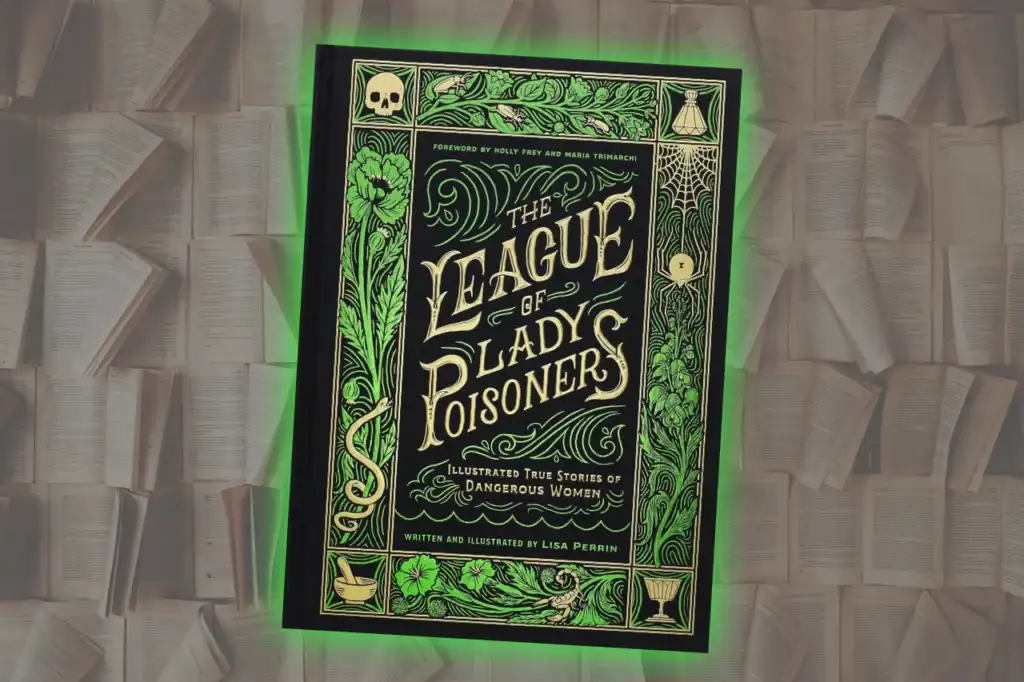

Lisa Perrin’s The League of Lady Poisoners isn’t your typical true crime book…and it knows it. This is an illustrated deep dive into some of history’s most notorious, overlooked and unsettling women who turned to poison not just out of malice, but often because it was the only power they had…
From the moment you open it, the book feels like an object of dark beauty. The design is drenched in Victorian flourishes, arsenic greens and ominous gold, pulling you straight into the sinister glamour of history’s golden age of poison. But Perrin’s work isn’t just about style. She pairs her striking, gothic-inspired art with researched, nuanced storytelling that gives these women depth far beyond tabloid villainy.
The gallery includes over twenty-five figures whose motives stretch from revenge to sheer ambition: Sally Bassett, who resisted the brutality of slavery; Giulia Tofana, whose discreet vials offered abused wives a terrible escape; and Belle Gunness, who crossed the line from survival into calculated murder. There’s a certain cold clarity in how Perrin lays out each case, resisting the urge to romanticise without shying away from the human context behind each deadly choice.
Perrin structures the stories by theme rather than date: power, greed, oppression and rebellion all appear in turn, making it feel less like a grim checklist and more like a study of why women across cultures and centuries reached for poison when every other option failed them. Alongside the stories, there’s an almost scholarly primer on poisons themselves – their science, history and cultural symbolism, which adds weight and keeps the book from tipping into pure gothic spectacle.
What makes the book resonate isn’t shock value; it’s the way Perrin humanises these “lady poisoners” without excusing them. Some victims were undeniably innocent and Perrin doesn’t look away from that. Yet in the same breath, she shows how systemic abuse, legal powerlessness and a society eager to demonise women made poison both an act of rebellion and an unforgivable crime.
It’s this tension – between horror and sympathy, fear and fascination, that makes The League of Lady Poisoners compelling. Perrin doesn’t ask us to admire these women, but she does invite us to understand them. The result is a book that feels both beautiful and unsettling in equal measure…
If you’re looking for blood-and-guts true crime, this isn’t it. But if you want a beautifully illustrated, carefully researched exploration of the shadows where desperation and defiance meet, Perrin delivers something richer: a history lesson told with wit, artistry and a steady moral gaze that refuses to look away from either the horror or the humanity. It’s a dark tonic and oddly, one worth sipping slowly…
Welcome to the League of Lady Poisoners. This riveting and well-researched volume by Lisa Perrin weaves together the stories of more than 25 accused women poisoners, exploring the circumstances and skill sets that led them to lives of crime. You might find yourself rooting for some of them - like Sally Bassett, who helped poison her granddaughter's enslavers in Bermuda, or Giulia Tofana, who sold her name-brand concoction to women wanting to be rid of their abusive (or otherwise undesirable) husbands. Other stories, though - including that of Yiya Murano, one of Argentina's most notorious swindlers and serial killers, or the terrifying Nurse Jane Toppan - may prove less palatable.