
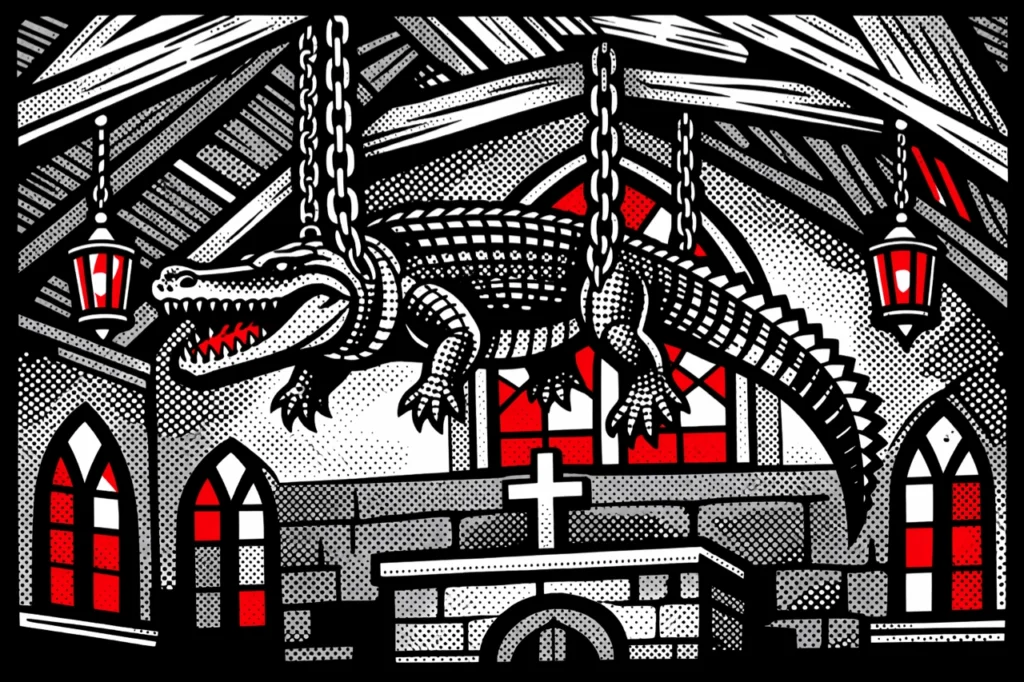

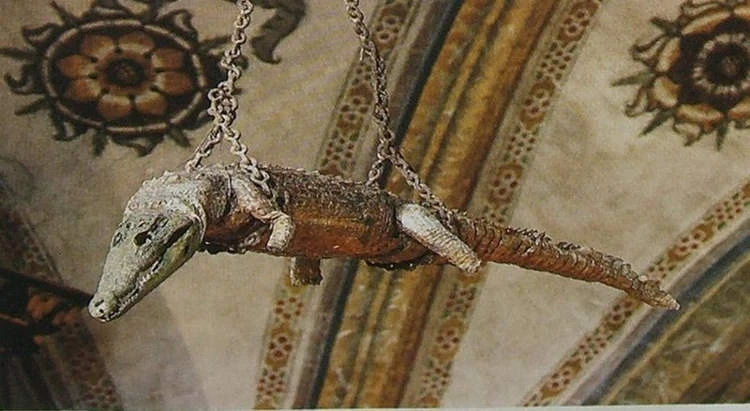
There’s a crocodile hanging from the ceiling of an Italian church. Not a sculpture. Not a painting. An actual stuffed crocodile, its ‘paws’ suspended above the pews in the Santuario Madonna delle Lacrime Immacolate, in Ponte Nossa. It’s been there for at least 500 years and church documents from 1514 discuss its removal, meaning it was already ancient by then…
But this isn’t some modern art installation gone rogue. It’s medieval Europe’s version of interior design and it’s far more bizarre than you’d think…
The World’s Oldest Taxidermy Isn’t In A Museum
The Ponte Nossa crocodile might be the world’s oldest surviving piece of taxidermy. But it’s got competition.
Radiocarbon dating of a similar specimen at Naples’ Castel Nuovo revealed an age of 585 ± 40 14C years BP, dating it to 1296–1419 AD. That makes it even older than the Ponte Nossa specimen.
The Naples crocodile is a Crocodylus niloticus from Lake Nasser, Egypt, preserved using rudimentary techniques – its skin treated with calcium hydroxide and stuffed with grasses including Phalaris, Agrostis and Triticum. Medieval taxidermy was brutal. No precision. No fancy chemicals worth mentioning. Just lime, straw and hope.
The crocodile’s leathery hide made it one of the few animals capable of surviving centuries when the practice hadn’t yet been perfected. Other specimens rotted away. But the crocodiles hung on.
This Wasn’t Random Décor
Medieval bestiaries starting from eighth-century Latin Physiologus manuscripts described crocodiles as symbols of death and hell—”qui inimicus est Domini Salvatoris nostri” (which is the enemy of our Lord and Saviour).
Displaying crocodiles inside Marian churches represented submission of the devil to divine majesty. So the hanging croc in Italy was calculated and symbolic warfare, not ecclesiastical whimsy.
You hung a crocodile in your church to show that evil had been conquered. That hell itself had been stuffed with straw and chained to the rafters.
The crocodile is’t decoration. It’s a trophy.
Seville’s Cathedral Has One Too
Seville Cathedral’s “Lagarto” (lizard) hangs in the Courtyard of the Oranges, dating to the 13th century. Legend says it was sent as a diplomatic gift from the Emir of Egypt to King Alfonso X alongside a marriage proposal for his daughter Berenguela.
The crocodile either died in captivity or was carved from wood and covered with its skin after death. Beyond the romantic legend, the crocodile God Sobekh held power in ancient Egypt as protector against the evil eye.
Its placement over the cathedral entrance likely served as spiritual protection against malevolent forces. Same function, different religion, same reptile.
A Fisherman’s Trophy Now Shares Space with Near-Death Mannequins
The ‘Santuario Della Beata Vergine Maria Delle Grazie’ in Curtatone houses a crocodile rumoured to have escaped from Federico II Gonzaga, Duke of Mantua’s exotic zoo during the 15th or 16th century.
A local fisherman killed and stuffed it. The church agreed to chain it from the ceiling.
The crocodile hangs alongside papier-mâché, wood and woven cotton mannequins depicting tragedies averted by divine intercession – men hung by their hands, condemned to the guillotine, all ex-voto. offerings from grateful believers.
You walk into this church and you’re greeted by a stuffed crocodile surrounded by life-sized recreations of people almost dying. It’s visceral gratitude frozen in three dimensions.
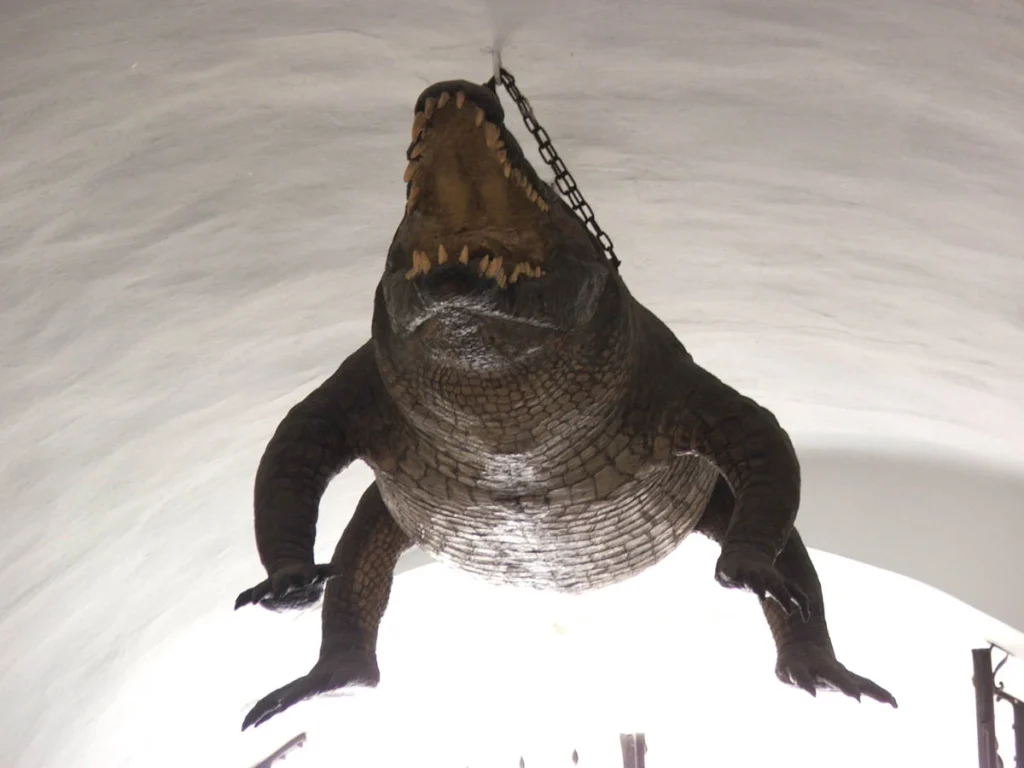
The “Dragon” That Terrified Brno Was Just A Crocodile
For another stuffed lizard, Brno’s Town Hall displays what locals called the “Brno Dragon”, a creature of legend said to have pillaged the town, devouring people and livestock until a clever butcher fed it meat laced with lye.
The preserved “dragon” hanging in the mayoral office is actually a stuffed crocodile, possibly gifted by a visiting dignitary or even a Turkish Sultan. For medieval Europeans who’d never encountered large reptiles, a crocodile was the closest thing to a dragon on Earth. It lacked only wings and fiery breath to complete the resemblance. You can’t blame them. If you’d never seen a crocodile and someone showed you one, you’d call it a dragon too.
This Tradition Spans the Entire Continent
M.R. James referenced a “dusty stuffed crocodile that hangs over the font” in Saint-Bertrand-de-Comminges Cathedral, France, in his ghost story “Canon Alberic’s Scrap-Book.” The crocodile genuinely exists there.
Another 5-metre mummified specimen hangs in Verona’s Church of Santa Maria della Pace, allegedly a 1608 gift from Marquise Bianca Bevilacqua Lazise, inherited from a crusader ancestor.
The tradition was so widespread that Napoleon’s campaign to Egypt and Syria yielded a stuffed crocodile now displayed in a famous Strasbourg restaurant. Church crocodiles appear from France to Italy to the Czech Republic. This wasn’t a local quirk. This was a continental phenomenon.
Nubians Still Use Crocodiles As Protection
And the medieval tradition persists. Nubians in southern Egypt display mummified crocodiles in their doorways to convey household strength and grant protection against the evil eye.
The practice demonstrates how functional beliefs about crocodiles as spiritual guardians transcended religion and geography, connecting ancient Egypt’s crocodile God Sobekh through medieval Christian symbolism to contemporary North African protective customs.
The Final Snap…
Where much of medieval Europe didn’t have natural history museums. They did have churches – in abundance. If you wanted to display something rare, something powerful, something that proved you’d conquered distance and danger and brought back proof—you hung it in the most important building in town.
And because crocodile skin is nearly indestructible, these specimens outlasted everything else. The tapestries rotted. The wooden sculptures cracked. The paintings faded. The crocodiles hung on.
So if you’re ever in Lombardy, Seville, Verona, or Brno, look up. You might find a 500-year-old crocodile staring back at you! Protecting the faithful. Terrifying the tourists and refusing to rot…