

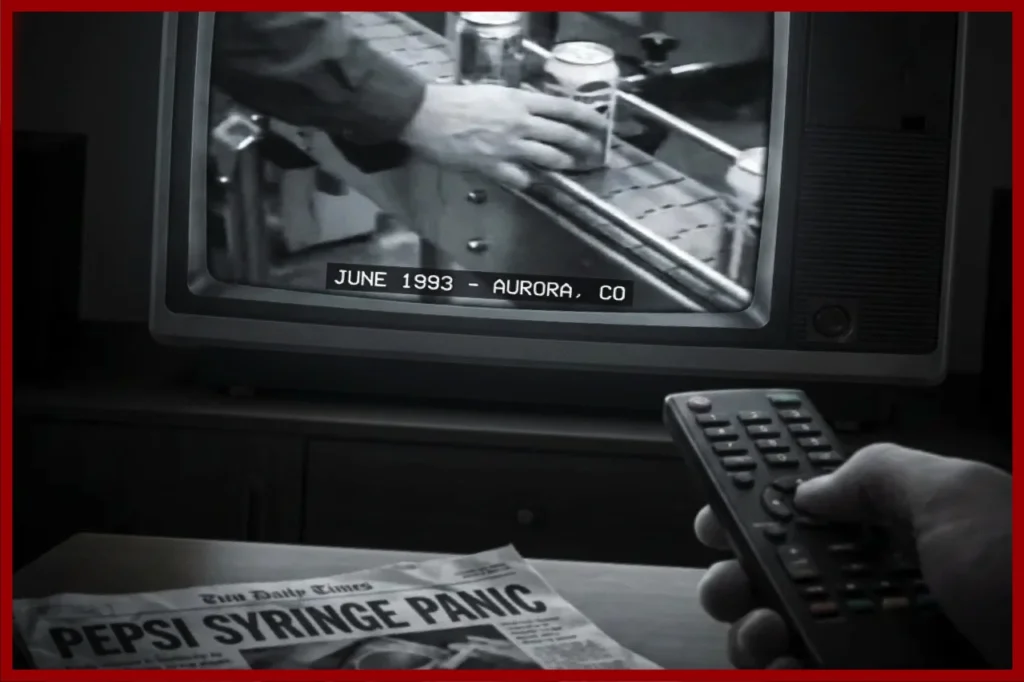

An 83-year-old man in Tacoma found a syringe in his Diet Pepsi can on 9 June 1993. What happened next wasn’t a call to Pepsi. It wasn’t a call to health authorities. The couple rang their lawyer first…
The lawyer immediately contacted the press and local health officials. Pepsi learnt about the contamination from news reports—not from the people who supposedly discovered it.
Bizarre But True! That single decision triggered the fastest-spreading product tampering panic in American history…
The Contagion Formula
Within 72 hours, Pepsi and the FDA were drowning in reports from over 20 states. An FBI consultant psychiatrist named Park Dietz had studied this phenomenon. He’d documented a pattern: each nationally publicised tampering incident generates 30 more claims.
The formula worked perfectly. By week’s end, more than 50 people across 23 states claimed they’d found contamination in their sodas. The total eventually hit roughly 300 reports nationwide.
And People weren’t just supposedly finding syringes anymore either…
They reported wood screws, bullets, crack vials, broken sewing needles and mysterious brown substances. One woman in Portland claimed two syringes in a single glass. A New York man said he’d accidentally swallowed two pins from a Pepsi bottle.
The inventory of bizarre objects kept expanding. The claims kept accelerating.
The Physics Problem Nobody Mentioned
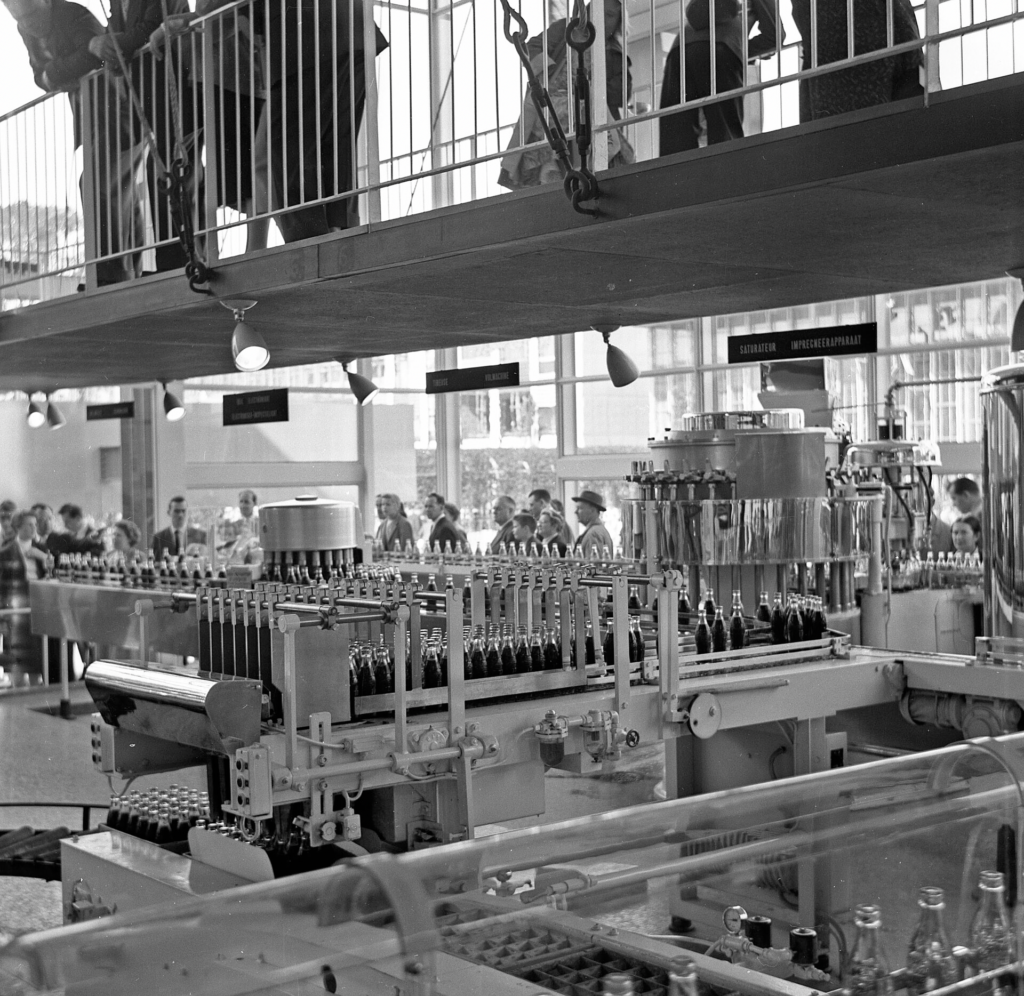
Pepsi operated 150 plants with high-speed canning lines. The process worked like this: cans got inverted, blasted with air or water, flipped upright, then filled. Each can stayed open for 0.9 seconds.
You’d need the reflexes beyond that of a professional athlete to insert a syringe during that window. You’d need to do it on a production line moving at industrial speed. You’d need to avoid detection by multiple quality control systems.
The physical impossibility became Pepsi’s strongest defence. But physics doesn’t stop panic when needles are involved.
Why Needles Worked As Weapons
The timing mattered more than anyone realised. This happened 11 years after the unsolved Chicago Tylenol murders, where seven people died from poisoned capsules. That case remained open. The killer was never caught.
But 1993 carried a different weight. AIDS anxiety sat at peak levels. An (at the time) incurable and highly fatal illness spread, amongst other things, through needles. The country had underlying dread about contamination, about invisible threats, about things you couldn’t see coming.
Reports of syringes lurking in millions of kitchen cupboards fed directly into that fear.
The hoaxers had accidentally discovered the perfect psychological lever. They weren’t just exploiting product tampering anxiety, they were tapping into existential terror.
The Surveillance Tape That Changed Everything
A supermarket camera in Aurora, Colorado captured something interesting.
A woman shopper appeared to insert a syringe into a Diet Pepsi can when the shop clerk looked away. The footage wasn’t ambiguous. It showed exactly what happened. Pepsi copied the tape and distributed it to television stations nationwide. 187 million viewers across 403 stations saw the evidence.
The woman was Gail Levine, 61 years old. She had a long criminal record for forgery, fraud and larceny. She’d also used 16 different aliases over the years. That single piece of footage broke the panic’s momentum in its tracks.
Visual proof of a large-scale hoax works faster than any press release.
The Media Blitz That Saved a Company
Pepsi’s response operated at industrial scale. Five company representatives gave 2,000 interviews over five days. CEO Craig Weatherup appeared on five network talk shows in a single day. One crisis team member gave 80 interviews daily during each of the five peak crisis days.
The company spent $25 million defending itself during the siege.
The FBI made 20 rapid arrests and roughly 55 people were arrested total, with 47 prosecuted. Filing a false tampering report carried penalties of five years in prison and a $250,000 fine.
The entire crisis resolved in 11 days.
Why People Lie About Finding Needles
FBI consultant Park Dietz explained the psychology.
Some hoaxers orchestrated tampering crimes to garner sympathy. They enjoyed the benefits of the victim’s role, emotional support, nurturing, attention. Psychologist N.G. Berrill added another layer: “Many Americans are generally angry at large conglomerates and believe that a corporation can afford to pay a few injury claims.”
Some wanted money. Others wanted fame. A few were just pranksters who hadn’t thought through the federal consequences.
The Story Everyone Remembers Wrong
But here’s the strange part. Most people who were media-aware in 1993 remember news stories about needles found in soft drink cans. Very few remember that the whole thing turned out to be a hoax.
The initial panic received massive coverage. But the resolution got buried on page six. To the majority of people, the story remains “bad guys hid needles in Pepsi cans and I could have got hurt.” Not “scam artists tried to shake down Pepsi by pretending to find tampered cans.”
The truth never catches up to the lie when the lie had a 72-hour head start…
Back To The Original Mystery That Started It All
The Tacoma couple, the ones whose lawyer made that first call, were eventually lumped in with the hoaxers.
They maintained their innocence. The FDA later apologised to them in July. One possible explanation emerged: the couple later discovered the needle could have been placed in the empty can by a diabetic in-law looking to safely dispose of it.
But strangely, the couple denied that person had been inside their home. The origin of the needle that incited nationwide panic remains an enduring mystery. We know what happened after, but we’re still not certain what happened first.
Sometimes the spark that starts the fire (or should that be the needle that spikes the drink?!) is the hardest part to verify…