
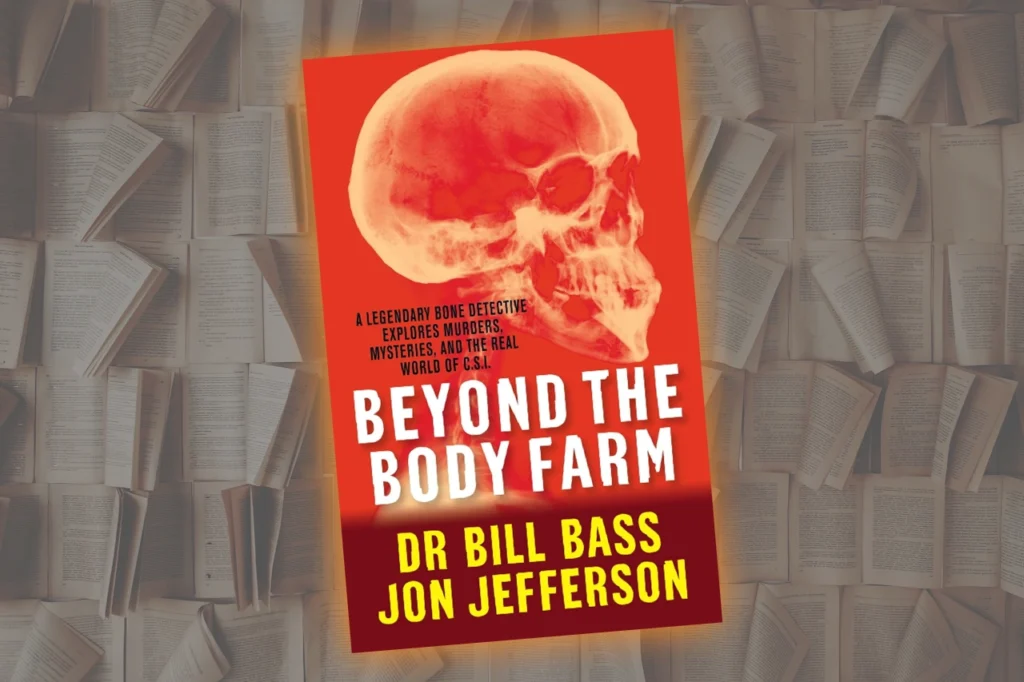
Step into the world of Dr. Bill Bass, the forensic anthropologist who founded Tennessee’s famously grisly “Body Farm” and you’ll find that solving mysteries is rarely as tidy as on TV. ‘Beyond the Body Farm‘ picks up where the first book left off, following Bass deeper into a career spent listening to what bones have to say about the dead… and often, about the living too…
Bass, working with co-author Jon Jefferson, doesn’t just stick to garden-variety murder cases. Instead, he wanders through everything from ancient Persian burials to modern investigations that call for everything from high-tech sonar to old-fashioned spadework. It’s part memoir, part detective story and part love letter to forensic science itself.
There’s a certain dry humour running through Bass’s recollections – as if he’s perfectly aware that talking about decomposing bodies, shattered skulls and unexpected exhumations isn’t everyone’s idea of polite conversation. But he also makes a compelling case that these grim details matter: every fracture, stain, and fragment of bone can help piece together the truth of how someone lived and died.
What makes it more than a parade of morbid curiosities is Bass’s fascination with how far forensic science has come and where it can still go. From a lake search that depends on sonar to a case that leans on scanning electron microscopes, Bass shows how science has turned seemingly impossible puzzles into solvable ones, one technique at a time…
At around 304 pages, it’s the kind of book you might dip into chapter by chapter, each case its own miniature mystery, with just enough grim detail to keep you hooked without tipping into gore for its own sake. And although the subject matter can be dark, there’s a sense of quiet respect running through it all: for the dead, whose bones often reveal hard truths and for the science itself, which Bass treats as both craft and calling.
In the end, ‘Beyond the Body Farm‘ isn’t just about what can be learned from the dead, it’s about why we keep asking those questions in the first place. And that, ironically enough, makes for a book that feels very much alive…
Dr Bill Bass' work, and in particular his Body Farm, has furthered forensic anthropology and made it possible to prove from the discovery of a skeleton, no matter how much time has elapsed since death, how and when death occurred and to whom the body belonged.
His work has been vital for the sake of science and the cause of justice In Beyond the Body Farm Jefferson Bass details the most memorable cases from his career, including alibis he has broken, cold cases he has solved - including one from the Ancient world that took him to Iran - and several cases he has been able to revisit throughout his career as new techniques have become possible and scientific discoveries made.
![[(Beyond the Body Farm: A Legendary Bone Detective Explores Murders, Mysteries, and the Revolution in Forensic Science)] [Author: Dr Bill Bass] published on (December, 2013)](https://m.media-amazon.com/images/I/51NFNdBw+GL._SY342_.jpg)