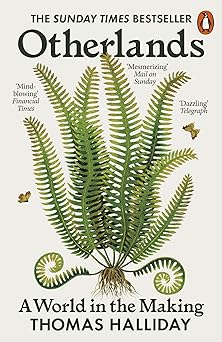

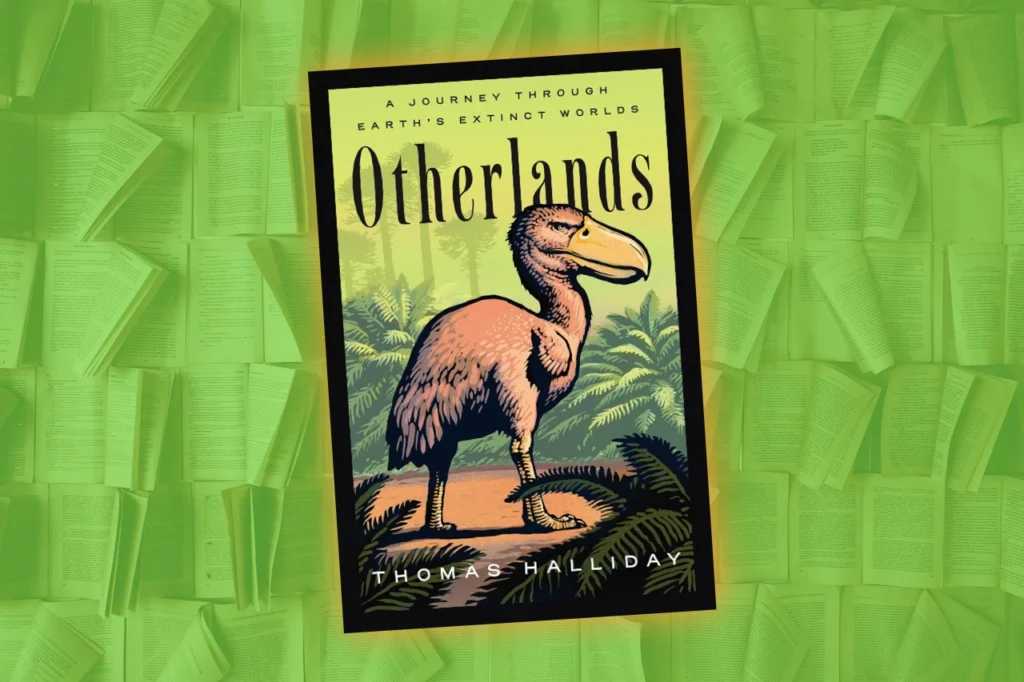

Dive headfirst into a prehistoric time machine with ‘Otherlands‘, a captivating exploration that transforms Earth’s vanished epochs into living, breathing landscapes. Thomas Halliday, a paleobiologist with a filmmaker’s eye for detail, doesn’t just recount ancient life, he revives it, plunging us into environments from 20,000 years ago all the way back to 555 million years BC..!
Each chapter’s a doorway into a vanished world – the Pleistocene plains of Alaska, Miocene woodlands in Italy, or the surreal millennia when slow-moving Ediacaran organisms blanketed the seas. These aren’t dusty chronicles, instead, Halliday invites readers to wander through these realms: feeling the crunch of ancient soil underfoot, the sting of prehistoric insects, the roar of ancient predators and the hush of ecosystems untouched by humans. The effect is immersion, pulling the past so close it feels within touching distance.
Readers can almost sense the heavy warmth of a Cretaceous summer or watch silurian coral reefs ripple beneath early life’s first predators. Scientific names abound – so this book isn’t for those with a fear of long words. Anthropornis, palaeoscolecids etc, but Halliday uses them like colours in a palette, painting a panorama rather than bogging down the narrative.
The structure is elegantly simple yet deeply effective. Sixteen chapters, each focused on a specific period and place, stretch backward in time, offering snapshots of life’s unfolding drama. Halliday’s pacing is masterful: in a few pages he can move from catastrophic mass extinction to the bloom of new species, always guiding the reader with clarity and style.
What keeps Otherlands from feeling like pure dino-nostalgia is its quietly powerful questions. Reflecting on atmospheric shifts and species evolution, Halliday nudges us to consider Earth’s future…and ours. Not preachy, but probing: if our planet has been through mass die-offs before, what does that say about climate change and our place in the next chapter?
Awards nods from the Wainwright Prize shortlist and praise like “extraordinary history of our almost‑alien Earth” and “spine‑tingling reflections on deep time” reinforce what the prose already delivers: Otherlands is as much a work of literary science as it is a record of bones and strata.
Whether you’re a passionate paleontology buff or simply curious about how diverse and alien Earth once was, Otherlands is a breathtaking time-travel companion. It reminds us that each of Earths layers holds a world and that those worlds, as vanished as they may seem, shaped the one we call home today…
This is the past as we've never seen it before. Otherlands is an epic, exhilarating journey into deep time, showing us the Earth as it used to exist, and the worlds that were here before ours.
Award-winning young palaeobiologist Thomas Halliday immerses us in a series of ancient landscapes, from the mammoth steppe in Ice Age Alaska to the lush rainforests of Eocene Antarctica, with its colonies of giant penguins, to Ediacaran Australia, where the moon is far brighter than ours today. We visit the birthplace of humanity; we hear the crashing of the highest waterfall the Earth has ever known; and we watch as life emerges again after the asteroid hits, and the age of the mammal dawns.
Otherlands is a staggering imaginative feat: an emotional narrative that underscores the tenacity of life - yet also the fragility of seemingly permanent ecosystems, including our own. To read it is to see the last 500 million years not as an endless expanse of unfathomable time, but as a series of worlds, simultaneously fabulous and familiar.