
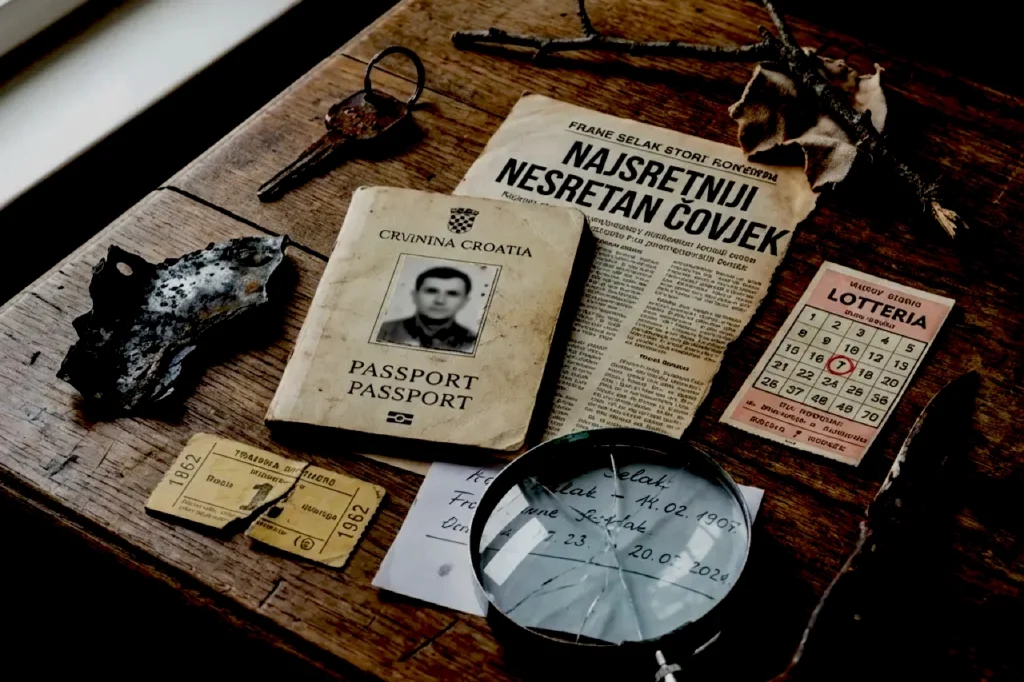
Frane Selak’s life reads like fiction. But here’s the thing: it might actually be fiction. Or at least partly. The Croatian music teacher became famous for surviving seven near-death experiences between 1962 and 1996. Train derailments. Plane ejections. Bus crashes. Car fires. A 300-foot drop into a gorge. But then in 2003, he won the lottery…
The Problem With Perfect Stories
None of Selak’s near-death experiences have ever been independently verified.
There are no records of a plane crash in 1963 around Croatia matching his narrative. His accounts changed across interviews. When The Telegraph spoke to him in 2003, he said he’d played the lottery for years. In 2010, he told them it was his first time ever playing.
The year of his win has likewise shifted across various retellings. This isn’t about debunking. It’s about something more interesting: the gap between what happened and what we can prove happened…
The Seven Claims (With Receipts Missing)
Here’s what Selak said happened between 1962 and 1996…
1962: Train Into River
In January 1962, Selak boarded a train from Sarajevo to Dubrovnik. Whilst riding through a canyon near Jablanica, the train derailed after a mudslide caused rockfall, plunging the train into the Neretva river below.
Selak broke the window with his elbow and swam to shore with an elderly woman he was escorting. Seventeen other passengers drowned. He suffered a broken arm and hypothermia. That part sounds verifiable. Railway accidents leave records.
Except there’s no record of a Sarajevo-Dubrovnik train accident in 1962 killing 17 people in existing railway accident databases.
1963: Ejected From Plane
In 1963, Selak received a call that his mother was hospitalised in Rijeka. He headed to an airfield near Zagreb and boarded a DC-8 on its first flight with seventeen passengers and four crew.
Whilst over Čabar, he heard a loud noise before the exit door opened. The changing air pressure sucked him out. He fell 800 metres, losing consciousness before landing in a haystack.
He spent four days in a coma and woke up with no fractures.
A DC-8 crashing on its first commercial flight would be documented. Aircraft accidents are amongst the most thoroughly investigated incidents on earth. There are no official records documenting a fatal Croatian plane crash in 1963.
1966: Bus Into River
In 1966, Selak was on a bus that skidded into a river, leaving four dead whilst he swam safely to the banks with only minor cuts and bruises.
Third fatal public transport incident in five years. Still no independent verification.
1970 & 1973: Two Car Fires
After three public transport disasters, Selak bought a car.
Bad idea.
In one incident, the engine of his car was doused with hot oil from a malfunctioning fuel pump, causing flames to shoot through the air vents. His hair was completely singed.
In 1970 and 1973, Selak reportedly survived two similar accidents in which his car spontaneously caught fire whilst he was driving it and then exploded just before he was able to flee to safety.
The accounts of these incidents changed across interviews. In a 2010 interview, Selak said the first incident occurred in 1970, with the engine fire happening first and the interior fire second, with no mention of his wife. Earlier tellings included his wife noticing the smell of petrol.
1995: Hit by Bus in Zagreb
After 22 accident-free years, the pattern resumed.
In 1995, he was struck by a bus in Zagreb, but sustained only minor injuries.
This one at least happened in a city with records, witnesses and modern infrastructure. Still, no documentation surfaced.
1996: 300-Foot Drop
The final claim is the most cinematically perfect.
Selak was driving on a mountain road between Gospić and Karlobag when a UN truck appeared around a curve, heading straight for him.
He swerved. Crashed through a guardrail. The car fell 300 feet into a gorge. He wasn’t wearing a seatbelt. That saved him. He was ejected from the vehicle mid-fall and grabbed a tree branch. The car exploded below. He climbed to safety. Ironically perfect. The thing that should have killed him—the lack of a seatbelt—kept him alive.
What We Actually Know
Selak was born two months premature whilst his parents were on a boat in the Adriatic Sea heading for Lokrum. His father cut the umbilical cord with a fishing knife.
That part is documented.
The lottery win is documented too. On 5 June 2002, Selak won between 6 and 7 million kuna (roughly €900,000). He bought a house and a boat. Then in 2010, he sold everything and gave most of it away.
“All I need at my age is my Katarina,” he said about his fifth wife. “Money would not change anything.” He died in 2016 at 87 years old. Natural causes.
The Social Cost of Statistical Anomaly
Whether or not every detail happened exactly as told, Selak’s story had real consequences.
Friends stopped travelling with him. Neighbours cancelled trips if they knew he’d booked the same journey. One neighbour said: “If I heard Frane had booked a flight or a train I have already booked, I would cancel mine.”
Selak himself acknowledged it: “There came a stage when I was lucky to have any friends at all. Many stopped seeing me saying I was bad karma.” That’s the friction between reputation and reality. People treated him like a walking curse whether the incidents happened or not.
The Philosophy He Chose
Selak said in 2003: “You could look at it two ways. I was either the unluckiest man in the world, or the luckiest. I preferred to believe the latter.”
That’s not optimism. That’s a choice about which frame to operate within.
When a Doritos commercial wanted him to fly to Australia, he refused immediately. “I don’t want to test my luck again.” He also disliked how media outlets monetised his story without sending him anything. “They could at least send me $1000,” he said. Even legends get annoyed about copyright.
What This Actually Tells Us
Selak’s story sits at the intersection of verified extremity and verification uncertainty. Some parts are documentable. Some parts aren’t. Some parts changed across tellings.
That doesn’t make it worthless. It makes it human. The lottery win happened. The social isolation happened. The philosophical choice to frame survival as luck rather than curse happened. The rest exists in the gap between memory and storytelling…
And that gap is where most extraordinary lives actually live.