

Bizarre But True! Three hundred million years ago, dragonflies the size of hawks patrolled our prehistoric skies and millipedes as long as cars crawled through ancient forests. The insect world was massive and for decades, scientists thought they knew exactly why. They were wrong…
The textbook explanation has always been simple: atmospheric oxygen levels during the Carboniferous period reached 31-35%, compared to today’s measly 21%. Higher oxygen meant bigger bugs. The maths seemed to work – insects breathe through tiny tubes called tracheae and so more oxygen in the air meant those tubes could supply larger bodies.
But a brand-new study published in March 2026 just ripped that theory apart…
The Evidence That Broke The Rule
Researchers analysed the physics of insect respiration and discovered something uncomfortable: oxygen supply through tracheae doesn’t actually constrain insect gigantism. The limitations aren’t where we thought they were.
But the data gets even more bizarre…
The largest Arthropleura fossil – a millipede-like creature that reached a massive 2.7 metres in length, comes from rocks deposited before the supposed oxygen peak. Oxygen levels back then were only about 23%, barely higher than today’s atmosphere. If oxygen was the key, that fossil shouldn’t exist.
Meet the Giants That Shouldn’t Have Happened
Meganeura monyi had a wingspan of roughly 70 centimetres. Picture a dragonfly the size of a seagull hunting through Carboniferous swamps.
Despite those massive wings, engineering analysis suggests specimens weighed only 100-150 grammes, surprisingly lightweight for something that dominated the skies.
But the real monster was ‘Arthropleura’. At 2.7 metres long and weighing around 50 kilogrammes, it holds the title of largest-known land arthropod of all time. Imagine encountering something the width of a small car skittering across the forest floor. (We’ll pass).
Recent fossil discoveries in France revealed something even stranger: Arthropleura had eyestalks that resembled those of a crab. This peculiar feature has never been seen in modern millipedes or centipedes. Scientists now think it might suggest an amphibious youth before the creature became fully terrestrial.
If Not Oxygen, What Made Them So Massive?
The answer is messier than a single variable.
The absence of aerial predators likely played a huge role. During the Carboniferous period, birds didn’t exist. Flying insects could grow to enormous sizes without the constant threat of being picked off by faster, more manoeuvrable predators.
Once birds evolved about 150 million years ago, insect size dropped dramatically even though oxygen levels were rising. Research analysing over 10,500 fossil insect wings shows that manoeuvrability became more important than size. Large insects were simply too slow to escape their new predators.
Biomechanical limits of having an exoskeleton might be the real constraint though. As insects grow larger, their exoskeletons (outside of their body) need to support more weight. There’s a physical ceiling where the structure simply can’t scale anymore without collapsing under its own mass. Different atmospheric pressures, evolutionary competition and even sexual selection could all have contributed.
The Gentle Giant That Looked Terrifying
Despite its armoured plating and car-sized body, Arthropleura was likely a ‘detritivore’ – it ate decaying plants and dead matter, not other animals. Scientists have dubbed it the “cow of the Carboniferous,” contradicting every horror-movie depiction of it as a predator.
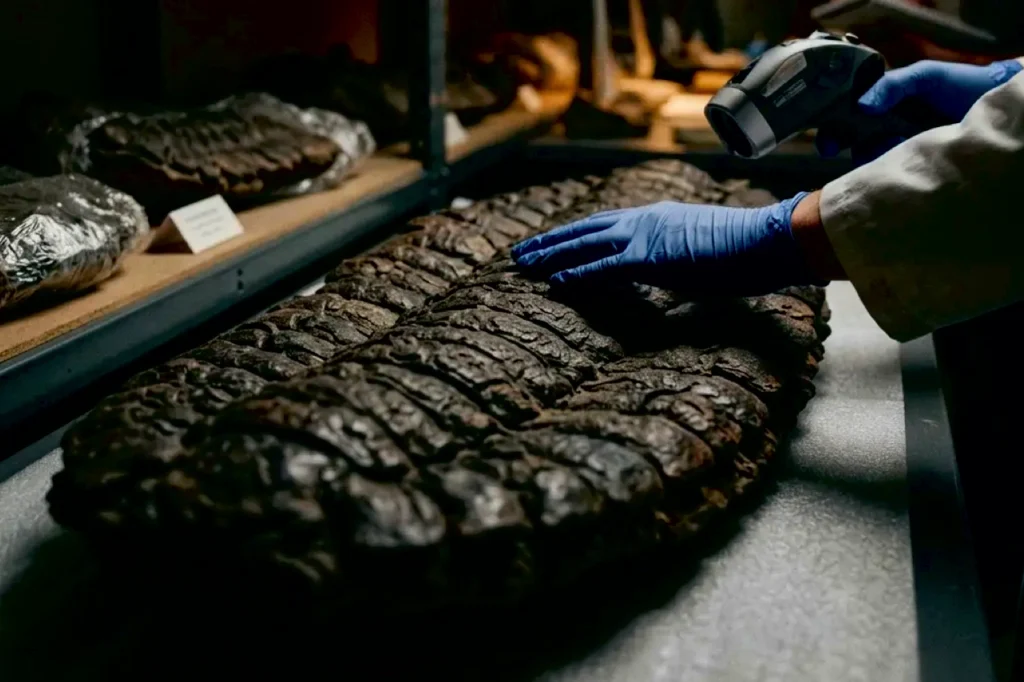
Only three fossil specimens have ever been discovered, all fragmentary. The rarity exists because once they died, their bodies tended to disarticulate. Most fossils are likely moulted exoskeletons the animals shed as they grew, not actual remains!
Another prehistoric critter, Meganeura, on the other hand, was a predator. It had large spines on its legs that functioned as a “flying trap” to capture prey mid-flight. Enlarged compound eyes provided nearly 360° panoramic vision, making it an exceptionally effective aerial hunter.
But here’s the catch: engineering analysis suggests its wings may have beaten at just 3 Hz, three beats per second, compared to the largest modern dragonfly which flaps at 18 Hz. Due to its size and the need to avoid overheating, Meganeura likely spent much of its time perched, flying only in short bursts rather than sustained flight. Some relief for its prey!
What This Means for Everything We Thought We Knew
The oxygen hypothesis wasn’t just a theory about bugs. It was the cornerstone explanation for how atmospheric conditions shaped life on Earth. If it’s wrong, we need to rethink how environmental factors actually constrain evolution.
The shift matters because it forces scientists to look at the interaction between predation, biomechanics and evolutionary pressure – not just atmospheric chemistry. The factors that allowed giant insects to thrive were ecological, not just chemical…