

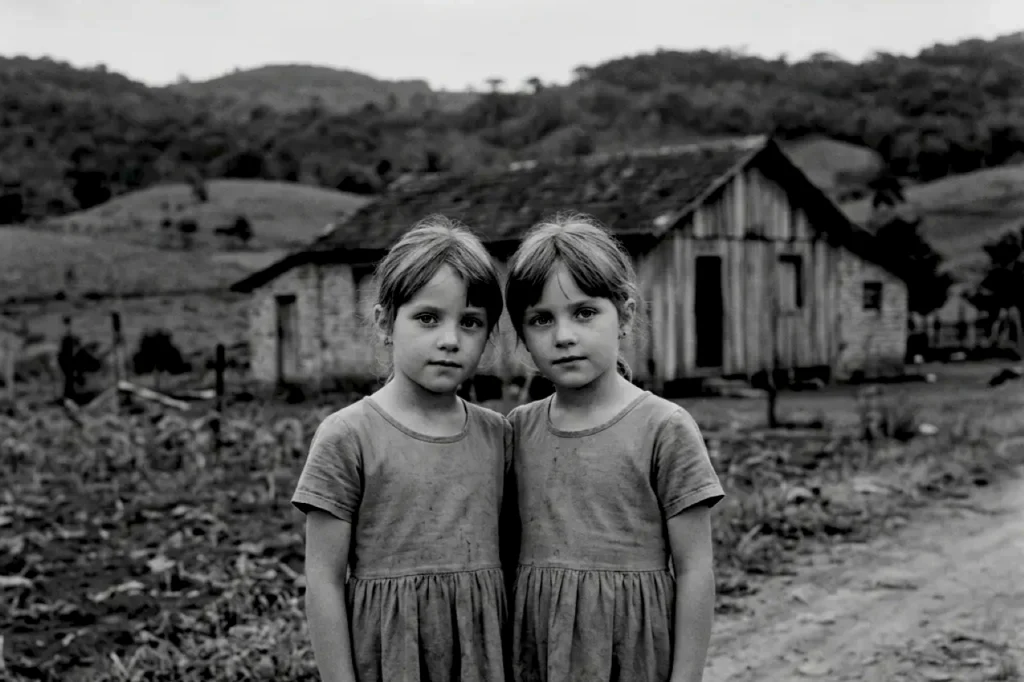

In the remote hills of southern Brazil, something strange happened starting in the early 20th century. Cândido Godói, a tiny farming town near the Argentine border, started producing twins at a rate that defied every known genetic model. Not occasionally. Not in isolated families. But everywhere…
Bizarre But True! By the late 20th century, one in every ten births in the town resulted in twins. That’s a 10% twinning rate – more than five times higher than anywhere else in Brazil and double the rate of southwestern Nigeria, which held the previous global record. The numbers alone are insane. But the real story gets darker…

The Nazi Theory That Refused To Die
For decades starting in the 1960s, locals whispered about a mysterious veterinarian who visited the area between 1964 and 1968. He offered medical treatment to pregnant women. He showed unusual interest in genetics and breeding.
His name was Josef Mengele…
The Auschwitz doctor, infamous for his grotesque twin experiments during the Holocaust in the 1940s, had fled to South America after the war ended in 1945. Some historians claimed he’d settled in the region during the 1960s, posing as a rural vet whilst continuing his obsession with genetic manipulation.
The theory gained traction because the timing seemed to align. Mengele allegedly visited between 1964 and 1968. The town’s twin rate appeared to spike around the same period.
It made for compelling folklore. A Nazi war criminal conducting secret experiments in an isolated German immigrant community, creating a genetic anomaly that persisted for generations.
…Except the data demolished the entire story.
What The Records Actually Showed
Modern researchers surveyed 6,262 baptism records from Catholic churches spanning 1959 to 2008, a nearly 50-year dataset. The results were brutal for the Mengele theory.
There was no statistical spike in twin births during the years Mengele supposedly operated in the area. The twinning rate remained consistent before, during and after his alleged presence.
More damning still, forensic evidence placed Mengele on a cattle farm in Serra Negra, São Paulo, approximately 800 miles from Cândido Godói. No credible documentation puts him anywhere near the ‘twin town’.
And the final nail: baptism records from the early 1900s, decades before Mengele even arrived in South America in 1949, already documented seventeen sets of twins amongst the first German immigrant families who settled the area in the 1920s and 1930s. The phenomenon predated the Nazi doctor by generations.
The Genetic Smoking Gun
So if Mengele didn’t cause it, what did..?
After years of research beginning in the 2000s, scientists identified something tangible: a specific genetic variant in the TP53 gene. Mothers of twins in Cândido Godói showed higher frequencies of the P72 allele compared to control groups. This variant appears to enhance the likelihood of double pregnancy after implantation – essentially increasing the odds that both embryos survive.
The mechanism involves something called the ‘founder effect’.
When a small group of people establishes a new population in isolation, rare genetic traits can become amplified across generations. Cândido Godói was settled primarily by German immigrants from the Hunsrück region starting in the 1920s, families already known for higher-than-average twinning rates.
These founding families from the 1920s and 1930s carried the genetic predisposition. The community remained isolated throughout the mid-20th century. Marriages happened within the town. The gene pool stayed concentrated and the genetic trait compounded over time.
The Hyper-Concentrated Epicentre
The phenomenon isn’t evenly distributed across the entire town. It’s hyper-concentrated in Linha São Pedro, a settlement established in the 1920s with fewer than 600 inhabitants today. Within just a 4-kilometre radius, approximately 80 families include over 40 pairs of twins born primarily between 1950 and 2010!
Nearly half of the twins examined in one study were monozygotic – identical twins. That’s significantly higher than the global average of 30%, and it makes the phenomenon even stranger because identical twinning rates remain remarkably consistent worldwide.
You can’t explain identical twins through genetic predisposition alone. Fraternal twins result from hyperovulation, which can be inherited. Identical twins result from a single embryo spontaneously splitting – a process that appears random across populations. Yet Cândido Godói produces both at elevated rates.
So whilst one mystery is solved, another has emerged…
The Town That Embraced the Oddity
Rather than fear their genetic peculiarity, Cândido Godói leaned into it.
The town’s welcome sign displays two identical profiles with the words “Garden City and Land of Twins.” Starting in the early 2000s, the community began hosting a traditional Twins Party every two years, with the 2024 edition attended by more than 100 pairs of twins.
Local businesses cater to twin families. Tourists visit specifically to witness the phenomenon. The town’s identity has become inseparable from its genetic anomaly.
This Isn’t Unique Either…
Cândido Godói isn’t the only place where twinning rates defy global averages either…
Igbo-Ora in Nigeria and Kodinhi in India both report similar phenomena. The Åland Islands between Finland and Sweden historically recorded elevated twinning rates compared to mainland populations.
Each case involves the same genetic isolation, founder effects and concentrated gene pools. The mechanisms differ slightly, but the pattern repeats: small, isolated communities with limited genetic diversity can amplify rare traits across generations.
But as far as Cândido Godói goes, myths of secret experiments and war criminals conducting covert genetic manipulation have been thoroughly debunked…