

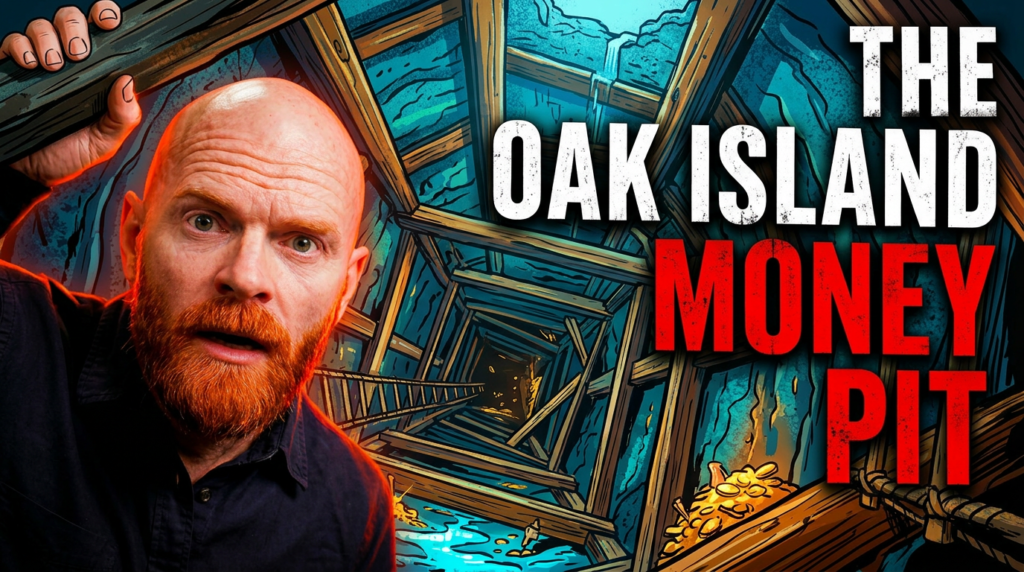
For over two centuries, a tiny island off the coast of Nova Scotia has lured treasure hunters, scholars, and adventurers alike. Legends whisper of buried riches—pirate gold, lost royal jewels, even the secrets of the Knights Templar. But every attempt to uncover its mysteries has been thwarted by a cunning system of booby traps, unexplained collapses, and even tragic deaths. So what exactly lies at the bottom of the Oak Island Money Pit? And more importantly… who put it there…?
Find out as we dig into the Bizarre But True Mystery of ‘The Oak Island Money Pit’.
Oak Island, a 140-acre patch of land in Mahone Bay, Canada, is been at the heart of one of history’s most baffling mysteries. It all began in 1795 when a teenager named Daniel McGinnis stumbled upon a curious depression in the ground. Above it, an old ship’s block and tackle dangled from a sawed-off tree limb, a telltale sign, he thought, of buried treasure.
McGinnis, along with friends Anthony Vaughan and John Smith, began digging. Just three meters down, they hit a platform of old oak logs. At six meters, another. And then another at nine. It was as if someone had intentionally hidden something deep underground. What they didn’t realize at the time was that they had just scratched the surface of a far more elaborate and sinister puzzle.
In 1803, a wealthy Nova Scotian named Simeon Lynds joined the hunt, organizing a company to fund further digging. His team unearthed layers of coconut fibre, an odd discovery, considering the nearest palm tree was thousands of miles away. Then, at 28 meters, they struck something solid. Lynds was convinced it was a treasure chest. But by the next morning, their hopes were drowned—literally. The pit had flooded overnight, seemingly by some unseen mechanism.
It wasn’t until 1850 that treasure hunters discovered the source of the flooding: a complex system of flood tunnels, designed to let seawater rush into the shaft. The diggers tried to block the flow by building a dam, but the ocean quickly tore it apart. Every attempt to circumvent the pit’s defences ended in failure. The more they dug, the more the mystery deepened.
Then came the tantalising clues. A flagstone inscribed with cryptic symbols was uncovered, allegedly reading: “Forty feet below, two million pounds are buried.” The stone soon vanished, fuelling speculation that it was a hoax. In the late 1800s, a drill brought up tiny links of a gold chain, along with a scrap of parchment bearing the letters “vi.” Some believed this hinted at lost documents—possibly even Shakespeare’s missing manuscripts.
More expeditions followed, each with its own dramatic failures and tantalising discoveries. In 1893, businessman Frederick Blair dedicated almost 60 years to solving the mystery. Using advanced drilling techniques, his team discovered layers of cement, oak, and iron deep within the pit. At 51 meters, the drill bit even recovered flecks of gold. But like all those before him, Blair was ultimately thwarted by the relentless flooding and an ever-collapsing shaft.
The 20th century saw even more determined efforts. In 1936, a New Jersey millionaire, Gilbert Hedden, sank over $100,000 into the excavation, hiring professional miners and even installing high-speed pumps to drain the pit. His efforts, too, ended in failure. The most tragic search came in 1965 when four men lost their lives, possibly due to toxic fumes.
By the time the History Channel’s ‘The Curse of Oak Island’ revived interest in the 21st century, the site had become an archaeological enigma riddled with unanswered questions. Theories abound: Was the pit a pirate’s trove, a lost Templar vault, or an elaborate hoax orchestrated centuries ago? Sceptics argue that the pit is nothing more than a natural sinkhole, it’s supposed treasures a mix of coincidence and wishful thinking.
But what if there’s something even more bizarre at play? Some researchers speculate that the Oak Island mystery might be connected to an underground network of hidden chambers. There have been reports of unusual electromagnetic readings and strange lights appearing near the site. Could there be a connection to an even older civilization—one that predates the pirate legends entirely?
Others point to the island’s possible links to Freemasonry. Several key figures involved in the Oak Island digs, including President Franklin D. Roosevelt, were known Freemasons. Some believe that the strange symbols and inscriptions found on the island bear a striking resemblance to Masonic iconography. If true, this could mean that the Money Pit is less about treasure and more about protecting some ancient knowledge or sacred relic.
Despite the failures, the search continues to this day. Modern treasure hunters, including the Lagina brothers, are determined to solve the riddle once and for all. Their company, Cerca Trova —Latin for “Seek and you shall find”—reminds us that, perhaps, the real treasure lies in the hunt itself.
So, is Oak Island hiding a legendary fortune, or is it the world’s longest-running practical joke? One thing is certain: until someone reaches as far as its humanly possible to go, the Money Pit will continue to keep its secrets.